
JUDICIAL ASSOCIATES BRISTLE AT ‘WHITE VIRTUE SIGNALING’
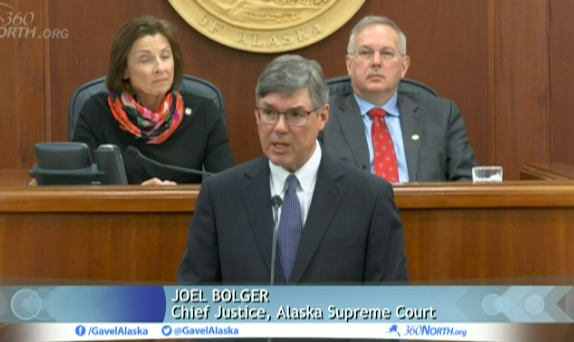
Why did Chief Justice Joel Bolger decide to leave the Alaska Supreme Court bench four years before the mandatory retirement age?
Bolger, who was appointed to the Supreme Court in 2013, will have served nearly eight years, but could have kept going until he turns 70 in 2025. Instead, he’ll be leaving this coming summer.
Could it have had something to do with the letter he penned this past summer, in which he and his fellow Supreme Court justices indicated that justice in Alaska is tainted by racism and unfairness, and called for greater equity?
It all started with the justices’ reaction to the riots following the death of George Floyd of Minneapolis.
“As we watch events unfolding in the aftermath of the death of George Floyd, we are saddened to see again that the ideals on which our society is founded are far from the reality of many people’s lives. We recognize that as a court system we must commit ourselves to making these ideals real by once again dedicating our efforts to ensuring that we provide an accessible and impartial forum for the just resolution of all cases,” Bolger wrote, in a letter signed by his fellow Justices Susan Carney, Peter J. Maassen, and Daniel Winfree. Justice Craig Stowers had already retired at the time of this letter and was not a signer.
“We recognize that too often African-Americans, Alaska Natives, and other people of color are not treated with the same dignity and respect as white members of our communities. And we recognize that as community members, lawyers, and especially as judicial officers, we must do more to change this reality,” the letter continued.
Bolger wrote that the country and Alaska are built upon the principle that all of us are created equal and that courts are tasked with putting that principle into action by allowing people to seek redress for their grievances with the assurance that they will be heard and treated fairly.
‘When so many members of our community are not heard or are not treated fairly, we must make changes,” the justices wrote.
And then the Supreme Court justices went further and and all but said the justice system is biased:
“As judges we must examine what those changes must be, what biases – both conscious and unconscious – we bring, and how we can improve our justice system so that all who enter may be assured they will receive equal treatment,” the letter continued.
The justices’ letter, posted as a statement on the Court System’s website, caught the attention of one of the long-term members of the Alaska Commission on Judicial Conduct.
During the Aug. 28 meeting of the commission, member Robert Sheldon of Talkeetna raised the issue, saying he had concerns about the letter, which he had first read about in the media.
“I”m actually surprise by the statement referenced in this article, which is directly from the entire Supreme Court. It brings to mind — what is the intended audience and are they likely to come before the court? There are specific sentences that lead me to further contemplation; I am actually uncomfortable that these sentences do more to cast doubt on our system than comfort to Alaska-specific readers,” Sheldon said.
“Why did they weigh in at all. Is this their job? Is there a problem with the justice system that they and … Chief Justice Bolger is administratively responsible for?” Sheldon asked his fellow judicial conduct commissioners.
“Does this weigh in on the Tuesday night attack on APD officers?” Sheldon asked the group. “What if that case moves through the system, somehow to the Alaska Supreme Court? What are the implications?”
Sheldon then read several sentences from the letter that made him uncomfortable. “The whole statement begins not talking about the issues surrounding George Floyd, it begins talking about the aftermath and almost prejudging the aftermath,” said Sheldon, who asked that the justices provide the Commission on Judicial Conduct an update on their activities to respond to their own statements in the letter and how they plan to remedy the situation, as they see it.
Sheldon suggested that the entire letter smacked of “white virtue signaling and the possible effect of gaining personal prestige.”
Judge Paul A. Roetman, the Superior Court Judge in Kotzebue, also spoke at the August meeting of the Commission on Judicial Conduct, and said he was surprised and mystified by the letter and wondered about its appropriateness. Roetman, who is Hispanic, said he had seen no such systemic racism in his time serving as a judge in rural Alaska and said that Alaska’s Court System is considered a model for the rest of the nation.
The commission will meet again at 9 am, Friday, Dec. 11, and may take up the issue, since it was tabled at the Aug. 28 meeting.
The details of the meeting were to be posted on the commission’s website by Dec. 4.
As of this report, the meeting details were not posted.


