
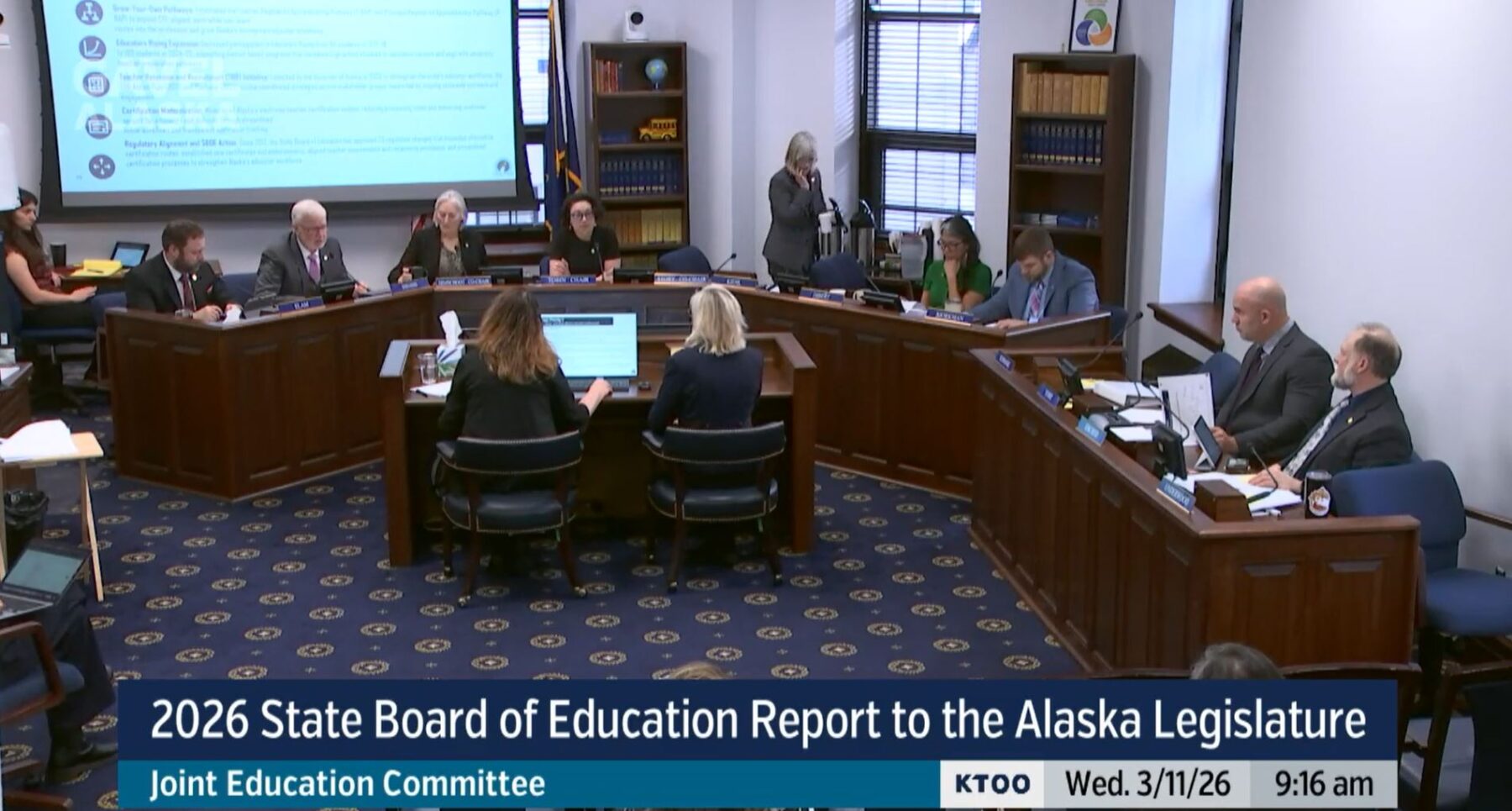
The House and Senate Education Committees convened a joint session to receive the Alaska State Board of Education and Early Development’s required 2026 annual report, covering January through December 2025. Presented by Board Chair Sally Stockhausen and Commissioner Dr. Deena Bishop, the briefing detailed progress under the five strategic priorities of Alaska’s Education Challenge while exposing persistent challenges in attendance, workforce stability, and public transparency.
The report fulfills AS 14.07.168, requiring an in-person legislative update on statewide education efforts. Stockhausen outlined Board actions taken after public comment, including updated teacher certification rules, early education flexibility, the new Office of Education Advocacy, and regulations supporting Alaska Native language literacy. The Board also endorsed an alternative certification pathway for military-affiliated adults and renewed or approved charter schools. These steps align with the 2017 Education Challenge framework, which organizes long-term improvement around early literacy, career and technical education, closing achievement gaps, educator workforce strength, and student safety.
Strategic Priority One drew significant attention. The 2017 indicators called for doubled proficiency in grades 3–5 English language arts and math, improved K–3 reading measures, and at least a 20 percent reduction in absenteeism. DIBELS screening data showed strong kindergarten gains: students meeting benchmark rose from approximately 24 percent at the start of 2023–2024 to 60 percent by year-end, with similar upward movement the following year. Commissioner Bishop emphasized early intervention efficiency, noting a 15-minute daily support in kindergarten equals 45 minutes to an hour in third grade for comparable catch-up.
Yet chronic absenteeism remains a stark concern. Roughly 45 percent of K–12 students miss 17 or more days annually, far exceeding the 20 percent reduction target. Senator Rob Yundt (R-Wasilla) described the rate as “close to fifty percent; in the high forties,” questioning why existing statutory tools for districts remain underused. Bishop clarified absences include all reasons—excused, unexcused, medical, or school-sponsored—and vary by community and grade, with kindergartners, first-graders, and twelfth-graders showing highest rates for different reasons. Representative Rebecca Himschoot (NA-Sitka) asked whether school-sponsored travel is separated in reporting; Bishop committed to follow-up, noting inconsistent district categorization under federal ESSA rules.
The Alaska Reads Act implementation received praise for structured parent engagement. Individual Reading Improvement Plans (IRIPs) for far-below students trigger monthly updates and documented third-grade progression discussions. Far-below students advancing to fourth grade receive mandated summer tutoring. Bishop described the law as “one of the best pieces of legislation in my lifetime,” crediting consistent family communication and before- or after-school interventions that avoid displacing other subjects. Cohort trends revealed summer learning loss but net positive movement from kindergarten into first grade. Representative Story requested future reports include such cohort summaries to track durable gains, which Bishop agreed could take a decade based on other states’ experience.
Strategic Priority Three on closing achievement gaps highlighted AK STAR results showing statewide English language arts proficiency at 32.7% and math at 32.2%. District-level data varied widely, with some smaller rural schools outperforming expectations. Bishop stressed that high-quality teaching and principals remain the strongest levers, citing Skagway’s success tied to exceptional classroom instruction. The Board is developing separate SMART goals for math, acknowledging the original assumption that reading gains would automatically lift math was unrealistic. “You have to actually teach math to improve math,” Bishop stated plainly.
Workforce stability under Strategic Priority Four emerged as the most pressing issue. ISER data show teacher turnover rising from 21% in 2013 to 28% in 2024, with principal turnover climbing from 28% to 35%. Rural-remote areas face acute strain: 31% teacher turnover and 55% principal turnover. First-day vacancies tripled from 139 in 2019 to 458 in 2024 before easing to 313 in 2025, while emergency-certified teachers fluctuated, reaching 209 in 2025. The state relies on 465 visa educators (280 H-1B, 180 J-1) to fill gaps. Both chambers passed resolutions supporting H-1B and J-1 pathways; Bishop reported ongoing coordination with the congressional delegation to address federal barriers, including an unaffordable $100,000 threshold.
The defunding of the Alaska Educator Recruitment and Retention Center (ARC) after a step-down contract drew pointed concern from Rep. Himschoot, who noted roughly 500 international teachers require targeted induction support beyond Title II-A mentoring. Bishop clarified international hiring fell outside ARC’s scope and was handled separately by districts, but acknowledged broader TRR playbook implementation gaps remain. Grow-your-own pathways through Educators Rising and registered apprenticeships show promise, with participation nearly doubling and some rural students entering paid aide roles while pursuing degrees.
Strategic Priority Five on safety and well-being featured Positive Behavioral Interventions and Supports (PBIS) expansion to 45 schools in 14 districts, trauma-engaged “Transforming Schools” distribution of 15,000 copies, and the “Strive for Five” attendance campaign. HB 57’s device restrictions during instructional hours aim to reduce distractions. Support for students displaced by Typhoon Merbok included Anchorage School District coordination and approximately $450,000 in federal trauma grants.
Transparency and Board capacity surfaced repeatedly. Chair Loki Tobin (D-Anchorage) noted difficulty navigating DEED’s website for data and pressed for a public dashboard promised under the Reads Act. Bishop admitted progress “hasn’t come to fruition” and committed to a status report and resource request. Representative Ted Eischeid (D-Anchorage) asked for a self-reflective grade on the Board’s performance; Stockhausen declined to assign one but highlighted literacy gains and apprenticeship potential while noting work remains. The Board plans SMART goals aligned to the five priorities, with public comment forthcoming.
Mount Edgecumbe High School governance drew focused discussion. Rep. Himschoot questioned oversight feasibility for the statewide boarding school and requested frequent updates. Stockhausen announced the Board would vote that day on forming an ad hoc committee to guide short-, mid-, and long-term actions, pledging coordinated legislative briefings.
The meeting closed with appreciation for the Board’s service. Chair Tobin emphasized the Legislature’s reliance on the Board for day-to-day oversight and reiterated the need for accessible data to inform policy. Upcoming sessions include a dedicated teacher recruitment and retention hearing and Task Force on Education Funding discussions on transportation and after-school programs.


