
(2-minute read) WOMEN’S MARCH RECEIVED FAWNING COVERAGE
The 2019 Women’s March on Saturday received roughly 15 times more television news coverage than Friday’s March for Life, according to the Media Research Center.
The Women’s March’s took place on Saturday despite widespread concerns about anti-Semitism at the organization’s leadership level.
One day before that march, now in its third year, the pro-life March for Life occurred.
NewsBusters managing editor Curtis Houck examined the coverage each event received on the ABC, CBS, and NBC morning and evening newscasts:
Between Wednesday morning and Saturday evening, the Women’s March had 14 minutes and 26 seconds of coverage, and the March for Life received just 58 seconds.
“For the March for Life, ABC and CBS were especially pitiful,” he wrote.
What coverage there was of the March for Life centered on a now-discredited fictitious account of a young Catholic youth who the media alleged was disrespectful of a Native American man who was drumming and chanting. The media was basing its story largely on Twitter and on the one-sided account of the Native American.

The story went viral and every major mainstream media outlet picked it up. Even conservative commentators like S.E. Cupp bit hard on the hook and ran out the line.
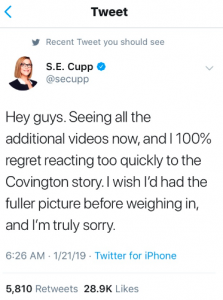
It turned out to be false, but not before some children from Covington Catholic High School were bullied and defamed. There were death threats. Even a boy who wasn’t the one accused of the rude behavior was bullied, in a case of mistaken identity. The reputation damage is incalculable for the institution and the student.
The mainstream media still doesn’t get it. But the incident is a caution to good-hearted people everywhere to be extra cautious about what is zipping around the internet. A story like that usually gets halfway around the world before the truth even knows where it set down its shoes. It was shameful.
And it will likely be repeated again and again, with the mainstream media like The Atlantic Monthly, CNN, ABC, NBC, New. York Times, Washington Post and the Los Angeles Times getting a pass, while other not-always-credible news purveyors, such as Alex Jones’ InfoWars, were banned by social media site Facebook and Twitter for stories with far less negative impact.