
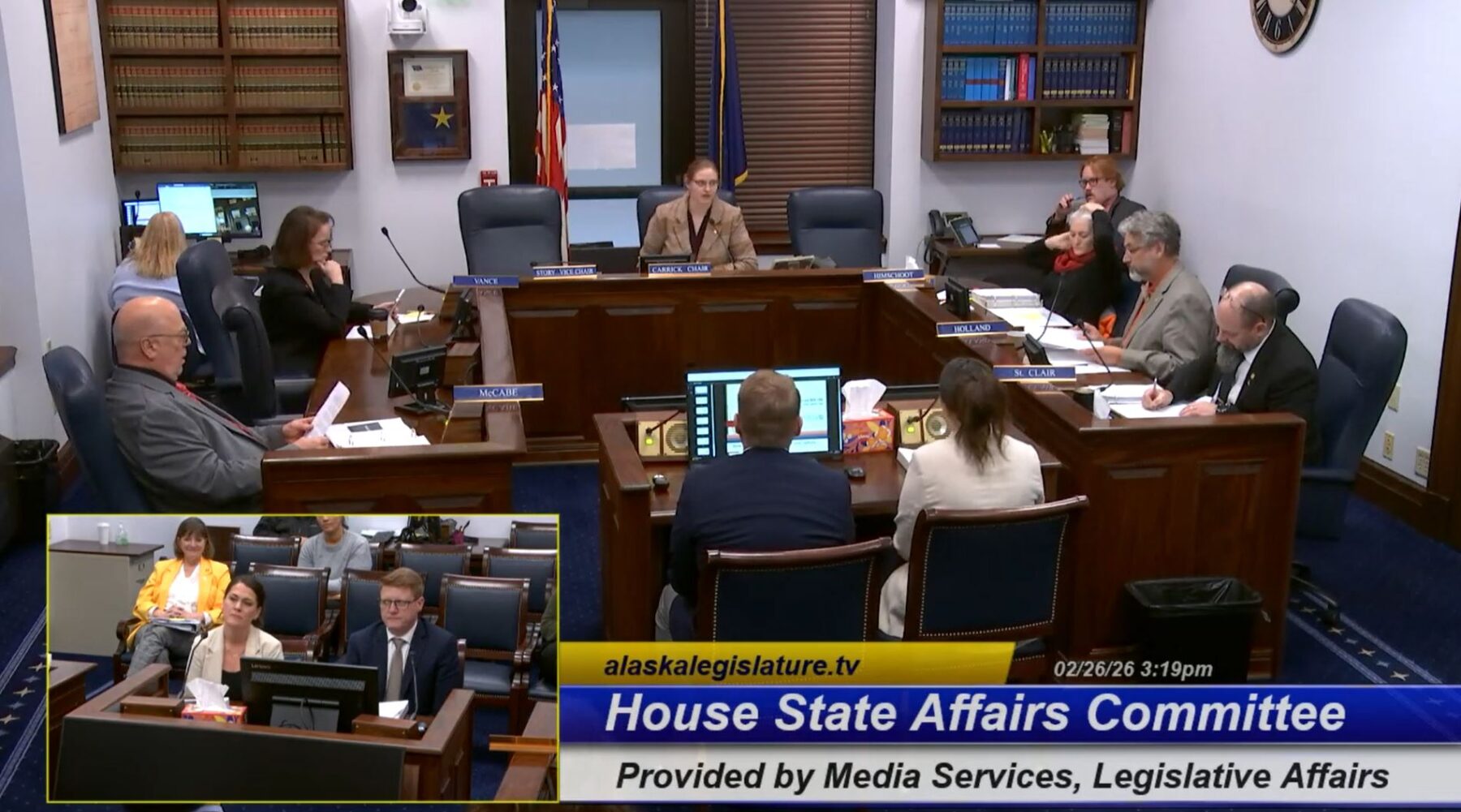
The House State Affairs Committee advanced HJR 23, a proposed constitutional amendment aimed at strengthening requirements for a governor’s balanced budget. The committee then turned to House Bill 152, a controversial measure to establish an education head tax, engaging in substantive discussion on its structure, implementation, and potential impacts.
After a brief recap of prior hearings on HJR 23, no amendments were submitted by deadline from the previous day. Representative Underwood (R – Wasilla), the sponsor, offered closing remarks: “I just want to say thank you for giving me the time to present this and for your really good questions. It helped prepare me for the next committee of referral.” The resolution advanced unanimously with individual recommendations and attached fiscal notes.
The committee then resumed its fourth hearing on HB 152, sponsored by Representative Galvin (NA – Anchorage). The bill proposes a $150 head tax on every wage earner in Alaska combined with a 4% tax on income above $150,000 for single filers (or $300,000 for joint filers), while closing the S-corp loophole to capture high-earning non-residents. Galvin framed it as a component of a sustainable fiscal plan to stabilize unpredictable revenues. “This bill strengthens our democracy by preparing the next generation to participate fully and responsibly,” she said during earlier testimony, though the focus shifted to revenue mechanics.
Staffer David Jiang detailed the technical levers: federal adjusted gross income as the base, with a large standard deduction and flat 4% rate above thresholds. Galvin acknowledged necessary amendments for joint filers and emphasized simplicity for implementation using existing federal forms. She presented scenarios showing how adjusting the head tax or income threshold could generate over half a billion dollars, noting data predates major North Slope projects like Pikka and Willow. “We went ahead and chose a way for us to implement a tax system that would allow us to use the federal tax forms that we already have in place,” she explained.
Committee members raised pointed questions. Representative St. Clair (R – Wasilla) asked why the bill is labeled an “education tax” when Article IX, Section 7 prohibits dedicated funds. Galvin conceded it is intent language only, stating education and healthcare represent the state’s deepest spending holes. Representative McCabe (R – Big Lake) challenged the fairness, citing estimates that non-residents would contribute only 15-25% of revenue. Galvin countered that these workers benefit from Alaska resources and high-wage jobs, arguing the tax invests in local education to prepare Alaskans for those opportunities. She disputed the percentage, suggesting updated data from new projects could show higher non-resident contributions.
Implementation concerns dominated. Representative Holland (NA – Holland) asked about timelines and phasing. Galvin noted the head tax could be implemented relatively quickly via payroll deductions, but the income tax portion might take two years. Representative Hannon (D – Juneau) inquired about comparative rates in western states and dedication mechanisms for education revenue. Galvin committed to providing data on national and regional income tax rates, noting Alaska’s overall tax burden remains the lowest at 5.8%.
Representative Allard (R – Eagle River) expressed privacy and consent concerns for 16-year-olds under a related pre-registration bill heard earlier, but discussion stayed on HB 152’s adult wage earner impacts. Representative Vance (R – Homer) highlighted his district’s 24% higher cost of living, questioning the $150 threshold’s suitability. Galvin responded that the figure was chosen to avoid taking “food off the table” while covering administrative costs, leaving adjustments to the committee.
The hearing wrapped with Galvin’s staff confirming research requests, including S-corp numbers and PFD tax credit implications. Chair Carrick set an amendment deadline for March 6 at 5:00 p.m. and scheduled another hearing for March 5. The bill was set aside.
The session reflected the committee’s careful navigation of fiscal innovation against constituent resistance, with Galvin emphasizing shared responsibility: “Every Alaskan now is going to say, ‘I am holding my state representative accountable because I am paying taxes.’”


