
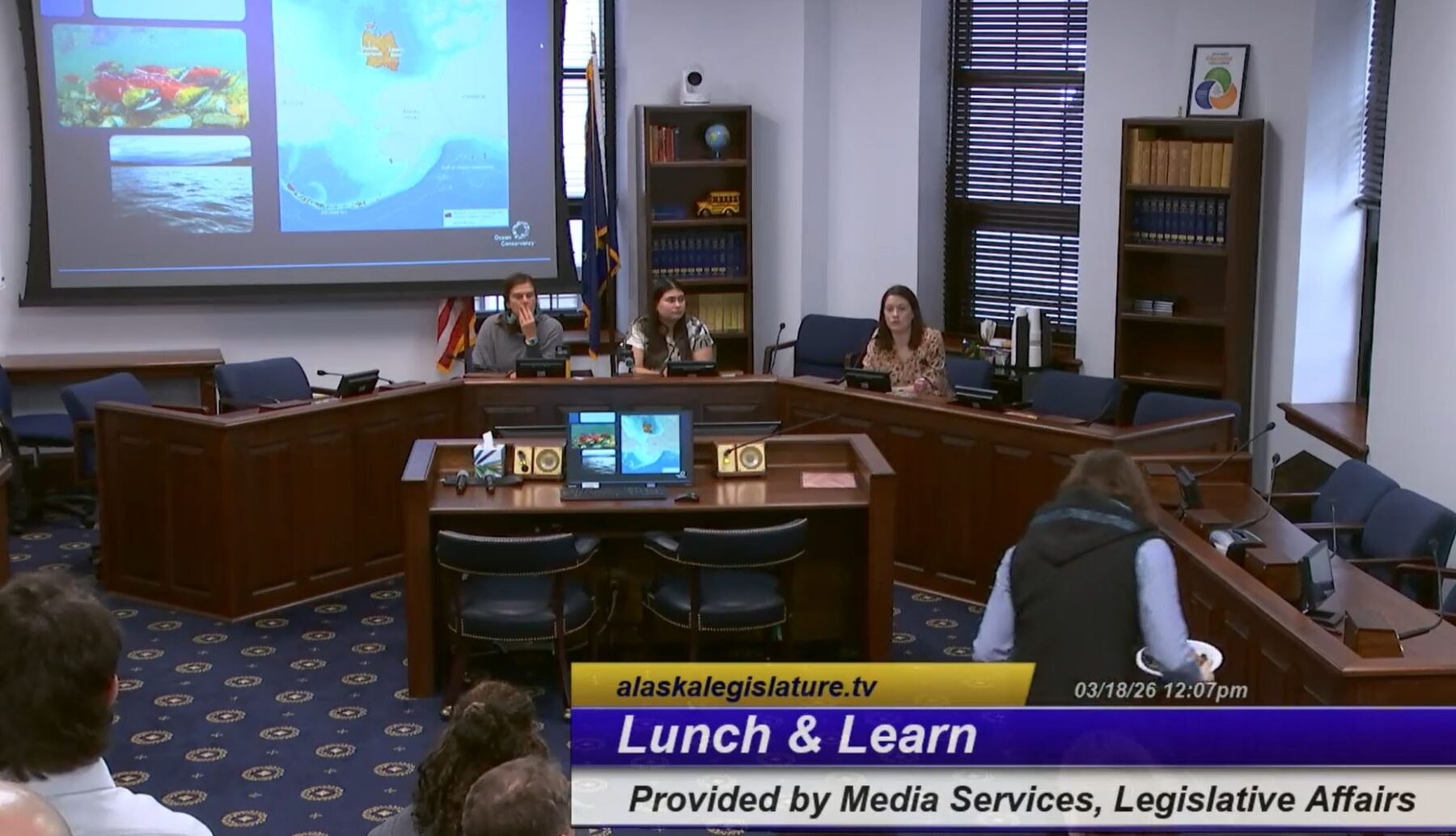
The House Resources Committee convened a Lunch and Learn session focused on the federal Bureau of Ocean Energy Management’s (BOEM) recent Request for Information regarding potential seabed mineral development in waters offshore Alaska. Hosted by the office of Rep. Maxine Dibert (D-Fairbanks), the briefing featured presentations emphasizing caution, environmental stewardship, and fiscal responsibility in the face of a rapidly advancing federal process. Speakers from AquaDC, Salt Horizon LLC, and the Central Council of Tlingit and Haida Indian Tribes of Alaska outlined significant uncertainties, potential harms to marine ecosystems and fisheries, and limited clear benefits for Alaskans over speculative development.
Ann Robertson of AKWDC presented slides on the BOEM RFI initiated January 29, 2026. Robertson noted the initial 30-day comment period was extended to 60 days at the request of Alaska’s congressional delegation, providing Alaskans additional time to weigh in. The proposed areas span the Aleutians, Gulf of Alaska seamounts, Good News Bay, Norton Sound, and the high Arctic Chukchi Borderlands and Canada Basin—regions critical for subsistence fisheries and ecosystem function. Robertson highlighted overlaps with essential fish habitat closures already in place to protect spawning and juvenile areas, questioning the logic of introducing large-scale disturbances in these zones.
Robertson detailed operational realities using graphics of heavy mining equipment, stressing that extraction would create broad seabed disruptions far beyond targeted surgical methods. “When we’re talking about extracting minerals from the seabed, we are not talking about a targeted and kind of surgical process,” she warned. Impacts could cascade through the food chain, affecting salmon migration, marine mammals, and subsistence resources already stressed by climate change and vessel traffic. Governance complexities in the Arctic, including unsettled extended continental shelf claims overlapping with other nations, added diplomatic uncertainty. Economically, Robertson saw scant benefit for Alaska: minerals would likely leave the state for overseas processing, leaving locals to manage environmental fallout without corresponding revenue streams.
Bobbi-Jo Dobush, founder of Salt Horizon LLC and marine governance specialist, expanded on the regulatory timeline and lessons from other regions. She clarified that commercial-scale seabed mining remains nonexistent globally, with even trial operations plagued by technical failures. The current push stems from a 2025 White House executive order directing expedited domestic extraction. Dobush cited BOEM’s actions in Guam and the Commonwealth of the Northern Mariana Islands, where an RFI closed January 12, 2026, and an area identification—twice the original scope—was released just 60 days later. Alaska sits at the RFI stage, with BOEM indicating a limited desktop Environmental Assessment may suffice before leasing, potentially allowing equipment testing without a full Environmental Impact Statement. “There could be actual testing of those kind of big mining equipment on your outer continental shelf without an EIS ever having been done,” she cautioned.
Dobush addressed the financial drivers, introducing “financialization” where leases become tradable assets generating profits through speculation rather than actual extraction. Once leased, reversal becomes difficult and costly. She noted no legal requirement for state royalty sharing—revenues flow to the federal treasury—and highlighted a company, Deep Sea Mineral Resources, expressing interest despite unconfirmed viable deposits. “It’s when you create an asset and you trade it on the market,” she explained. “And nothing actually ever happens, but a bunch of people start making money off of it.” This dynamic risks an industry persisting on paper even if practical economics fail.
Ana Velasquez, Alaska Sea Grant Fellow for the Central Council of Tlingit and Haida Indian Tribes of Alaska, presented the tribe’s formal position. Representing 38,000 citizens across Southeast Alaska homelands, Velasquez stressed cumulative impacts would jeopardize traditional ways of life, subsistence harvests, and the $6 billion seafood industry. Roughly 80% of the RFI area overlaps with habitats closed to bottom trawling for conservation reasons. The tribe’s comment letter requested a 90-day extension (granted to 60 days total, closing April 1, 2026), a comprehensive Environmental Impact Statement (EIS), formal government-to-government consultation, and evaluation of a “no leasing” alternative. “We don’t want to be the guinea pigs,” Velasquez quoted Guam’s lieutenant governor, underscoring cultural and sovereignty concerns.
Rep. Dibert, co-chair, acknowledged the transboundary nature of ocean systems and committed the committee to continued study. “We have a lot of work to do obviously, to help us prepare,” she stated, pledging collaboration with stakeholders.
The presentations collectively urged a precautionary, science-based approach prioritizing Alaska’s fisheries, subsistence rights, and economic self-interest. With no commercial mining occurring anywhere and processing capacity absent domestically, the session highlighted risks outweighing speculative gains.


