
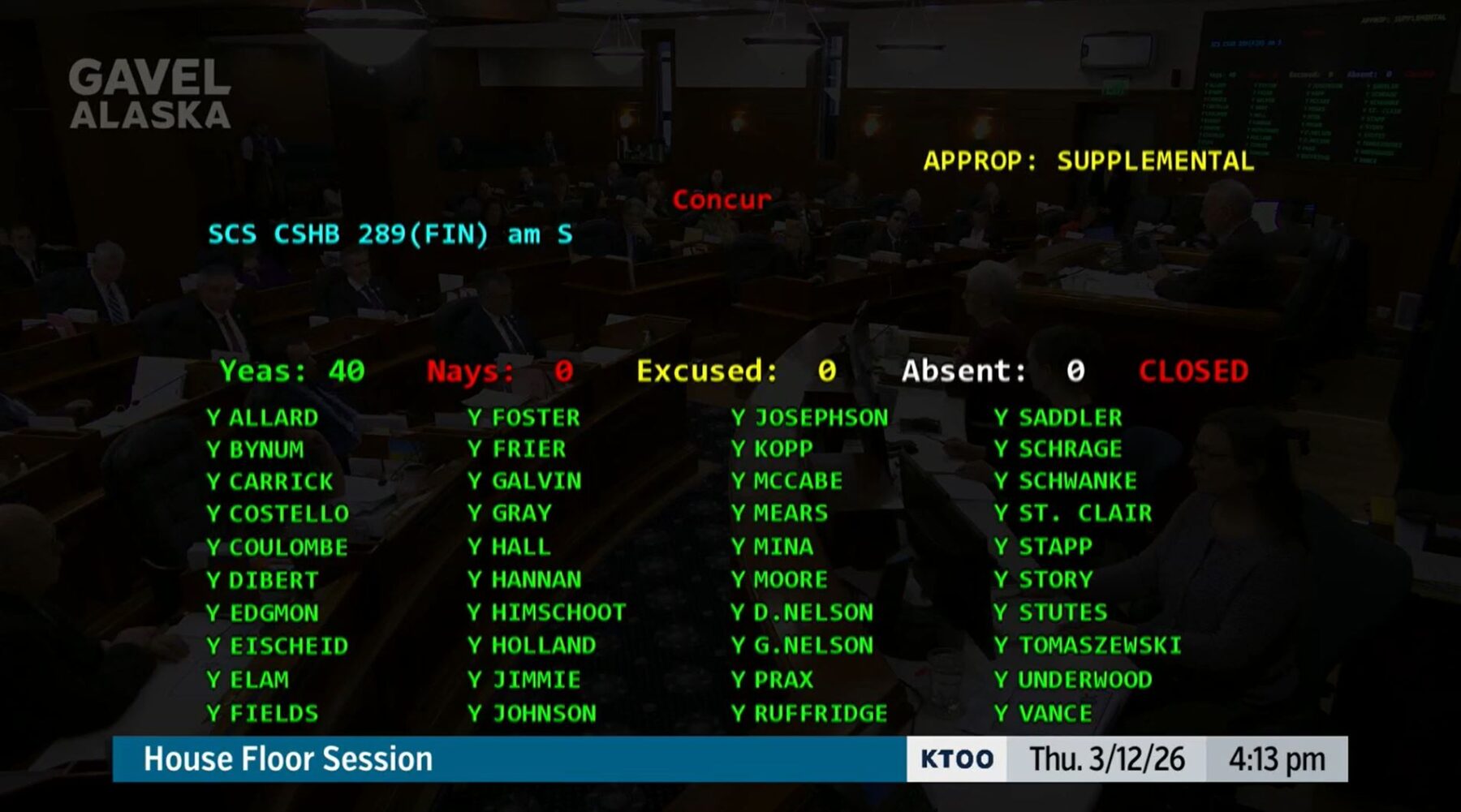
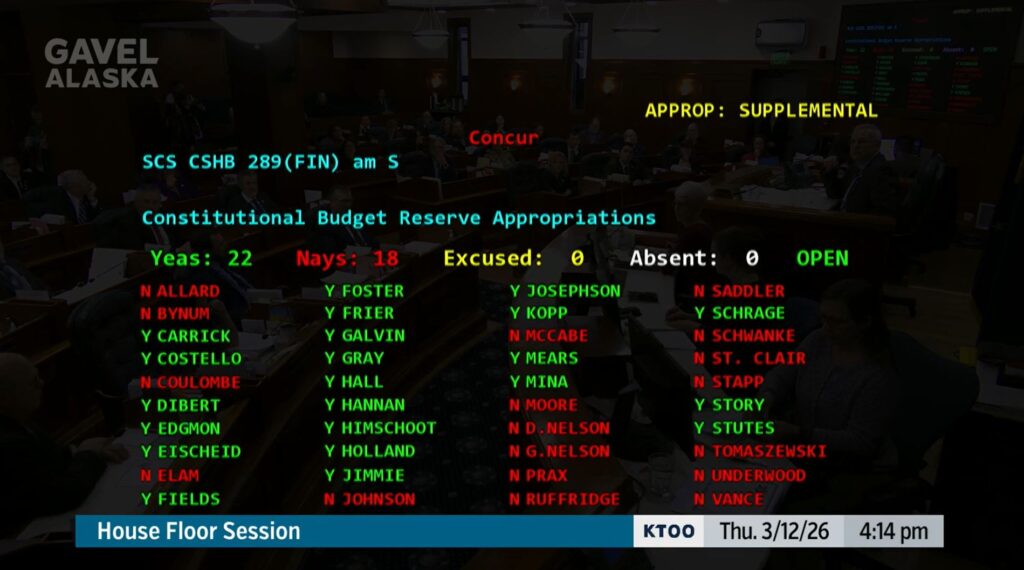
The Alaska House of Representatives convened for a full session debate over Senate amendments to HB 289, a critical supplemental budget measure. What began as a near-unanimous concurrence vote quickly unraveled when the required supermajority for a Constitutional Budget Reserve (CBR) draw failed, prompting leadership to rescind the action and return the bill to the Rules Committee.
Rep. Andy Josephson (D-Anchorage), explaining the Senate changes, noted the original House version contemplated roughly $490 million in CBR authority, including headroom. The Senate trimmed it to $373.6 million focused on four urgent items: $75 million in disaster relief, $99 million for fire suppression, $70.2 million in Department of Transportation capital match funds, and $129.7 million to recapitalize the Higher Education Investment Fund. “These items are all important, need to be funded now,” Josephson urged, emphasizing the bill used a direct CBR transfer without additional headroom or broader agency spending.
Debate quickly highlighted tensions between immediate action and waiting for updated revenue data expected March 13. Rep. Will Stapp (R-Fairbanks) appreciated the Senate’s focus on essentials but questioned the timing. “I find it really interesting that we’re taking up this item the day before we actually know how much money we have and what the size of our deficit is,” he said, noting the previously assumed $51 million current-year deficit had never materialized given sustained higher oil prices. He committed to supporting the bill’s substance while opposing the CBR draw.
Rep. Jeremy Bynum (R-Ketchikan) expressed disappointment that the Senate had transformed the measure from targeted CBR authority with $30 million headroom into an unconditional direct transfer. Rep. Schrage (NA-Anchorage), voiced frustration at shifting goalposts, warning of uncertainty for contractors and students relying on the Alaska Performance Scholarship. Industry leaders had texted concerns that delayed funding jeopardized hundreds of millions in summer road work.
Rep. Kevin McCabe (R-Big Lake) provided historical context, reminding members that the DOT “meet the match” shortfall stemmed from prior legislative reappropriations that became encumbered and an executive veto. Rep. Ashley Carrick (D-Fairbanks) read from DOT projections: 91 projects valued at $670 million to $1.1 billion, plus 24 shovel-ready initiatives up to $314 million, all hinging on the $70 million match to leverage a favorable nine-to-one federal ratio. “What a shame,” she warned, stressing the private-sector stakes.
Optimism emerged from Rep. Justin Ruffridge (R-Soldotna), who favored concurrence today but deferring the CBR vote. “The exciting thing is, is that we absolutely, with concurring on this bill today, have the opportunity to fund all of those things and not draw a dime out of our savings account,” he said, citing consistently strong oil prices above the $65-per-barrel budget assumption. Rep. Zack Fields(D-Anchorage) pushed back sharply against any gamble: “There is no way I would ever vote to gamble the future of our construction, oil and gas industry on months of oil prices in the most volatile market.” He clarified the bill only authorizes a draw if necessary, providing a backstop without immediate spending.
Minority Leader Rep. DeLena Johnson (R-Palmer) questioned the rush, arguing a multi-billion-dollar decision should wait for facts arriving within 24 hours. Rep. Mears (D-Anchorage) cautioned against crystal-ball predictions, urging action on known needs. Rep. Mike Prax (R-North Pole) acknowledged the desire to wait but supported funding for construction certainty while urging faster progress on pending healthcare provider recruitment bills to address rural shortages.
The House first concurred in the Senate amendments 40-0. The subsequent CBR appropriations motion, requiring a supermajority, failed 22-18. Leadership then moved to rescind concurrence, which passed 21-19 over objection. A final motion returned HB 289 to the Rules Committee, also 21-19. The bill now awaits further review once the revenue forecast is released.
The House adjourned until Monday, March 16, at 10:30 a.m., with public testimony on the operating budget and State Affairs Committee meetings scheduled immediately after.
While the substance of HB 289 enjoyed broad support, the procedural reset ensures lawmakers can incorporate fresh revenue projections before committing savings. With summer construction season looming and federal matches at stake, the coming days will test whether bipartisanship can produce a fiscally responsible path forward that safeguards Alaska’s economy without unnecessary reliance on reserves.


