
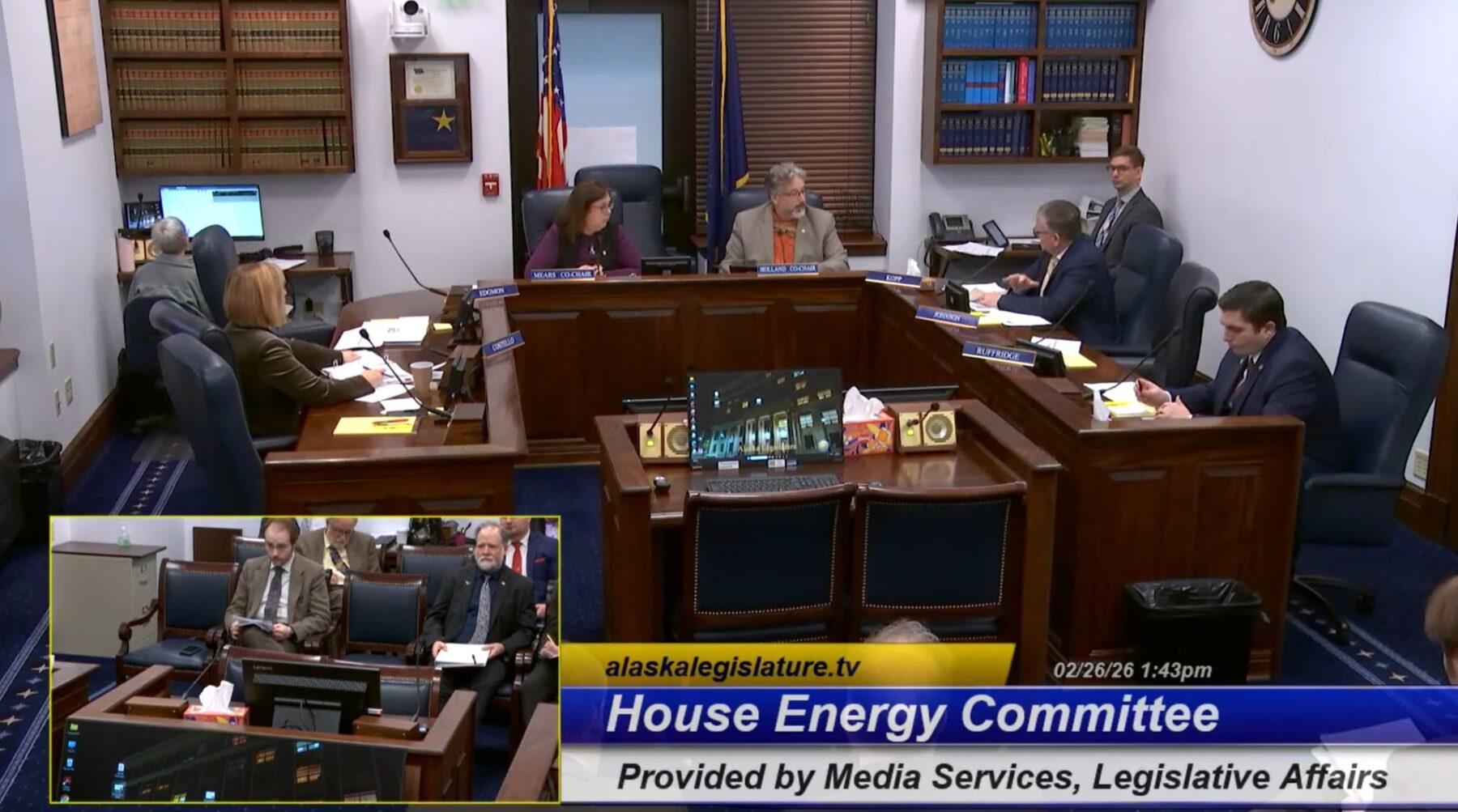
The Alaska House Special Committee on Energy advanced targeted updates to portable solar regulations while unveiling a broad new bill aimed at stabilizing energy costs across the state. In a session marked by technical amendments and forward-looking policy, lawmakers balanced consumer access, utility concerns, and long-term affordability amid ongoing natural gas shortages.
HB 257 – Clarifying Portable Solar Generation Devices
The committee dedicated significant time to House Bill 257, sponsored by Representative Ted Eischeid (D – Anchorage), which supports small-scale portable solar devices. After three hearings, members adopted three amendments to address safety, scale, and applicability.
Co-Chair Ky Holland (NA – Anchorage) moved Amendment 1 to clarify power output limits. “Amendment 1 is clarifying the power output of the devices… This clarifies that this would be 1,200 watts individually, or combined with other portable solar generation devices connected to the same electric meter,” Holland explained. The change prevents ambiguity for consumers aggregating multiple units.
Amendment 2 exempted small utilities selling 5 million kilowatt hours or less annually. Holland noted this protects off-grid and lightly resourced systems: “This would not apply to utilities that sell… 5 million kilowatt hours or less of electricity… with the idea that they could absorb the impact of these small power generating devices.” Representative Kopp (R – Anchorage) confirmed it would primarily benefit communities with around 100 customers.
Safety remained central. Amendment 3 added anti-islanding requirements so devices cannot energize circuits during outages. Eischeid emphasized public perception: “This was a request from the utility companies to have some redundancy here in the language… people’s perception safety is important.” Staffer Aren Callahan added that research found “no documented cases of either backload into the grid, causing problems for linemen, or touch safety issues,” and systems inconsistent with emerging UL standards fall outside the bill.
Amendment 4, allowing utilities to require simple pre-use registration, failed on a 2-4 vote after debate on potential conflicts with approval prohibitions. Representative Ruffridge (R – Soldotna) opposed it as unnecessary and potentially burdensome: “I think people are using these now… I think the idea of having them take any additional step… runs into the problem of not being in the intent of the bill.”
With amendments complete, the bill was set aside. The updates aim to expand safe, accessible solar while addressing utility operational concerns.
HB 369 – Energy Affordability Omnibus Targets Diversified Portfolio and Cost Stability
The committee then received its first overview of House Bill 369, the Energy Affordability Omnibus sponsored by the committee itself. Co-Chair Holland framed it as building on last session’s Renewable Portfolio Standard (RPS) work while incorporating feedback to remove penalties and expand options.
Holland highlighted the bill’s focus: “House Bill 369… is primarily focused on policies to diversify energy options and infrastructure for future investment… We removed penalties. We included options for nuclear power and clean coal. We included contingencies for a large pipeline delivering affordable natural gas.”
Staffer Tim Treuer detailed the core Diversified Portfolio Standard (DPS), setting a 40% target for diversified resources by 2036. Eligible sources include renewables, nuclear, clean coal, and natural gas from a phase-two pipeline. “Diversity for energy is important in two ways… diversifying a portfolio is a hedge against volatility,” Treuer explained, citing Kodiak Electric Association’s stable pricing as evidence.
The bill links the Railbelt’s Integrated Resource Plan (IRP) to DPS compliance, enables pre-approval for aligned projects, and updates state energy policy. It also creates an economic development rate for excess renewable energy and adjusts the Renewable Energy Fund advisory process.
Holland emphasized Railbelt-rural linkages: “Holding down Railbelt costs helps hold down rural costs” through Power Cost Equalization (PCE). Discussion touched on gas eligibility, wind multipliers, and IRP alignment, with Representative Kopp cautioning against predetermining outcomes: “We’re basically predetermining the outcome of the integrated resource plan before it is complete.”
The bill was set aside for deeper sectional review and stakeholder input. As Holland summarized, the omnibus seeks “stable pricing” and “reliable source” options for all Alaskans.


