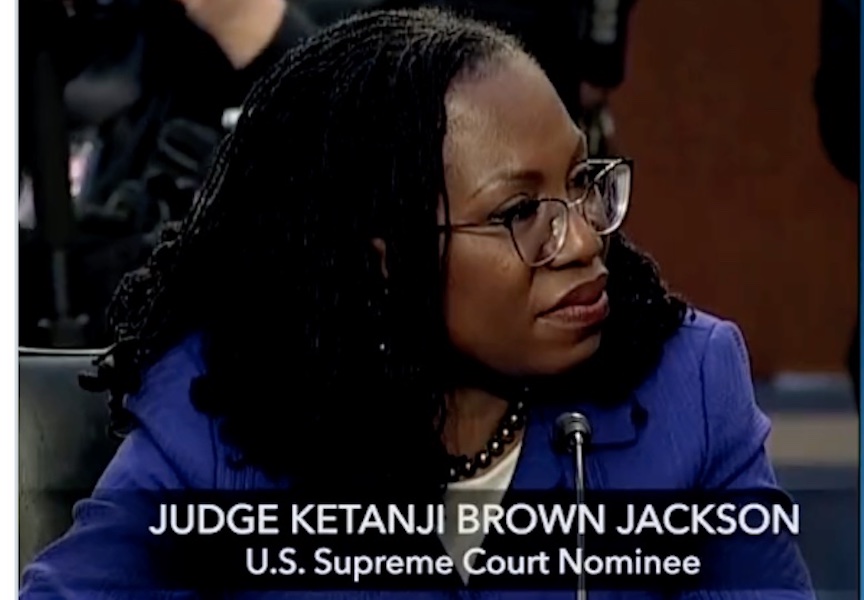
Supreme Court Justice Ketanji Brown Jackson famously refused to say during her confirmation hearings in 2022 what defines a woman.
Sen. Marsha Blackburn, R-Tenn., asked the then-Supreme Court nominee: “Can you provide a definition for the word ‘woman’?” Jackson responded, “I’m not a biologist.”
But if she doesn’t understand what males and females are, Justice Jackson evidently knows what race is, as she scalded her colleagues on the U.S. Supreme Court over their decision to end college race-based admissions.
Jackson said in her dissenting opinion, “No one benefits from ignorance. Although formal race-linked legal barriers are gone, race still matters to the lived experiences of all Americans in innumerable ways, and today’s ruling makes things worse, not better. The best that can be said of the majority’s perspective is that it proceeds (ostrich-like) from the hope that preventing consideration of race will end racism. But if that is its motivation, the majority proceeds in vain. If the colleges of this country are required to ignore a thing that matters, it will not just go away. It will take longer for racism to leave us.”

Thursday’s Supreme Court decision rolled back the affirmative action law that allows colleges and universities to use race as screening tool. Harvard University and the University of North Carolina were the defendants in a case bought by Students for Fair Admissions. One of the problems the majority identified is that affirmative action programs have to end at some point, and there’s no clear way to say when system racism ends.
Chief Justice John Roberts, wrote that the programs that weed out Asian and white students “lack sufficiently focused and measurable objectives warranting the use of race, unavoidably employ race in a negative manner, involve racial stereotyping, and lack meaningful end points.”
Jackson recused herself from the Harvard case, because she has had a role on the university’s governing board. Her written opinion was in response to the University of North Carolina case.
“With let-them-eat-cake obliviousness, today, the majority pulls the ripcord and announces ‘colorblindness for all’ by legal fiat. But deeming race irrelevant in law does not make it so in life,” Jackson wrote. “It is no small irony that the judgment the majority hands down today will forestall the end of race-based disparities in this country, making the colorblind world the majority wistfully touts much more difficult to accomplish.”
Harvard University responded to its loss in the 6-3 decision with a statement that said it will instead now rely on college essays that have students discuss how race has affected “his or her life, be it through ‘discrimination, inspiration, or otherwise.’ We will certainly comply with the Court’s decision,” the school said, giving its carefully-worded middle finger to the Supreme Court in a reference that indicates it will continue to discriminate against white and Asian students in favor of other races, but in new ways.
President Joe Biden’s comments were to be expected. In a long statement from the White House, he told reporters, “The Court has effectively ended affirmative action in college admissions. And I strongly — strongly disagree with the Court’s decision.”
When asked if the court had gone rogue, he replied, “This is not a normal court.”