By RICK WHITBECK
When Congresswoman Alexandria Ocasio-Cortez and others rolled out the “Green New Deal” to America on Feb. 7, they hailed their resolution as a comprehensive plan to address climate change and economic inequality.
The responses I heard upon its release ranged from exuberance to disdain, as my friends and family read, watched and digested the sheer magnitude of the social and economic programs included in the Green New Deal.
The one topic that almost everyone came back to was the sheer cost of implementing the goals laid out in the legislation. How were we supposed to pay for it? What was it really going to cost?
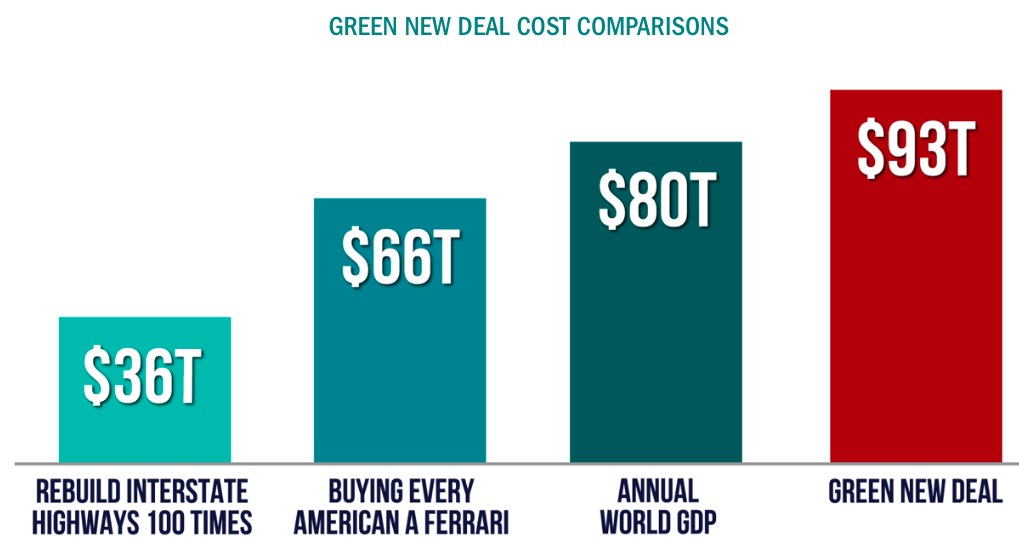
Experts and policy groups were quick to supply some numbers. Over $1 trillion in regulatory and administrative costs. Between $51 and $93 trillion over the first 10 years for full implementation.
But those numbers were crunched and reported on within the first three weeks of the Green New Deal’s launch. What if a group spent some time and studied a portion of the plan in-depth?

That’s exactly what my organization, Power The Future, did. In collaboration with the Competitive Enterprise Institute, we undertook a months-long deep dive into the prospective costs of implementing only the energy and climate-related facets of the Green New Deal for a typical household in five representative states (Alaska, Florida, New Mexico, New Hampshire and Pennsylvania).
Using readily-available and public statistics as starting points, we focused our research on four categories:
- Additional electricity demand;
- Costs associated with shipping and logistics;
- New vehicles; and
- Building retrofits.
The results are staggering. We found that a typical household in Alaska would pay more than $100,000 the first year, more than $73,000 for years two through five, and over $67,000 annually after that to implement the Green New Deal’s goals in energy and climate-related changes.
With the median Alaskan household annual income sitting at $66,251, who, if anyone, could afford the Green New Deal?
Before any readers start shouting, “Show me the math!”, we’ve done exactly that. The costs associated with the Green New Deal’s implementation are actually understated. The study excluded the costs to bring air cargo into compliance, for lack of available data.
Alaskans know all-too-well that this is a major pathway for delivery of so many of our goods and would be costly to change. The study also excluded a myriad of other Green New Deal program costs, such as a government takeover of healthcare and a guaranteed jobs program.
There was also no publicly available data on the costs to replace combustion engine-driven snow machines, ATVs, boats or private airplanes, so those weren’t included in the study.
For Alaskans, these are highly-used secondary sources of transportation to/from business, recreational and subsistence activities. Think of the costs associated with replacing each of them with electric capacity-driven alternatives.
Adding those numbers to the equation would likely make the Green New Deal even more gut-wrenching to the average Alaskan household.
The takeaway from all of this is that the Green New Deal sounds great to some on the far left of the political spectrum, but a closer look reveals the Green New Deal to be a smorgasbord of programs that would decimate Alaskan families, who simply cannot afford a $100,000 plus bill.
It’s time for Alexandria Ocasio-Cortez and her far left allies to go back to the drawing board, because Americans will not, nor should not, accept a plan that will bankrupt our country.
Rick Whitbeck is the Alaska State Director for Power The Future, a national non-profit advocating for energy workers and development opportunities, while pushing back on radical green groups and the ideologues who fund them. Contact him at [email protected].