
‘THE BINDING DEAL’ MAY HAVE OBLIGATED THE STATE FOR BILLIONS
Gov. Bill Walker has been courting China for the past year. Through the Alaska Gasline Development Corporation, he is preparing to sign loan agreements with the Bank of China to finance a $40-60 billion gasline project.
In November, he signed a joint development agreement between AGDC, Sinopec, CIC Capital, and Bank of China, and large LNG buyers in China, Korea, and Japan.
He only needs a few things in place, such as the Legislature’s approval of AGDC’s authority to borrow $1 billion of “stay afloat” money. Senate Republicans have balked, while House Democrats have given their blessing.
Walker also was told by Goldman Sachs and the Bank of China, the global capital coordinators for the project, that he needed to have some gas to sell. He didn’t own the gas. This was going to make it hard to sell the project to investors.
It was time for a good-news press release.
WALKER SIGNS TO BUY GAS AT A PRICE
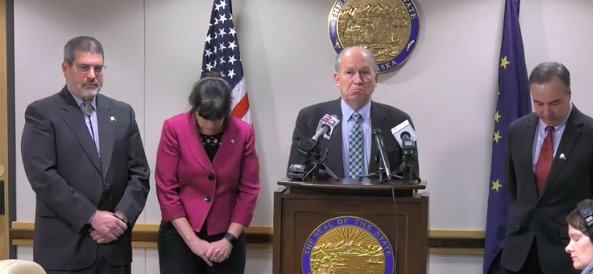
Today, Walker says he has a binding agreement with BP to buy their share of North Slope and Pt. Thomson gas. The press release issued by his office says AGDC and BP Alaska have agreed to the “key terms” as they relate to price and volume in a gas sales agreement.
The volume is unknown. No one even knows how much BP has in gas in Pt. Thomson.
The price? Also unknown. No one has revealed the price AGDC President Keith Meyer has agreed to pay for that gas, and what the variables might be for cost overruns, or the multitude of risk escalators. Part of this is because there are two other producers who must sign off on any agreement — ConocoPhillips and ExxonMobil. Along with BP, they have complicated gas balancing agreements between them that must be factored in.
The timing of the news release, 10 days before the end of the legislative session, shows both a political purpose and a commercial one, because if AGDC and BP were close to an actual gas sales agreement, they would have said so. That agreement will be truly binding, whereas this “precedent agreement” is “binding lite.”
The carefully worded “precedent agreement” is a bit of progress, and Walker needed to get it out there to keep the project alive.
STILL A FRAGILE PROJECT
Not even the appropriating body, the Alaska Legislature, knows today what the agreed price is or the terms that surround it; legislators will have lots of questions in coming days. The Senate has yet to sign off on AGDC’s ability to borrow $1 billion from China to continue.
Alaskans recall that in 2016, Walker made it impossible for ExxonMobil, BP, and ConocoPhillips to remain as the lead partners in the project, which was advancing slowly due to an unfavorable market, one flooded in natural gas. They were shown the door by the Walker Administration, which chose to go it alone.
But BP remained as a technical adviser to the project, and continues in that role today, which makes it no surprise that the company would also be the one to step forward first and say: “Give it your best shot, Gov. Walker, and we’ll sell you gas.”
With Walker’s campaign season in full swing, AGDC has been in the field polling Alaskans about what it would take for them to get back on board with the gasline. The agency has sifted through polling data and come up with ways to court public opinion. Alaskans told AGDC that they hope the project pennies out, but they have their doubts as to whether it’s viable.
Because Gov. Walker needs some good news to get the wind in the sail of his re-election campaign, now was as good a time as any to announce an agreement to keep working toward an agreement.

