
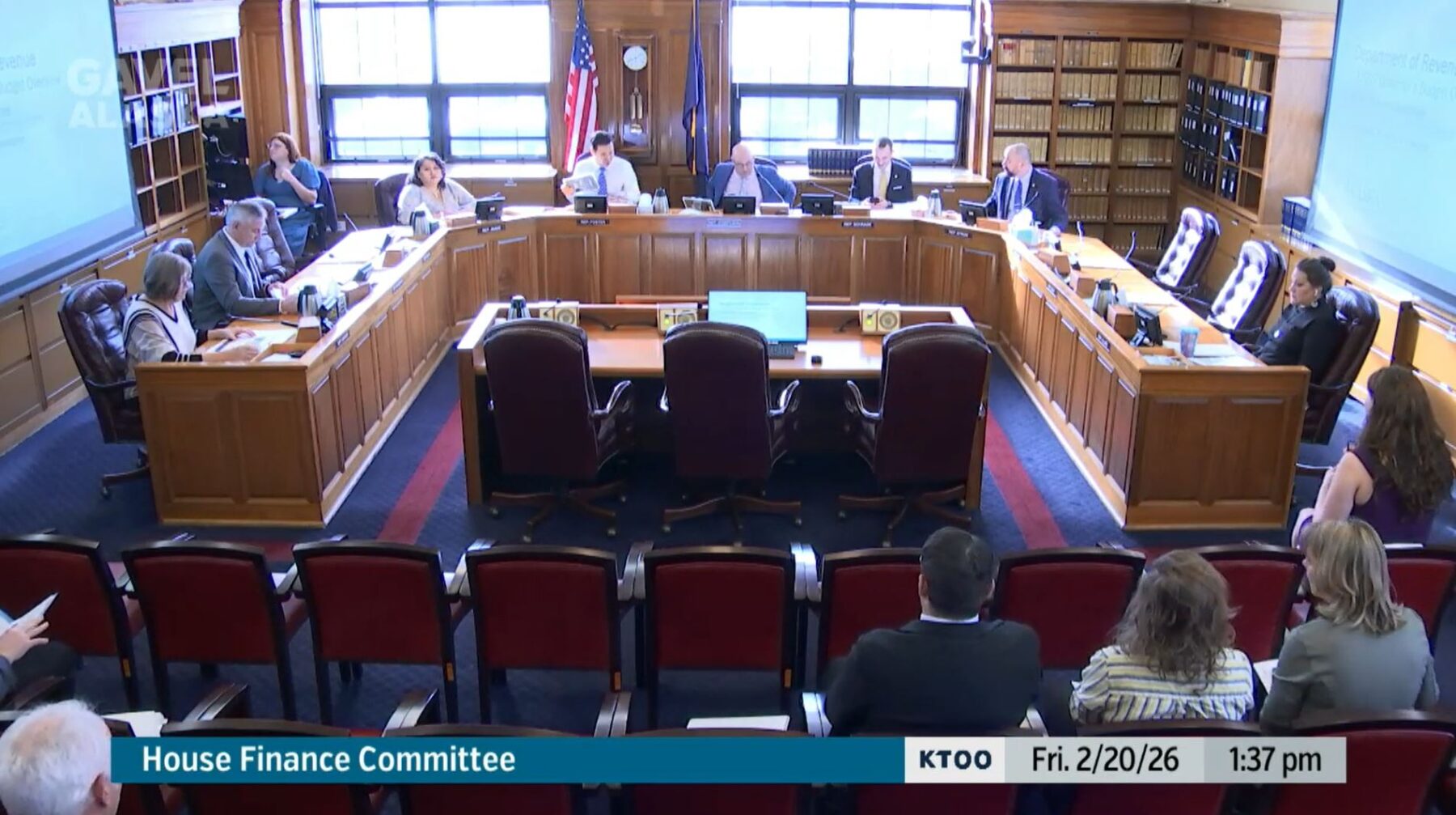
The House Finance Committee convened on February 20 to scrutinize the Alaska Permanent Fund Corporation (APFC) and the Department of Revenue’s (DOR) proposed FY27 budget. The meeting, chaired by Co-Chair Andy Josephson (D – Anchorage), highlighted the fund’s role in generating two-thirds of the state’s unrestricted revenue, while addressing investment strategies, governance, and fiscal discipline amid economic uncertainties. Marking the 50th anniversary of the Permanent Fund’s creation, discussions balanced historical gratitude with forward-looking challenges, including inflation proofing, active management debates, and budget adjustments.
Part 1: APFC Overview – Celebrating Legacy While Navigating Investment Realities
The APFC presentation, led by Executive Director and CEO Devin Mitchell alongside Chief Investment Officer Marcus Frampton, began with a nod to the fund’s origins. Mitchell emphasized the visionary decision by Alaskans in 1976 to establish the fund through a constitutional amendment. “The fact that we have this resource is because the people that lived in Alaska in 1976 elected to save money for us rather than spending it on themselves,” Mitchell said, noting that 75,588 voters—67% of the electorate—approved the measure in a “landslide.” This amendment mandated saving at least 25% of certain revenues, investing them, and making earnings available to the general fund unless otherwise specified.
Mitchell illustrated the fund’s growth through a counterfactual: without reinvestment and statutory frameworks, the fund would hold just $20 billion today, compared to its actual $86 billion as of the latest financial statements. Breaking it down, principal stands at $59.1 billion (constitutionally protected), with the Earnings Reserve Account (ERA) and unrealized gains adding layers of complexity. He highlighted $17 billion in unrealized gains, explaining the distinction between total return (more volatile but higher on average) and statutory net income (realized returns available for spending).
Governance drew scrutiny, with Rep. Allard (R – Eagle River) seeking confirmation on board appointments. Mitchell reiterated: “We have six trustees, two of which are members of the cabinet, and four of which are appointed by the governor on four-year staggered terms… all of them… are appointed by the governor at this point.” Representative Hannon inquired about Acting Commissioner Janelle Earle’s role, which Mitchell affirmed as standard practice.
Investment strategy discussions revealed a shift from conservative fixed income in 1976 to a diversified portfolio targeting risk equivalent to 80% equities and 20% fixed income. Frampton addressed a recurring public question posed by Co-Chair Schrage (NA – Anchorage): why not simply index to the S&P 500? “Index and passive investing is a very sound investment approach,” Frampton acknowledged, but warned of recency bias. He cited Nevada’s passive model as “valid,” but stressed diversification’s necessity, noting three decades where the S&P 500 returned near zero. “If you did a back test with a 5% POMV, it would be fairly devastating to be only S&P 500,” he said.
Performance metrics showed the fund beating its benchmark by 30 basis points over 10 years and 16 over five, net of fees. Frampton was transparent about recent underperformance: a deliberate underweight in mega-cap tech stocks amid high valuations hurt short-term results, but he anticipated recovery as cycles shift. On fees, he noted APFC’s inclusive reporting makes it appear “expensive” compared to peers, yet it’s “on the extreme efficient side.” Private equity, comprising 17% of the portfolio, drew focus for its 20% carried interest, but Frampton highlighted outsized returns, like 60% in 2021 versus the S&P’s 30%.
The CPI + 5% target was framed as probabilistic—achievable about half the time with fiscal discipline. Mitchell reported $114 billion in total earnings generated, with $97 billion realized, funding dividends and services. Under the Percent of Market Value (POMV) draw—5% of the five-year average balance—the FY27 draw is $4 billion, keeping the effective rate below 5% due to growth.
ERA sufficiency sparked debate. With $6.6 billion spendable after segregating the FY27 draw, Mitchell credited foregoing inflation proofing in FY25 and FY26. “We’re either $500 million behind… if you include the $4 billion as inflation proofing or $4.5 billion behind if you did not,” he said, disagreeing with prior legislative labeling of a transfer. He advocated rules-based inflation proofing to balance generations.
Other highlights included discontinuing the underperforming Alaska-focused private equity program (residual $100 million exposure), economically driven proxy voting, and modest AI adoption for efficiency, not core investing. Mitchell welcomed oversight: “Having as many eyes looking at the corporation and the permanent fund as possible is always going to be for the betterment of our state.”
Part 2: DOR’s FY27 Budget – Technical Tweaks Amid Broader Fiscal Pressures
In the FY27 budget overview, Acting Commissioner Janelle Earls, supported by Division Operations Manager Adam Bryan and agency leaders, outlined DOR’s mission to “collect, distribute, and invest funds for public purposes.” Organized into four divisions, four corporations/authorities, and oversight of items like shared taxes (revenues redistributed to municipalities), the budget emphasizes restricted “other state funds” from entities like APFC and the Alaska Housing Finance Corporation (AHFC).
Key adjustments included Treasury Division’s reduction of a vacant position and salary tweaks. For the Alaska Retirement Management (ARM) Board, Earls noted $150,000 for external legal counsel on private investments, passed through from the Department of Law. A significant discrepancy emerged: the ARM Board requested $34-37 million more in service fees than the governor’s budget, tied to amortization assumptions for unfunded liabilities targeting full funding by 2039. Treasury Director Pam Leary explained: “The one that was adopted by the ARM Board was partially adopted in the Governor’s budget… I believe the difference… is about $37 million.” The chair favored the ARM Board’s cautious approach but deferred to actuaries.
ARM Board incentives rose $13.6 million for external manager profit-sharing, contingent on $54 million outperformance. “Fees would only be paid from the retirement funds if external managers outperformed market benchmarks,” Earls clarified.
The Permanent Fund Dividend (PFD) Division sought $611.6 million for cloud hosting a new application system, plus postage increases—a figure flagged for scope clarification. The Alaska Mental Health Trust Authority added $298,500 for merits and inflation.
AHFC achieved UGF savings: $685,000 via debt service from dividends and $490,000 from vacant positions. For APFC, Earls highlighted restoring a single appropriation structure (split last year), fully funding incentives (previously at 75%), and minor IT/subscription increases. Fee authority saw a net $8 million reduction based on historical spend, with facilities adjustments including $66,000 for non-state-owned spaces and $32,000 for Juneau’s Michael J. Burns building—owned by the fund, not the state. Representative Hannon questioned the setup: “We’re just shuffling money between ourselves… this must be something that we do every year.” Earls confirmed the appropriation mechanics.
Child support inquiries revealed no agency fees for enforcement under Title IV-D, though courts may impose civil fees. Anchorage office costs for APFC were detailed at $71,100 last year, aiding recruitment.
The session adjourned without votes, but action items included reports on inflation proofing, fees, performance, and clarifications on budget items like the PFD hosting increment.
Overall, the meeting reinforced the Permanent Fund’s centrality—generating 66% of unrestricted revenue—while stressing disciplined management. As Mitchell reflected, the fund transforms “one-time resource revenue into… a renewable resource generating revenue from the world’s economy.” With FY27 draws and budget tweaks in focus, Alaska’s fiscal stewards aim to sustain this legacy amid volatility.


