
Parents logging into the Q/ParentConnection database in the Anchorage School District’s web pages can find up-to-date information about their students, including items such as grades, contact information, and class news. Some parents know this website as Zangle.
What they don’t see is what the school district officials can see — the student’s preferred pronoun. That information only shows up on the district’s side of the database — hidden from parents’ view.
One Anchorage parent, who is also a teacher, happened to notice the difference between the information shown to teachers and administrators, and information that she as a parent can see from the parent portal. It’s the only part of the database that is different between the two portals. Thus, if a student has decided to go by a different gender pronoun at school than is familiar to his or her family, parents won’t know.
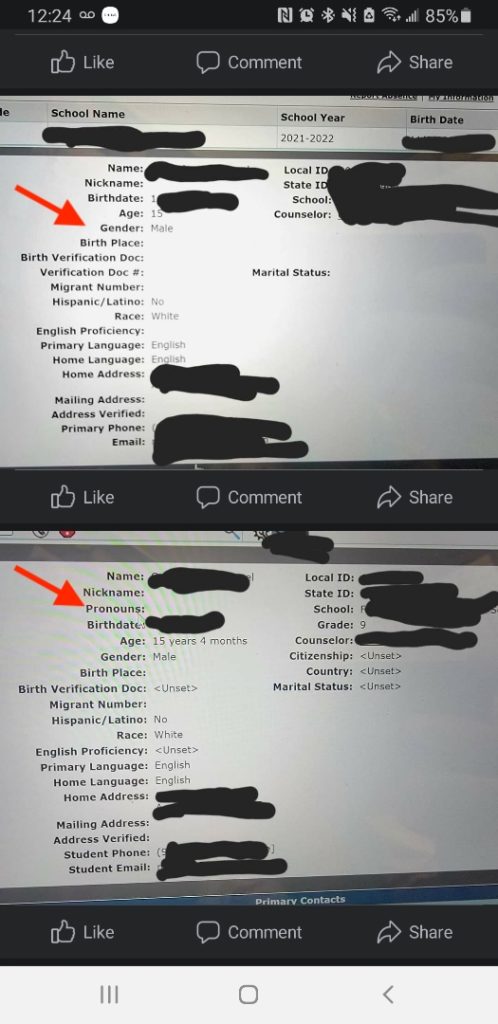
According to the Heritage Foundation, this is a trend across the country. In Montgomery County, Maryland, parents sued the school district for actively keeping information about a student’s gender identity preference hidden from parents — an action in direct contravention of legally guaranteed parental rights, and in violation of the Family Educational Rights and Privacy Act.

FERPA gives parents certain rights with respect to their children’s education records. These rights transfer to the student when he or she reaches the age of 18 or attends a school beyond the high school level. Students to whom the rights have transferred are “eligible students.”
Under FERPA, parents have the right to inspect and review the student’s education records maintained by the school. Parents or eligible students have the right to request that a school correct records which they believe to be inaccurate or misleading. If the school decides not to amend the record, the parent or eligible student then has the right to a formal hearing. After the hearing, if the school still decides not to amend the record, the parent or eligible student has the right to place a statement with the record setting forth his or her view about the contested information.
But when parents are seeing a different school record than one the school maintains for teachers and staff, parents’ rights under FERPA are being violated. Read more about FERPA at this link.
According to some gender language leaders, there are 78 gender pronouns that may be used, including these, which are considered more common:
| Subject | Object | Possessive | Possessive pronouns | Reflexive |
| (f)ae | (f)aer | (f)aer | (f)aers | (f)aerself |
| e/ey | Em | Eir | Eirs | Eirself |
| He | Him | His | His | Himself |
| Per | Per | Pers | Pers | Perself |
| She | Her | Her | Hers | Herself |
| they | Them | Their | Theirs | Themselves |
| Ve | Ver | Vis | Vis | Verself |
| Xe | Xem | Xyr | Xyrs | Xermself |
| Ze/zie | hir | hir | hirs | hirself |