On the Mike Porcaro Show on Monday, (650 KENI) congressional candidate Sarah Palin once again repeated her belief that the third vote getter can win the election in the ranked choice voting system.
That makes three times in one week that Palin has asserted her theory in the public square — the first two times were in Texas. It’s unclear why Palin keeps repeating this theory.
As wacky as Ballot Measure 2’s new election design is, it is still mathematically impossible for the third-place candidate to win next week’s special congressional general election for the temporary seat in Congress.
Every round of ballot counting involves a smaller voting universe. With three candidates, there will be only two counting cycles: The first one eliminates the third-place finisher, and then the election is between just two people.
Everyone who votes for the last-place finisher will remain part of the second (and final) voting universe only if they have made a second choice on their ballot. Ranking other candidates will never harm your first-choice candidate.

For example, if someone votes for Palin, but she comes in third, and if the voter has not selected either Mary Peltola-D, or Nick Begich-R as their second choice, the ballot is exhausted and tossed. In this case, that will probably lead to a Peltola win, since the Democrat will have all the liberal votes in Alaska, which can overcome the conservative votes that remain, in this sample scenario.
But if someone votes for Palin as their first choice and then marks Nick Begich as their second choice, their ballot is still in the running, even after Palin is eliminated. Now the race is only between Begich and Peltola, and it’s as if Palin never existed. Begich gets that one more vote, but the overall number of ballots is, by this time, shrinking because not everyone will rank. With a smaller voting universe, it takes fewer overall votes to win.
If someone votes for Begich first, and Palin second, and if Begich is the third-place candidate, he is eliminated, and the contest is between Palin and Peltola. In this scenario, Palin just earned one more vote that came from the eliminated Begich ballot.
Using yet another example, if Peltola voters do not rank beyond their first choice, and if Peltola comes in third, those ballots are exhausted and the race is just between Begich and Palin. But if Peltola voters rank Palin second, then in the race between Begich and Palin, Palin will get those votes.
It’s a system that makes voting harder than it should be, but the bottom line is that the last-place finisher cannot win because they are always the first to be eliminated.
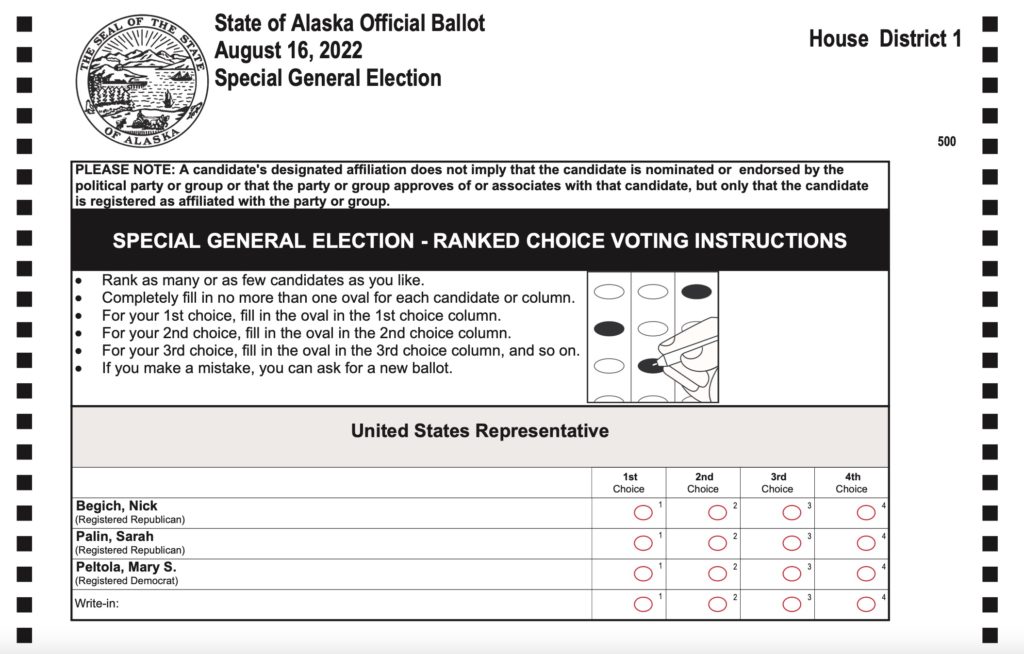
Here’s what the ranked choice ballot looks like on the back of the Aug. 16 primary ballot: