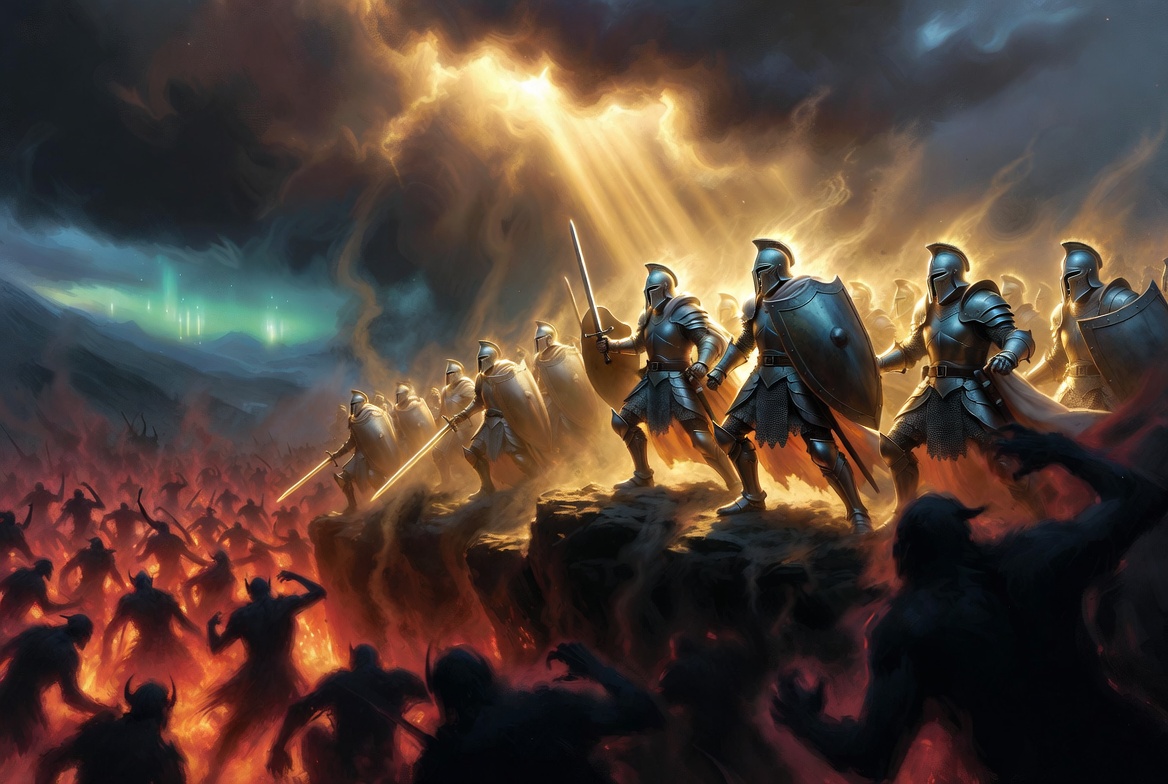
There was a movie in 2008 called The Spiderwick Chronicles, adapted from the popular book series of the same name. In both the books and the film, the Grace children discover a pair of special glasses that suddenly reveal the hidden world of fantastical creatures living all around them—goblins, sprites, and other beings invisible to ordinary human sight. Without those glasses, the children remain completely blind to the dangers and wonders that share their everyday environment, a blindness that could have proven fatal.
The spiritual realm is similarly metaphysical: we humans cannot ordinarily see the good or evil spirits that surround us. Imagine for a moment that God were to give you the eyes to see and the ears to hear. How would you react? If you could perceive the full truth of the spiritual realm—and recognize that you, as a rational creature endowed with free will, stand amid an invisible combat between good and evil—what would you choose to do with that knowledge? How might your daily life be transformed?

Angels and Demons
St. Thomas Aquinas, the Angelic Doctor of the Church, offers a profound and systematic philosophical framework for understanding this unseen reality. In the Summa Theologica (I, questions 50–64), Aquinas reasons from the hierarchy of being that the perfection of the created universe requires pure intellectual substances—angels—who are entirely incorporeal. These beings are subsisting forms of pure intellect and will, free from any admixture of matter. They occupy a rank intermediate between God, who is pure Act, and embodied rational creatures such as human beings.
All angels were created good by God; yet some, through a free choice rooted in pride and envy, rebelled and became demons. Neither angels nor demons can ever compel the human will, for free will remains inviolable. They influence us only indirectly: good angels illuminate the intellect with truth and gently stir the passions toward virtue, while demons present deceptive phantasms to the imagination and inflame disordered desires.
For Aquinas, the spiritual realm is not less real than the material world we perceive with our senses; it is more real and more perfect. It constitutes the higher order of creation that governs, ministers to, and ultimately perfects the lower order. Without the light of faith ordered by reason and revelation, we remain “blind” to this dimension, much like the Grace children before they put on the seeing stones.
If God were suddenly to grant us the sight to perceive our guardian angels standing at our side, the fallen spirits seeking our ruin, and the continuous spiritual warfare that surrounds every moral choice, our reaction would almost certainly be one of profound awe, holy fear, and a radical reorientation of priorities. Temptation would no longer register as a mere psychological impulse; virtue would no longer appear as optional self-improvement. Every decision would stand revealed as participation in a cosmic contest whose stakes are nothing less than eternal beatitude or eternal loss.
Aquinas develops this teaching further by explaining that each human soul is assigned a guardian angel from the first moment of existence (conception). This pure intelligence has a single mission: to guide the person toward the ultimate end of union with God while scrupulously respecting the freedom of the will. The angel works through subtle inspirations, sudden clarifying insights, unexpected strength in moments of weakness, and even physical protections that the unenlightened may dismiss as lucky coincidences.
At the same time, the demonic legions—though already defeated by Christ—retain the ability to suggest false goods and to exploit the lingering wounds of original sin. Thus, in Aquinas’s vision, the drama of every human life is never merely private or psychological. It is always enacted on a stage crowded with invisible actors whose presence is more decisive than the visible forces of nature, society, or personal psychology.
To receive the “eyes to see” would be to awaken fully to this truth, transforming the most ordinary moments of decision into conscious acts of cooperation with, or resistance against, these higher powers. Prayer would cease to feel like speaking into emptiness; it would become real dialogue with allies already present. Sin would lose its casual familiarity and stand exposed as temporary alliance with the enemy. Charity would gain new urgency, for every genuine act of love would be recognized as a tangible strengthening of the luminous ranks that stand between us and destruction.
Tolkien and Aquinas
J.R.R. Tolkien, whose deeply Catholic imagination was formed in the same intellectual and spiritual tradition that shaped Aquinas, dramatizes this exact unveiling with masterful clarity in The Lord of the Rings. When Frodo Baggins slips on the One Ring at Weathertop, he is abruptly drawn into the Unseen World—the wraith-realm that coexists with the physical world we know. Suddenly the black-robed Nazgûl appear in their true forms: tall, pale, crowned kings of death whose eyes burn with merciless hunger. At the same moment the Elf-lord Glorfindel, who dwells simultaneously in both the Seen and the Unseen, shines before Frodo as a figure of pure white light that does not diminish. The Ring does not merely confer invisibility upon its wearer; it strips away the veil so that, as Tolkien writes, “things appear as they truly are: beings of differing shades of light and darkness.”
Later, when Samwise Gamgee briefly wears the Ring in the tower of Cirith Ungol, the orcs around him become “a phantom company, grey distorted figures in a mist,” while the true spiritual corruption of Mordor presses upon his soul with almost unbearable clarity.
These moments function exactly like the magical glasses of Spiderwick: the ordinary physical world continues uninterrupted, yet a higher, more decisive reality is disclosed. The hobbits’ reaction—terror mingled with steely resolve—illustrates precisely what Aquinas would expect of a soul granted such vision: immediate recognition of the enemy’s true nature, instinctive reliance upon the luminous aid of the good, and a renewed determination to complete the quest of holiness even when the cost is great.
Tolkien returns to this theme repeatedly. As the Fellowship draws nearer to Mount Doom, Frodo and Sam experience successive moments in which the physical landscape of Mordor seems overlaid with a deeper spiritual desolation, a sense of being watched and hunted by powers no sword can reach. Gandalf, whose true nature as an incarnate Maia places him among the higher orders of created intelligence, continually reminds the Company that “there are other forces at work in this world, Frodo, besides the will of evil.”
When the Great Eagles arrive at the last possible moment to rescue the exhausted hobbits from the erupting mountain, the reader senses the unmistakable intervention of that same invisible hierarchy Aquinas describes—not by abolishing free will, but by answering the perseverance of those who have chosen the good despite overwhelming darkness.
Even Gollum’s tragic end, which simultaneously fulfills the quest and reveals the terrible consistency of a will long surrendered to the Ring, underscores Aquinas’s teaching that free creatures can either cooperate with grace or harden themselves against it until the final moment. In Tolkien’s narrative, as in Thomistic philosophy, the spiritual realm is never distant or abstract; it is the more real world pressing upon every choice, waiting only for the eyes of faith—or the sudden gift of clearer vision—to be recognized.
Such an unveiling would not leave any of us unchanged. Seeing the guardian angel who has accompanied us from the first moment of life, or the demon who has whispered the same familiar lie for decades, would strip away every remaining excuse of ignorance. We would pray with greater urgency, confess with greater honesty, and love with greater courage, knowing that every act of charity strengthens the legions of light, and every sin opens a door, however briefly, to the powers of darkness.
Experiencing Spiritual Reality
A few years ago, our family experienced a moment that brought this invisible reality into sudden, unforgettable focus. We were traveling along the Parks Highway on what had begun as an ordinary day. Ahead of us, around a sweeping bend, a car drifted across the center line and slammed directly into a group of six motorcyclists riding together. Time seemed to slow as we watched the catastrophic impact unfold. Motorcycles were hurled into the air like toys, crashing down onto the asphalt with sickening force and then skidding and tumbling wildly across both lanes of the highway. Metal, glass, and human bodies scattered in every direction.
My husband reacted instantly, slamming on the brakes. Our van swerved hard to the right in a desperate attempt to avoid the spreading chaos. That abrupt maneuver lifted the entire vehicle onto its two right-side wheels. For a suspended instant we hung there, balanced on the knife-edge between recovery and disaster. The driver’s-side wheels left the pavement; the ground rushed toward the windows. In that terrifying fraction of a second, I cried out the only prayer that rose from the depth of a mother’s heart: “Lord, please do not let my children suffer.”
What followed felt like an eternity of impending harm—an endless moment in which the van continued its slow, inevitable roll toward the steep embankment that dropped away from the shoulder of the road. Then, without any action on our part, a sudden, powerful thrust pushed against the tipping side of the vehicle, as though an unseen force had placed itself between us and the ground. In one seamless motion, the van settled firmly back onto all four wheels. We came to a controlled stop on the shoulder, the engine still running, the children safe in their seats, the world still turning.
We sat for a moment in stunned silence and then poured out thanks to God for His mercy. There was no natural explanation for the way the vehicle had been righted. We knew—beyond any doubt—that our guardian angels had acted in perfect unison, applying that precise, invisible pressure that restored us to solid ground, prevented us from rolling down the embankment, and quite possibly saved us from death or catastrophic injury. An inexplicable peace settled over the entire family even as the emergency unfolded around us. That peace did not feel like the absence of fear; it felt like the presence of something stronger than fear. We immediately got out of the van and went to help the injured motorcyclists scattered across the highway, doing what little we could until the first responders arrived.
God was truly and tangibly present on that stretch of road that day. Not a single day has passed since then that I do not thank Him for every ordinary moment of every ordinary day. That fleeting yet unmistakable glimpse of the spiritual realm—exactly the kind of intervention St. Thomas Aquinas describes in his theology of the angels and that Tolkien so vividly portrays in the unveiling of the Unseen World—has permanently reshaped the way I live. I now approach the most routine hours with deeper gratitude and firmer trust, confident that the same invisible help still surrounds us, guiding and protecting even when our physical eyes cannot perceive it.
If God were to grant us permanent “Spiderwick glasses” for the metaphysical world, the daily grind of work, relationships, errands, and quiet duties would be transfigured into the open theater of the great war between heaven and hell. We would live, as Aquinas insists we already do, as rational creatures summoned to cooperate freely with the higher intelligences God has placed at our service and to resist those who seek our destruction.
The ordinary commute, the patient conversation with a tired child, the decision to forgive or to withhold forgiveness, the choice to speak truth or to remain silent—all would stand revealed as moments of eternal consequence. Temptation would no longer feel like a private struggle against personal weakness; it would be recognized as the calculated whisper of an enemy already defeated yet still active. Moments of unexpected strength, sudden clarity, or unaccountable peace would be received as the tangible assistance of those pure spirits assigned to our care.
In short, we would begin to live the truth that faith already proclaims: that the visible world is only the surface of a far deeper reality, and that every human life is lived under the watchful eyes of both light and darkness. The only question that remains is whether we will begin even now, by the light of faith, to live as if we already see.