
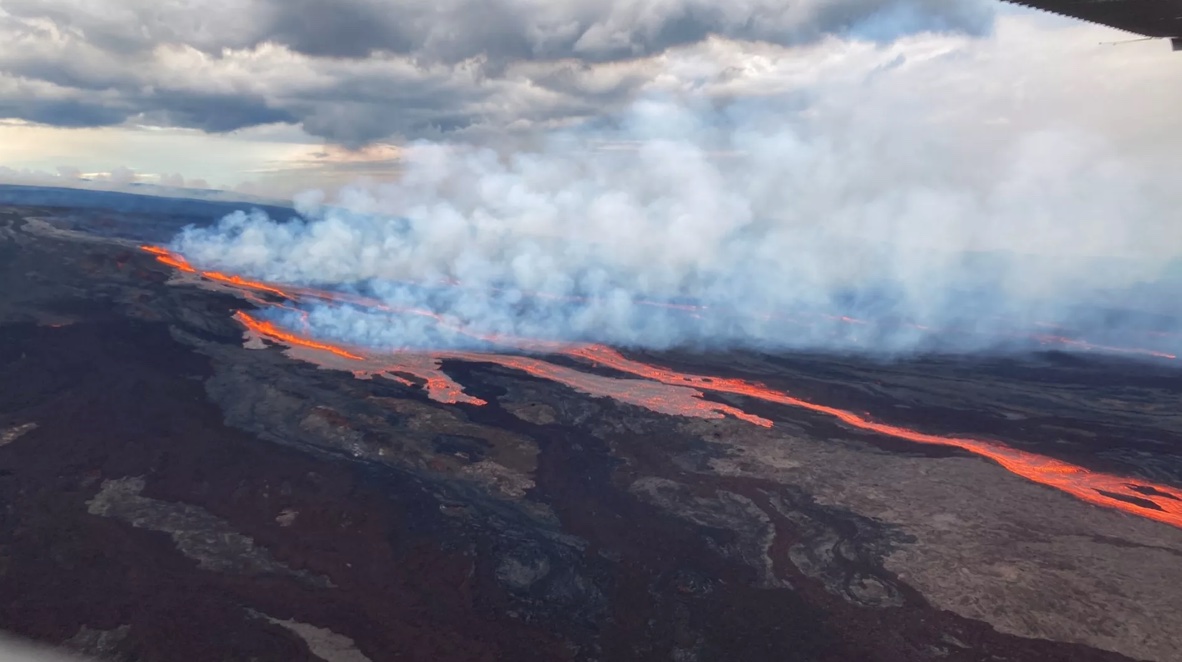
The world’s most active volcano, Mauna Loa, began erupting Sunday on the Big Island of Hawaii, sending ash high into the atmosphere and creating spectacular sunsets. It is the first eruption of the volcano since 1984 and it has disrupted some air travel, with ash as high as 45,000 feet, and an ash plume heading in the direction of Maui.
Such volcanic events can affect travel and conditions can change quickly; Alaskans heading to the Big Island should check with their airlines and destination hosts.
Hawaii’s Department of Transportation issued a travel advisory Monday, warning passengers of flight disruptions at Hilo International Airport and Ellison Onizuka Kona International Airport at Keahole. Southwest Airlines canceled nine flights from Hilo over several hours on Monday. Hawaiian Airlines is issuing volcano travel waivers for those who had tickets to and from the Big Island through Dec. 4. The airline said, “Upon rebooking a new flight, no change fees will be charged, but a fare difference may apply.”
Kilauea has also erupted on the Big Island but has been regularly burbling since Sept. 29, 2021, when it exploded, causing damage to several structures, including total loss of the Wahaula Visitor Center, the Royal Gardens community center, Mauna Kea Congregational Church, Puna Canoe Club halau, and the Kalapana Drive-In. The losses from that eruption were over $60 million. But for now, the Kilauea eruption is confined to the summit lava lake.
The National Weather Service issued an ash fall advisory for all districts of Hawaii, but has since cancelled it. The lava flows are not presently a threat to communities or private properties on the island, according to the U.S. Geological Survey and Hawaii Volcano Observatory.
Mauna Loa is 13,678 feet above sea level (compare that to Alaska’s Mount Denali, 20,310 feet above sea level); the heat from the explosion can be seen from satellites.
For visitors heading to the island, Hawaiʻi Volcanoes National Park remains partially open, but the Mauna Loa Road is closed to vehicles. The summit, cabins, and many higher elevations had already been closed since the volcano became more active in October. Mauna Loa Observatory Road, outside of the park, is also closed, and the lava crossed the road Monday night.
On Monday, an earthquake also was felt on the Big Island, with a magnitude of 4.2. It’s unclear if it was related to the volcanic eruptions, but the epicenter was near Pahala, about 20 miles from Mauna Loa.
The Federal Aviation Administration notified aviators of a Temporary Flight Restriction within a five-mile radius around Mauna Loa summit, a restriction extended until Dec. 5.
Are you on the Big Island? Put your observations in the comment section below.
Photo credit: U.S. Coast Guard.


