
Among resource development and legal professionals in Alaska there’s a big topic this week: President Joe Biden is planning on shutting down access to the Ambler Mining District.
Word is that Biden will be playing to his environmentalist base on Monday, Earth Day, with the Bureau of Land Management issuing a decision on the right of way needed through federal land: It will be the “no build” option.
Earth Day in an election year means using public symbolism as a campaign asset. Since Biden polls poorly in Alaska and will likely not be getting any of the three electoral votes from the resource-rich state, canceling the Ambler Access Project comes at no cost to him with Alaska voters, but is a sure way to shore up his support in the powerful environmental community in major urban areas of the country.
It won’t be the only big symbolic gesture by the Biden Administration on Earth Day, but if sources are correct, it will be one of the biggest shutdowns in the nation announced that day. Due to the fragile state of global peace and Biden’s expanding wars, he may not attack oil and gas on Earth Day. But mining in Alaska? That one is easy and can gain him a lot of mileage with Democrats.
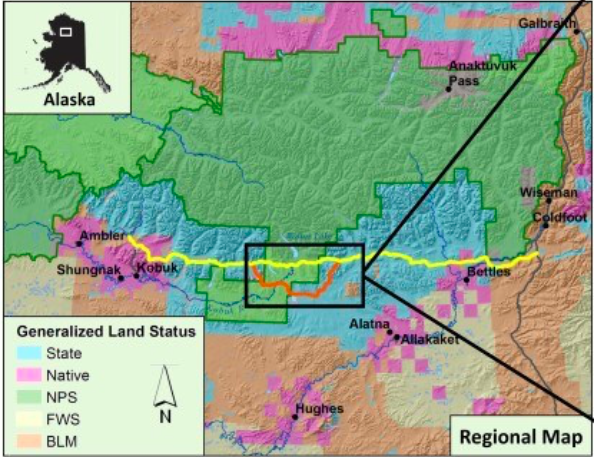
The Ambler Access Project is a proposed 211-mile, controlled industrial-access road that would provide access to the Ambler Mining District from Bornite to the Dalton Highway. The area currently lacks the transportation infrastructure needed for the development, construction, and operations of potential mines in the district. President Donald Trump’s administration issued an environmental impact statement for the road, but that EIS was suspended by Biden, pending further review. The Biden Administration wanted a different answer.
The large prospective copper-zinc mineral source has extensive deposits of critical minerals and other elements that are needed for the technologies Americans depend on, for green-energy products, and for military readiness. It will create hundreds of high-paying jobs for families in an area of the state where poverty is the greatest.
The Alaska Industrial Development and Export Authority has been working to get the road built for years.
The access to Ambler is enshrined in federal law through Section 201(4) of Alaska National Interest Lands Conservation Act (ANILCA.)
Violating that law will no-doubt draw a lawsuit from the State of Alaska, AIDEA, and others who will demand that Biden follows what was signed into law by President Jimmy Carter.
The draft supplemental environmental impact statement has gone through its public comment period in 2023, and many professionals in the mining field have predicted the announcement about the decision would come in the second quarter of 2024.
“Throughout 2021, the Ambler Access Project made significant progress achieving multiple land access milestones, including rights-of-way (ROW) between AIDEA, the National Park Service (NPS), and BLM as well as an AIDEA-Doyon land access agreement and an AIDEA-NANA land access permit. The agreement and permit with Doyon and NANA, respectively, are effective until December 31, 2024,” the agency said. “Note that these are not ROW agreements. Project resources were added to advance the project through Final Feasibility and Permitting, including a dedicated program manager, external communications manager, and a team of contractors to complete nine critical scopes of work.”
In 2021 and 2022, several key stakeholders published letters and resolutions in support of the AAP, including Northwest Arctic Borough, the Native Village of Shungnak, Alaska’s Congressional Delegation, the Alaska Chamber, the Alaska Miners Association, the Alaska Support Industry Alliance, the Council of Alaska Producers, and Resource Development Council for Alaska, Inc.
The Alaska Industrial Development and Export Authority has formally communicated with the Bureau of Land Management regarding the importance of including recent tribal support in the decision-making process for the Ambler Access Road Supplemental Environmental Impact Statement.
The letter sent to BLM Alaska State Director, Steven Cohn, highlights tribal endorsements from several communities closest to the project – Allakaket, Ruby, and Hughes – and provides “good cause” for acceptance into the record along with the reminder of BLM’s commitment to meaningful consultation with tribal communities—a key factor in its previous decision to revisit the original EIS.
Tribal leaders and communities closest to the project area have expressed their support, highlighting how the project aligns with their community’s interests, AIDEA has pointed out.
- “Our future generation needs to have opportunities to earn a good living and support our families, as well as, stay in the community and practice subsistence. Supporting the Ambler Road is our way of steering towards a path of economic strength and job creation. Our commitment to our community’s future is unwavering. This resolution embodies our dedication to responsible resource development and securing a prosperous future for our younger and coming generations,” said Thelma Nicholia, chief of Hughes Village.
- “In the words of Larry Westlake, the right question to ask is not ‘what happens to our communities and Tribal members if a road is built and mining occurs’ but ‘what happens to our communities and Tribal members if a road is not built and no jobs or opportunity exists for our children and future generations,’” said PJ Simon, first chief of Allakaket Village Council.
“The Ruby Tribal Council is dedicated to ensuring jobs and opportunities for our children and grandchildren. The resolution stands as a testament to our village’s dedication to responsible resource development. We want to have a say over our future and supporting the Ambler Road is one way we can plan for future generations,” said Chief Patrick McCarty, first chief of the Ruby Tribal Council.
- “I strongly believe that the road will greatly benefit my community and I’m not alone. Many of my neighbors also support the road, as do other villages in the region. I worry though that our voices are getting drowned out by people outside the region [who] don’t understand thestruggles of my community,” said Miles Cleveland, president of the Native Village of Ambler and Northwest Arctic Borough Assembly member.
The North Slope Borough Assembly and Northwest Arctic Borough Assembly stated a resolution the importance of “geotechnical work to proceed, and to promote responsible natural resource development that benefits our people for the long term.”
Governor Mike Dunleavy requested that the Bureau of Land Management consider the tribal support and project significance for Alaskans in the SEIS process.
“The resolutions from these tribal communities are a clear indication of the importance of this project. Their inclusion in the final decision process by the BLM is not only appropriate but essential for a project of this magnitude,” Dunleavy said in a statement.
“AIDEA expects BLM to recognize the weight of these community support resolutions as a critical element in the decision-making process,” said Randy Ruaro, executive director of AIDEA. “Honoring the principles of collaboration and respect are central to sustainable economic development. AIDEA is committed to responsible resource development on the Ambler Access Project, mirroring the success and approach of the Red Dog Mine, which exemplifies how economic development and environmental stewardship can both be achieved.”
The Ambler Access Project Subsistence Advisory Committee recently adopted protections for fish and wildlife which emphasize the balance between responsible resource development and the protection of subsistence resources.
Extreme environmentalists oppose the access because they say it will harm caribou migration in the area. The Sierra Club, based in Oakland, Calif., wrote, “The Ambler Road, 50 miles above the Arctic Circle, is the last thing Native hunters and wildlife need.”


