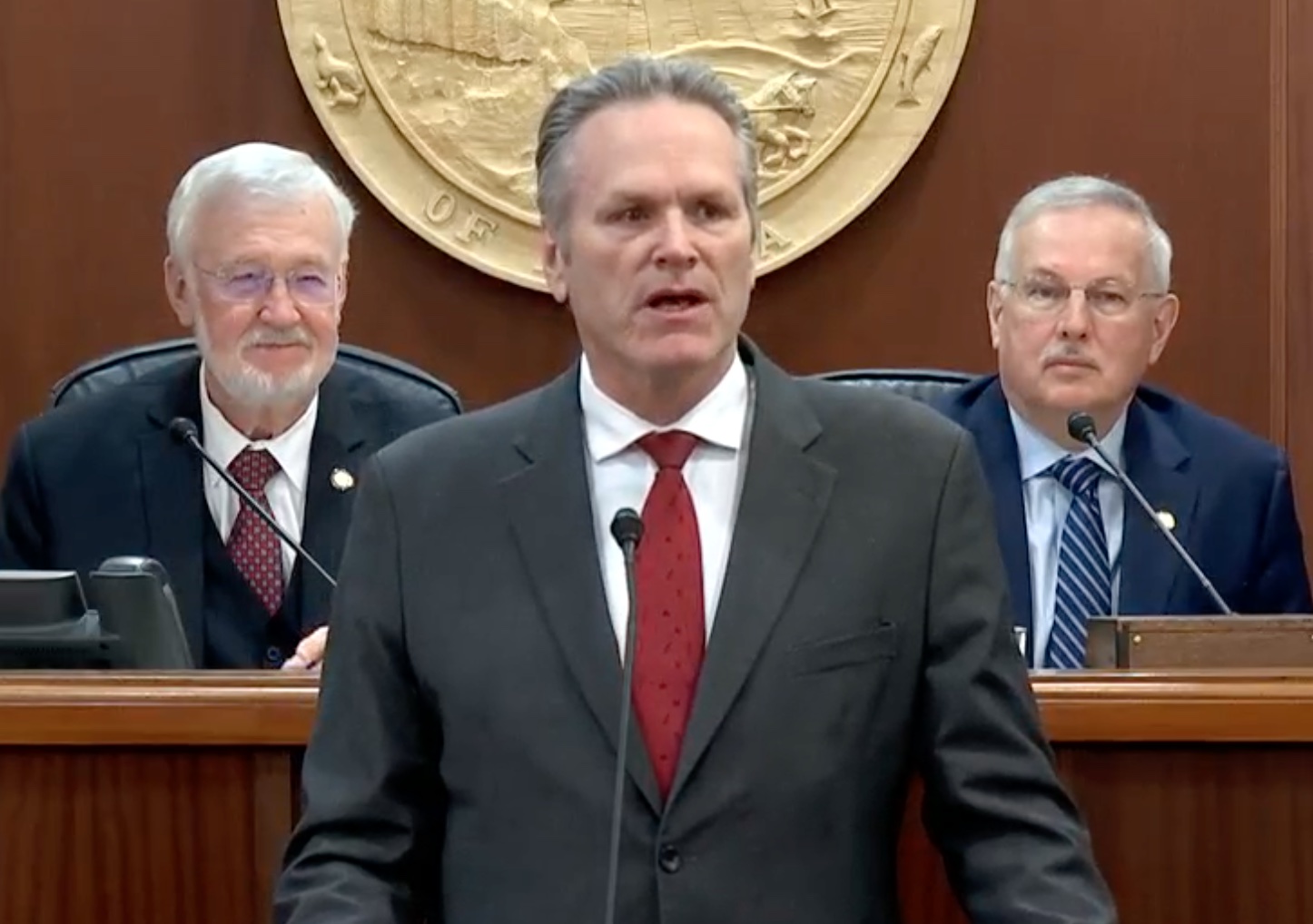
Gov. Mike Dunleavy’s State of the State Address to the Legislature on Tuesday was upbeat and marked by several themes, including progress and economic growth in Alaska, infrastructure and business expansion, public safety, education, and most of all optimism for the future.
Dunleavy noticeably has a cold, evidenced by his hoarse voice, his stuffy nose and clearing of his throat throughout his 24-page speech. Nevertheless, the speech was upbeat.
He acknowledged that he is in his seventh year as governor, but he said, using football metaphor, “And I have no intention of running out the clock and taking a knee with the time I have left.”
“What is our State of the State,” he asked. It’s heading in the right direction, he answered, and then went into an inventory of positive outcomes for Alaska that have occurred this past year and throughout his administration.
Here are some of the main points of his speech:
The population of the state has not only stabilized, but has grown from about 734,000 in 2020 to more than 741,000 in 2024. A combination of immigration plus births has helped raise the population to the highest level since 2017, he said.
Alaska is projected to add another 5,300 jobs in 2025, which would break the all-time high reached in 2015.
Jobs grew at a faster rate than the US for each of the past two years.
Wage growth was 6.4% while the rest of the country averaged 5.5%.
Assets managed by the Department of Revenue grew by nearly $600 million in 2024, the best performance in 10 years.
The Alaska Permanent Fund has grown by nearly $16 billion since 2020, and is projected to reach the $100 billion milestone by 2031.
The state investment bank, known as AIDEA, grew its net income to a record high of $66 million in 2024 and has paid the State nearly half a billion in dividends since 1997.
Five new cargo carriers moved into Anchorage the last year, and cargo activity grew by nearly 5% in that time. In addition, Delta and United Airlines announced plans to expand their operations in Alaska, and WestJet will begin its first ever service between Anchorage and Calgary this summer.
The Red Dog mine received approval from the federal government for its permit to build a road to an additional find that will extend the life of the mine.
Graphite One mine construction could begin by 2027 and the mine could be producing as early as 2029.
During Dixon Diversion construction, estimates are for 3,250 jobs with a total economic output estimated at $584 million dollars.
During SSQ construction, an estimated 460 jobs will be created with a total economic output of $96 million.
During HVDC construction it’s estimated that 1,470 jobs should result in a total economic output of $332 million.
When Dunleavy took office there were just 382 budgeted State and Wildlife Troopers positions. Today, the state has 411 positions, and he is requesting an additional five troopers in his budget proposal to and to reopen the shuttered Trapper Creek post. There are 77 Village Public Safety Officers serving rural Alaska as first responders, the highest number the state has had since 2014.
“My proposed budget asks for funding for five more positions,” Dunleavy said.
Overall crime rate is down 37% since 2018. Property crime is down 42%. Violent crime is down 17%.
Felony sexual assault is down 27%.
In the last academic year, according to assessments used by school districts across the nation, the percentage of Alaskan students who met early literacy benchmarks grew from 41% to 57%. Among kindergarten students, proficiency rates rose from 24% at the beginning of the year to 60% by the end of the year. According to national data released last June, Alaska students outpaced the national growth in kindergarten, first, and second grades.
In fall 2023, research from Harvard University concluded that Alaska’s charter schools are the best performing charter schools in the nation.
Over six budgets, his administration has held operating spending growth to just 8% since 2019.
Ten years ago, in the 2014 Revenue forecast, North Slope production was predicted to be just 314,000 barrels per day by 2024.
The Department of Interior estimates the state could see as much as $2 billion per year in revenue if ANWR is fully developed.
In a few years, because of this investment on the Slope, Alaska may be reporting overall production of over 650,000 barrels per day, he said. The current production is about 480,000 barrels per day.
He reminded legislators that 20% of the income from the Alaska LNG Project will be devoted to rural energy projects.
He said he was excited about Alaska’s future because of Donald Trump as president. He said that Trump singled out Alaska for the first batch of his executive orders. No other state got that kind of attention, he said.
Dunleavy said Alaska was sanctioned more than Iran and North Korea by the prior administration of Joe Biden.
He ended on a note of optimism:
“I’m an optimist because I believe in the people of Alaska, and the great things we can accomplish together. The people are the reason I’ve stayed here for more than 40 years … The people are the reason I chose to serve. I’d like to believe that’s the same reason all of us are here to serve as well. There’s no doubt we’re going to have our differences over the next few months.
But I believe we’re going to find more areas where we agree than we don’t. That’s because we’re Alaskans. I believe that our wins are going to be Alaska wins. When we put our minds together to create good policy, great things will happen. I’m ready to get to work, and to work together. I know you are, too. So I want to thank you again for the invitation to speak with you and our fellow Alaskans tonight. And I want to ask God bless Alaska, and I want to ask God to bless the United States of America,” he said.