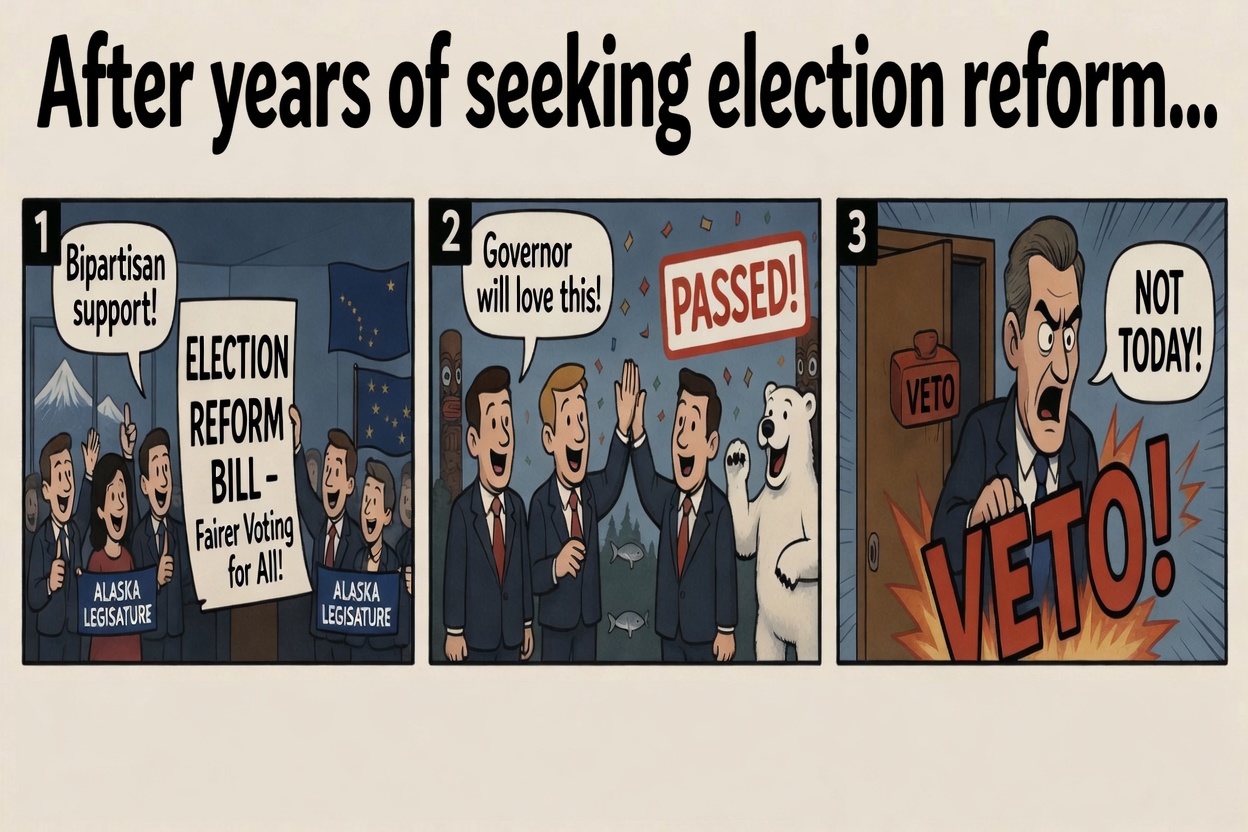
On April 30, 2026, Governor Dunleavy vetoed a significant election reform bill, Senate Bill 64, which would have provided measures to increase Alaska’s election integrity and efficiency.
Representative Sarah Vance (R-Homer) and Senator Bill Wielechowski (D-Anchorage) negotiated the terms of SB 64 for nearly a decade, finally leading to an election reform bill with broad bipartisan support and which passed the Legislature 39-20. SB 64 even includes provisions introduced by Governor Dunleavy himself.
Dunleavy cites “legal and operational challenges” as the reason for his veto. However, according to a press release from the Senate Majority, “The Lieutenant Governor’s office, which oversees Alaska’s elections, assured the legislature that there was plenty of time to implement this bill before the upcoming election.” The Lieutenant Governor’s office did not indicate any legal or operational barriers to implementing the bill before the November election.
Among the measures rejected by Governor Dunleavy are:
- Ballot tracking and prepaid return postage for absentee ballots;
- Ballot curing to fix minor errors before a valid vote is discarded;
- Voter ID limited to government-issued IDs, including recognized tribal IDs;
- Voter roll cleanup;
- A rural election liaison to prevent polling failures;
- Earlier ballot review and faster certified results;
- Public disclosure of ballot counts and ballot tabulation data; and
- Cybersecurity breach notification requirements and updated election tampering statutes.
The ability for Alaskans to “cure” their ballots for minor mistakes would have had a significantly positive impact on rural Alaskan voters and military voters. In the last election, JBER House District 18 had the most rejected absentee ballots in the state, with House Districts 21 and 19, which are home to many service members living off base, following close behind. SB 64 solves that issue and maintains security by directly tying ballots to a verified ID on file.
Many ballots are rejected for technical errors, voter rolls are inflated with over 100% of the voting-age population on the rolls, and voting machine tampering is not explicitly illegal in Alaska. Alaska is long overdue for serious election reform.
According to Rep. Vance, SB 64 would have made Alaska’s election “easy to vote, hard to cheat.” In her op-ed published by Must Read Alaska, Rep. Vance explains the bill’s provisions and how they are essential to providing Alaskans with an election system they can trust.
Republican opposition to the bill seems centered around secure election outcomes potentially favoring Democrats.
According to The Alaska Story, “Ccuring [sic] tends to benefit Democrats more than Republicans; the side with the most organized outreach infrastructure will gain an advantage by contacting voters to fix rejected ballots. They contended the measure effectively gives voters “a second bite at the apple.” More mistakes are made on Democrat-cast ballots, which will benefit from the curing.”
However, it is essential to election integrity to pass common-sense reforms not based on how they may benefit a certain party but based on how they benefit Alaskan voters.
The Legislature intends to vote to override the Governor’s veto.