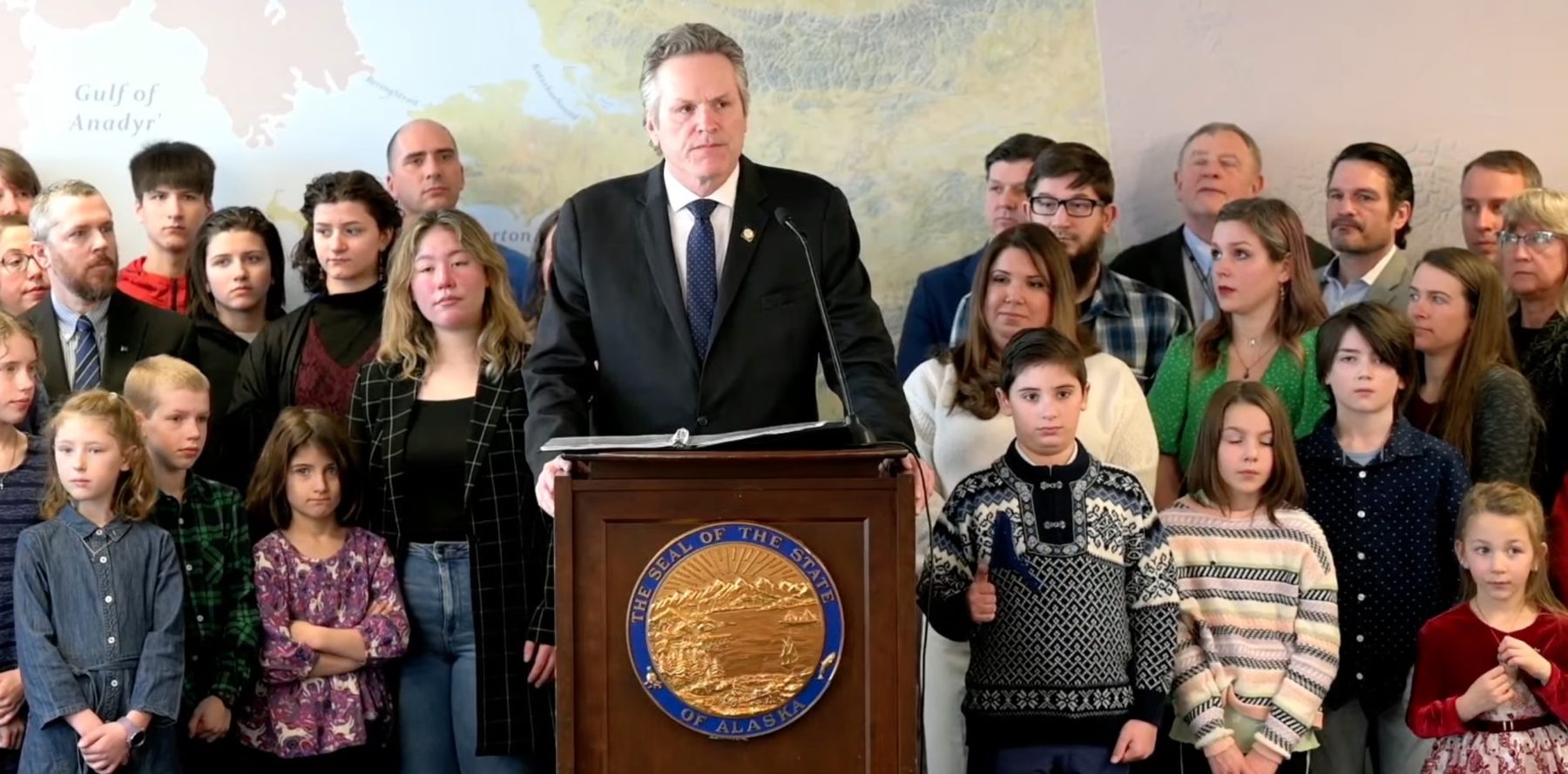
Surrounded by children, parents, and educators, Gov. Mike Dunleavy introduced a pair of bills that give teachers bonuses and reinforce the rights of parents to safeguard their children from gender ideology policies that may be inflicted on families by local school districts.
One bill ensures transparency in schools by codifying parental rights and by requiring school districts to adopt procedures addressing the physical safety and privacy of students in locker rooms and restrooms in public schools.
The other bill is a teacher recruitment and retention incentive that will provide full-time, certified classroom teachers a cash payment each July for a period of three years.
Parental Rights in Education bill
The Parental Rights in Education bill amends Alaska’s education statutes to increase opportunities for parental involvement in their children’s education by creating meaningful notice and consent requirements.
“We believe it is absolutely crucial for parents to be engaged in the education of their kids,” Dunleavy said.

A bill passed in 2016 was an “opt out” approach for sexual education, he said. Now, with all that has happened in the past couple of years, it is evident there needs to be “informed consent,” Dunleavy said.
The bill clarifies existing statute requiring parental notification prior to discussing human reproduction or sexual matters to include gender identity and requires written permission for the child to participate in the activity, class or program.
“Any idea that this is a ‘don’t say gay’ bill or anti-anything is wrong, it’s pro-parent,” he said.
The bill requires written permission from a parent before the name or pronoun used by a public school to address to the parent’s child is changed.
It also requires school districts to inform parents in writing of the right to pursue legal action against a school district if the parent’s rights have been violated.
“I’ve supported increasing parental involvement in education as a school principal and school board president. Then as a State Senator in 2016 I sponsored the bill that codified some parental rights in education in Alaska. This bill builds upon that work to increase family involvement and secure parental rights in education,” Dunleavy said. “Research shows that involving families more in a child’s education leads to better relationships and improved educational outcomes for students, and this bill will do just that.”
The bill also ensures that a school district does not selectively withhold information regarding a child’s physical, medical, or mental health from a parent, foster parent, or guardian unless a reasonably prudent person would believe that disclosure of the information would result in child abuse or neglect.
Currently, some school districts, including Anchorage, are making side arrangements with children to not only refer to them by different names than the ones given to them by their parents, but to refer to them by their preferred gender pronoun, without the knowledge of their parents.
“Parents need to be able to say whether they want their children to be part of this or they don’t,” he said. He said schools have begun to “play a game of cat and mouse with parents,” denying them the right to know what is going on with their children at school.
“Part of this bill would also prohibit sex and gender education before the fourth grade. We think it crucial that we focus on reading. we think it’s crucial that we focus on math,” he said.
Sen. Forrest Dunbar, Sen. Loki Gale (she/her) have introduced a mandatory sex-education bill, SB 43, that would require sex education to begin in kindergarten with what the government believes is “science-based sex ed.”
The governor’s bill, also recognizes every child’s right to privacy by requiring school districts to include procedures addressing the physical safety and privacy of students in locker rooms and restrooms as part of the school’s disciplinary and safety program.
This includes the privacy and gender separation of students in locker rooms.
“Physical safety and privacy of students in locker rooms is to be addressed through the physical separation of students by biological sex, access to single occupant facilities, or other safety and privacy protocols consistent with A.S. 14.18.040.,” the statement from the governor said.
Already, liberal members of the Senate have privately stated they will kill this bill.
Teacher Retention and Recruitment Incentives
The Teacher Retention and Recruitment Incentive bill identifies cash payment tiers for each school district in the amount of $5,000, $10,000 or $15,000. The highest tier payments are directed to Alaska’s remote and rural schools. The $10,000 tier is targeted toward rural schools that, despite their remoteness, are sufficiently linked to Alaska’s urban networks to allow for more regular access to goods and services. The $5,000 tier is focused on incentivizing teachers in Alaska’s most urbanized areas.
“As a former educator in rural Alaska, I know how big of a difference it makes when a teacher stays in a community for a longer period of time,” Dunleavy said. “The labor market for teachers is tight across the country, but this bill will help Alaska school districts recruit and retain qualified teachers for years to come.”
Under the terms of the bill, certified full-time teachers assigned to a classroom teaching assignment will receive a lump sum payment on, or around, July 1, 2024, July 1, 2025, and July 1, 2026.
In order to be eligible for the lump sum payment, a teacher must occupy a teaching position for the entirety of the school term for the school year immediately preceding the date of payment. The purpose of the bill is to provide a post-school year payment to encourage teachers to remain in Alaska for the entirety of the school year, thereby promoting continuity for Alaska’s students and maximizing education outcomes.
This is a $58 million spend, the government said, and would be considered a three-year pilot program.
The Alaska Senate is trying to get a different bill passed that would increase the “base student allocation” for schools on a permanent basis. The Senate, run by liberals, is not likely to give the governor’s bill favorable treatment. The Senate is trying for a separate bill that would increase the base student allocation, which is the baseline funding for schools. Liberal senators are likely to try to tie the governor’s funding proposal to the BSA.
$5,000 Bonus Tier School Districts
Anchorage
Fairbanks North Star Borough
Juneau Borough
Kenai Peninsula Borough
Matanuska-Susitna Borough
$10,000 Bonus Tier School Districts
Alaska Gateway
Aleutian Region
Aleutians East Borough
Annette Island
Chugach
Copper River
Cordova City
Delta/Greely
Denali Borough
Galena City
Haines Borough
Ketchikan Gateway Borough
Kodiak Island Borough
Mt. Edgecumbe High School
Nenana City
Nome Public Schools
Petersburg Borough
Saint Mary’s
Sitka
Skagway
Unalaska City
Valdez City
Wrangell Public
Yakutat
$15,000 Bonus School Districts
Bering Strait
Bristol Bay Borough
Chatham
Craig City
Dillingham City
Hoonah City
Hydaburg City
Iditarod Area
Kake City
Kashunamiut
Klawock City
Kuspuk
Lake and Peninsula Borough
Lower Kuskokwim
Lower Yukon
North Slope Borough
Northwest Arctic Borough
Pelican City
Pribilof
Southeast Island
Southwest Region
Tanana City
Yukon Flats
Yukon-Koyukuk
Yupiit