
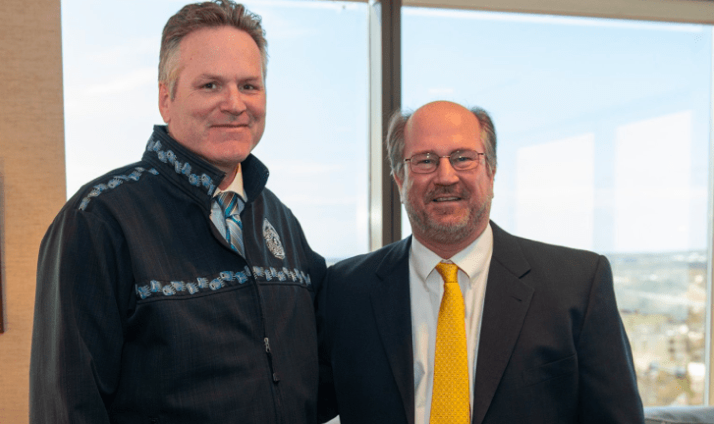
Alaska Attorney General Kevin Clarkson has until Monday to announce his decision on whether the recall petition to remove Gov. Michael Dunleavy can move ahead to the second phase of signature gathering.
His decision will be to say whether the group wishing to recall the governor has adequate grounds: Misconduct, incompetence, or failure to perform duties prescribed by law.
The Recall Dunleavy group says the governor failed to perform his duties when he didn’t appoint a judge to the Palmer District Court seat within the 45 days mandated by law. Dunleavy was engaged in making the appointment, and was negotiating with the Alaska Judicial Council over their nominees. He appointed that post late, but not before it was vacated by the retiring judge.
The group also says that the Dunleavy Administration made an error in a budget decision. That error was corrected quickly, but the group says it is evidence of incompetence.
Finally, the Recall Dunleavy group says the Governor’s Office used State resources to push partisan ads on Facebook. Those ads were actually targeted at legislators who were opposing the governor’s budget policies, but whether they were partisan in nature will be up to the courts to decide.
All of these are fig leaf reasons, critics say, to mask the real discontent with the governor for cutting the budget. In its own words on its Recall Dunleavy website, the group admits as much:
“His brief time as governor has brought us an atmosphere of fear and distress, as people worry about whether they will be able to care for special-needs children or whether they will lose their jobs, their homes, and their ability to live in Alaska.
“We cannot allow a governor who doesn’t understand the concept of the separation of powers to remain in power. He cannot be allowed to attack the judiciary because courts make decisions he doesn’t like. He cannot be allowed to keep the legislature from upholding its constitutional responsibilities to fund programs that provide for the health, education, and well-being of Alaska’s people.”
In other words, it is really about things like cutting the court’s funding and shifting that money over to pay for court-ordered abortions.
This reason, along with the actual stated reason in the recall petition itself concerning a delay in appointing a judge, put the judges in an awkward position. They do, in fact, have a dog in the fight because the governor has made decisions about their budget — decisions that Alaska Supreme Court Justice Joel Bolger has already said on the record were adverse to the courts, and he asked the Legislature to reverse the governor’s decisions.
History gives no particular hint about how the judges would rule.
A recall campaign against a sitting governor in Alaska last occurred in 1992, when a group formed to recall Gov. Wally Hickel. The Department of Law and Director of the Division of Elections certified the application on Aug. 26, 1992, against the advice of outside counsel.
Lawsuits were filed in Juneau and Fairbanks Superior Courts on Aug. 27, 1992 and Sept. 25, 1992.
On Sept. 5, a judge instructed the director of the Division of Elections to cease petition activity. One year later, on Sept. 14, 1993, the Fairbanks Superior Court determined that certain ground for recall were not legally sufficient, while other grounds were, but overall the grounds were insufficient. The matter died.
[Read: A list of all the recall outcomes in Alaska, chronologically]
If Clarkson approves the recall petition language, the Recall Dunleavy group will be able to start collecting its 71,252 signatures needed to force the matter into a special election. The group has already shown its political clout by collecting an initial 49,006 signatures, which it submitted to the Division of Elections on Sept. 4. The Alaska Democratic Party is pushing hard to help the Recall Dunleavy group, and will be a staunch ally if there is a legal battle.
The Attorney General is in a slightly awkward position, as both legal counsel to the governor and the top attorney for the people of Alaska.
If he rules that the recall rationale is sound enough to take to the voters, then he would not be able to represent the governor, who would probably challenge that ruling, and have to rely on a private attorney to do so.
But Clarkson is more likely to rule that the recall campaign has not provided sufficient grounds; he’ll see it in favor of defending elections and not creating a condition where elections are immediately overturned by the disgruntled through a never-ending churn of costly court challenges.
If he turns them down, that would trigger a lawsuit being filed at Alaska Superior Court by the Recall Dunleavy group, which has already promised it will challenge the ruling.
After the decision is announced on Monday by Clarkson, Scott Kendall, Alaskans can anticipate that an immediate news release will come out from the Recall Dunleavy group, which is being funded by Ed Rasmuson. The details of the challenge will likely come at a press conference that Scott Kendall and his group will hold, for maximum exposure in the media.
Kendall, who is the group’s legal counsel and who was chief of staff to the disgraced Gov. Bill Walker, will probably file the appeal in Anchorage Superior Court. The hearings could take place within weeks, and the decision from the Superior Court judge would be appealed to the Alaska Supreme Court by whichever side loses.
STAND TALL WITH MIKE GROUP FORMS
Meanwhile, the Stand Tall With Mike group is beginning to get organized and is raising funds for the defense of the governor — eight full months after the recall group started its activities.
“Right now in Alaska, Mike Dunleavy’s opponents have near total control of the airwaves and the news most Alaskans are seeing, hearing, and reading. Your generous donation will allow us to get the other side of the story out. This will lead to increased public support for Mike and his conservative agenda that Alaska so desperately needs,” the Stand Tall With Mike website says.


