
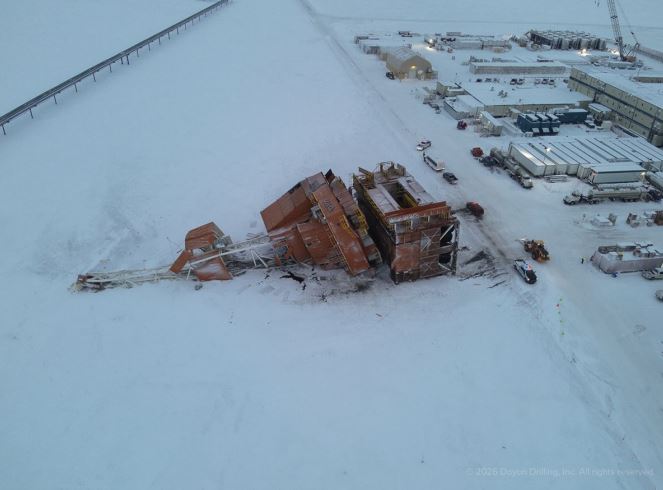
The toppling of Doyon Drilling Rig 26 on January 23, 2026, during transport on a North Slope gravel road has temporarily disrupted ConocoPhillips’ operations, but highlights the company’s commitment to innovative, responsible resource development amid ongoing legal challenges. The massive rig, known as “The Beast,” ignited a contained fire after collapsing in unseasonably warm 30-degree temperatures. All personnel escaped serious injury, with eight individuals treated and released, and no damage to pipelines or communities reported. The incident, just miles from Nuiqsut, landed 50 feet from gas lines, prompting an environmental assessment under Unified Command led by Doyon Drilling.
Engineered for Arctic extremes, Doyon 26 features a 165-foot cantilever mast, 1.3 million-pound hook load, and 3,000 hp drawworks, with a modular design of five support modules and a two-piece subbase for ice-road mobility. This enables extended-reach drilling (ERD) to tap 154 square miles from a 14-acre pad, as seen in the 2022 Fiord West Kuparuk record well of 35,526 feet.
The outage—limited to the derrick subbase, allowing potential modular rebuild—could delay projects like Willow, but Conoco has pivoted to Doyon 142 for exploration. By comparison to another massive ERD land rig, Russia’s Sakhalin-1 Yastreb rig, a 230-foot seismic-resistant giant with 1.5 million-pound capacity and world-record ERD of over 37,000 feet horizontal, Doyon 26 showcases transportability over scale. The modular design between the Doyon 26 and Doyon 142 provides a distinct advantage to enable a quicker turnaround to resume development drilling.
Amid this, a U.S. District Court ruling allowed Conoco’s winter exploration to proceed despite a lawsuit by groups including Earthjustice, which argues rushed approvals harm wildlife and subsistence in areas like Teshekpuk Lake. Earthjustice, a nonprofit environmental law firm with a stated goal to end the extraction and burning of fossil fuels, contrasts Conoco’s prosperity-focused development by challenging permits to ensure legal compliance and environmental safeguards.
“This project opens a new era we call ‘growth without gravel’ where we can use extended reach technology to access 60 percent more acreage from a single pad, dramatically reducing our footprint,” said Erec Isaacson, president of ConocoPhillips Alaska.
This remains a developing story.


