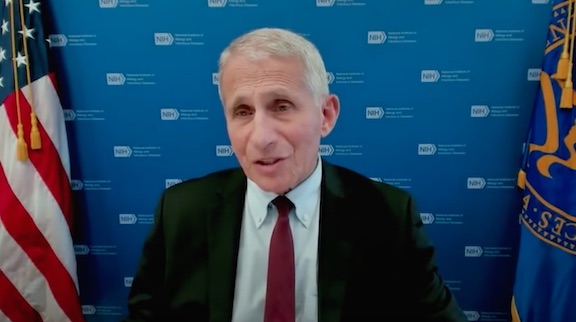
In an interview with ABC News, Dr. Anthony Fauci, the nation’s chief infectious disease officer, said it was not his fault that schools closed during the Covid pandemic. It’s a message he’s been trying to get out during his last few weeks on the job, as he plans to resign at the end of the year. He did admit, however, that the school closures have had some negative effects on children.
Fauci, who heads up the National Institute of Allergy and Infectious Diseases and who has been the nation’s top adviser on Covid policy during the Trump and Biden Administrations, was asked by an ABC News reporter if it was a mistake for schools to be closed for as long as they were in 2020 and 2021. A national report shows that since then, reading scores for 9-year-olds fell five points on average, the largest drop in more than 30 years. Math scores fell seven points in 2022, compared to 2020. Average math scores fell seven points in 2022 compared to scores in 2020, the first drop ever recorded by the Department of Education, according to a study released last month.
“I don’t want to use the word ‘mistake,’ … because if I do, it gets taken out of the context that you’re asking me the question on,” Fauci replied. “We should realize, and have realized, that there will be deleterious collateral consequences when you do something like that.”
Fauci went on to say that he never said the schools should close down and that he always advised officials must do “everything we can to keep the schools open. No one plays that clip. They always say ‘Fauci was responsible for closing schools.’ I had nothing to do [with it]. I mean, let’s get down to the facts,” said Fauci.
In July of 2020, Fauci told the American Federation of Teachers union that there could not be a one-size-fits-all solution for schools to reopen.
“What might be good in one county, one region, one city, one state, might not be the same for all …. The default situation should be that we should try— to the best of our ability—to get the children back to school,” he said then, acknowledging the “unintended ripple effects” for families, including how the social isolation caused by school closings had been hard particularly on children.
At the same time, he advised that “paramount among all of this is the safety, the health and the welfare of the children, of the teachers, of the school personnel and … the families of those people.”
Because many young people are asymptomatic, “people will not know they are infected,” said Fauci in 2020, and that schools would need to have the availability of testing for children and contact tracing to respond quickly when someone becomes sick.
School closures were the result of state and local policies, and also union pressure, and were not directed by the White House. However, local officials leaned on the direction and clues given by experts like Fauci and the heads of the Centers for Disease Control and Prevention, Robert Redfield under President Donald J. Trump and Rochelle P. Walensky under President Joe Biden.