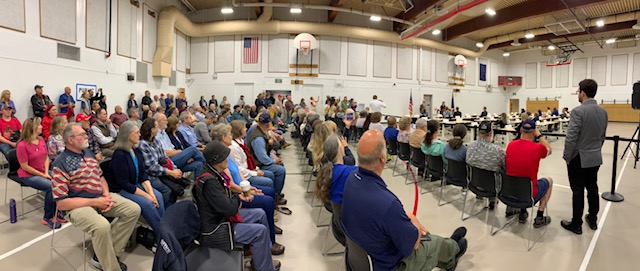
As the legislators walked into the Wasilla Middle School gymnasium to take their seats on Friday morning, the audience stood and cheered. And cheered. And cheered.
To the 200 conservatives who had come to support the 18 lawmakers who stayed in Wasilla rather than flying to Juneau, these elected Alaskans were heroes, and they received the heroes’ welcome.
On Friday, unlike Wednesday, security was beefed up in the gymnasium, with Wasilla police at every door and legislative staffers standing on watch.
Wednesday’s spectacle of the takeover of the meeting by unruly radicals didn’t repeat — no protesters were present on Friday.
Instead, every seat was filled with a supporter of the legislators who stayed in Wasilla. It was standing room only. The area for the legislators was cordoned off, and signs warned that no firearms or backpacks would be allowed — this was a middle school, after all.
[Read: Raging protesters take over legislative meeting in Wasilla]
The prayer was not disrupted on Friday, as it had been on Wednesday. The Pledge of Allegiance preceded a vocal performance by Adele Morgan of the Alaska Flag Song, and everyone cheered before taking their seats to observe democracy in action.
Sen. Mia Costello stood at the podium and announced the obvious: There was no quorum, but she reiterated that those present believed that the Special Session was to take place in Wasilla, where the governor had called it, which is why they all had determined to follow the law.
She said that negotiations were continuing with the governor and the two thirds of the Legislature that has been meeting in Juneau.
Meanwhile, in Juneau, both the Senate and House held separate technical sessions, with nine House members present and four Senate members present.
Their efforts to override the governor’s vetoes had failed and most members had left Juneau for the weekend. The Senate and House are adjourned until Wednesday.
The Democrat-led Majority in the House and the Senate leadership issued a press release on Friday that listed fall-out expected from the vetoes. They predicted dire consequences, such as:
- The University of Alaska will meet Monday to start down the path of declaring financial exigency, effectively a bankruptcy proceeding, which could lead to hundreds of job losses, campus closures, and rushed liquidation of assets. Exact steps to deal with the $135 million reduction need to be identified by July 30.
- Scholarships were abruptly revoked from 12,000 of the most qualified students in the UA system, many of whom lack resources to attend college otherwise.
- Alaska’s most financially vulnerable elders who rely on Senior Benefits Program payments are doing without food and medication: 1,742 people with $942 monthly income or less lost out on a $250 payment as a result of the vetoes.
- The Brother Francis Shelter in Anchorage is ending its day service, which provides case management and a clothing room for homeless people.
- Nonprofit grant recipients are starved of resources, leaving service providers facing dire choices. Hospice of Anchorage, for example, is unable to bathe and feed dying people.
- In mid-August, DOT will be forced to stop work on some highway projects already in progress during summer construction season, including on the Sterling Highway.
- Without a compromise, there will be no Power Cost Equalization benefits this winter, dramatically increasing energy prices on rural residents.
The $444 million cut represents a 12.5 percent cut to the budget presented by Gov. Bill Walker, which had grown larger than the spending plan of the previous year.
Gov. Dunleavy has said that budgets must come into alignment with available revenues, and that Alaskans should get the full Permanent Fund dividend they are promised under Alaska law.