
It was a week in which Alaska Democrats in Juneau were in an unserious mood, but it was a week to remember in Juneau, as its main feature was foot-stomping.
Several Democrat House of Representative members helped facilitate and encourage truancy on Thursday, encouraging dozens of local high school students to skip school and march to the Alaska Capitol, where they would shout, chant, bang on doors, and even surrounded one female legislator, blocking her from being able to leave a committee room for 40 minutes.
Some of the legislators had even skipped their own committee meetings across town to Juneau-Douglas High School to march with the students to the Capitol, where they noisily advocated for an increase to the permanent formula for funding school districts.
The takeover of the Capitol was “what democracy looks like,” said House Minority Leader Cal Schrage, as students crowded into committee rooms and halls, making them impassible and setting up a safety hazard.
The House ended the week on an even stranger note on the House floor: Viagra for bush rats for the purpose of masturbation.
During debate over Senate Bill 45, establishing “direct care practice” health care services, several amendments were made on the House floor to dramatically alter health care in Alaska by forcing doctors to do things they might not want to do.
Rep. Andrew Gray tried to get his colleagues to vote for the establishment of a single-payer health care system in Alaska, which would socialize medicine.
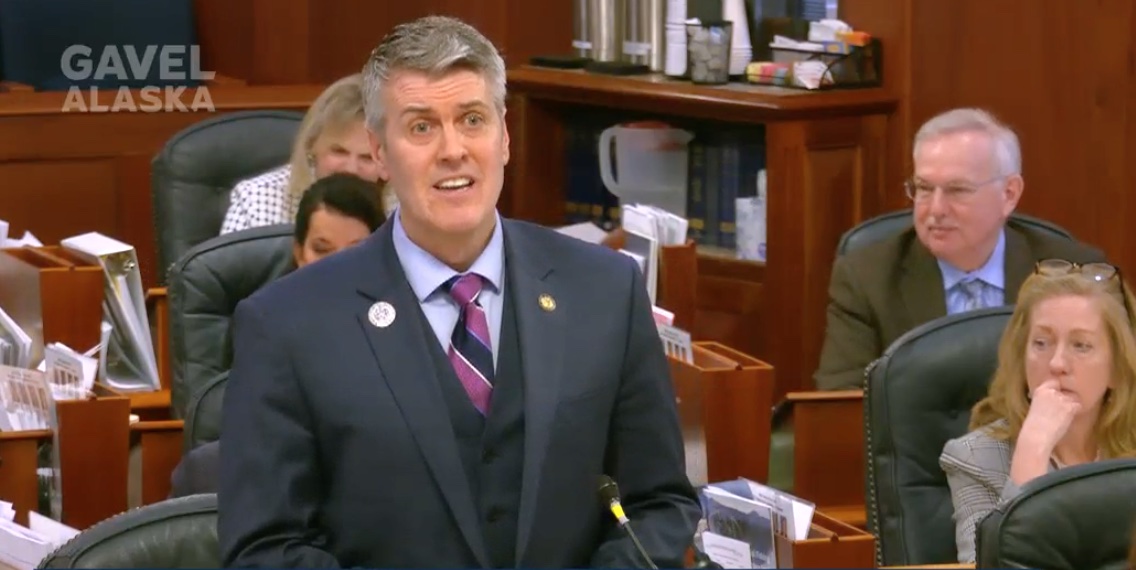
He gave a passionate floor speech, in which he excoriated the medical care system, insurance companies, and doctors themselves, as he called for the socialized model. Then he went after Republicans, and had to be stopped short with a point of order. And then another point of order. And a third one. He was out of control.
“Republican policies got us into this mess and I would like Republican policies to get us out,” Rep. Gray said. He wants all doctors to accept any and all patients, and be paid by the state. Doctors could not reject any patients in what would be essentially universal Medicaid in Alaska. “We need to blow up the Alaska health care system,” Gray said, using incendiary language. “What do we have to lose?”
For doctors, it would be a loss of freedom, having state bureaucrats tell them that they must do all kinds of things they might not want to do, making them de facto employees at the will of the government.
Gray said his amendment would cost the State of Alaska about $7 billion a year, but there was no researched fiscal note attached to amendment #15, which consisted of just seven words. Ultimately, the amendment was ruled out of order.
Amendment 16 was offered by Rep. Jennie Armstrong, who was, as she is known to do, inserting sexual orientation, gender identity, gender expression (LGBTQ) language into the bill, forcing doctors to treat patients even if the doctors don’t feel qualified. The amendment could expose the doctors to legal peril if, for example, they chose not to prescribe hormones to teens for gender transitions.
That gave Gray another chance to grandstand. He talked about his own experience as a physician’s assistant and told a story about working in a clinic:
“We had older, single men who lived in remote Alaska and out in the middle of nowhere by themselves … She [a doctor] refused to prescribe Viagra to those patients because she believed that they might use it for masturbation.”
Gray said that he would then prescribe the medication if he felt it was medically suitable, supplanting his own judgment as a physician’s assistant over a doctor’s medical judgment.
SB 45 allows patients and doctors or health care providers to have direct-compensation relationships outside of insurance intermediaries. Typically, the direct care practice operates on patient membership fees and does not rely on insurance reimbursements. A direct health care agreement is a contract between a patient and doctor that involves a flat, monthly fee in exchange for routine visits and other services. These are sometimes called “concierge doctors” and the doctors often cater to those who are not in government-sponsored health care plans, but who have the money to pay for the membership fees.
As the government has made medical care more complicated, less accessible, and more expensive throughout the country, some doctors are choosing to provide these membership plans as a way to decrease their own stress level and increase their ability to care for people without an insurance company telling them what they can and cannot do. In America today, it’s often the insurance companies that actually make the decision about the level of care a person can receive; the same holds true for those on Medicaid, Obamacare, or Medicare — the government calls the tune on care.
Democrats in the House had tried amendments that would have upended the bill entirely, forcing doctors to see a mandatory percentage of patients who are on Medicaid and Medicare.
The bill is scheduled for the House floor once more on April 8 for a vote on final passage — without the Viagra clause.


