

By DAVID BOYLE
For years, Mississippi was near the bottom when it came to teaching its children how to read.
The other southern states would say, “Thank God for Mississippi,” because they could rely on the fact that no matter how bad their education systems were, Mississippi would always be at the bottom.
At least they were not as bad as Mississippi when it came to reading.
Mississippi knew this and decided to transform its educational system. In the last 10 years, all its energy has been placed into getting all children to read at the third-grade level by the time they complete third grade.
The results are astounding. On the National Assessment of Educational Progress test, Mississippi is soaring in national rankings. In the 2022 NAEP tests its low-income 4th grade students ranked second in the Nation.
Meanwhile, Alaska was dead last.
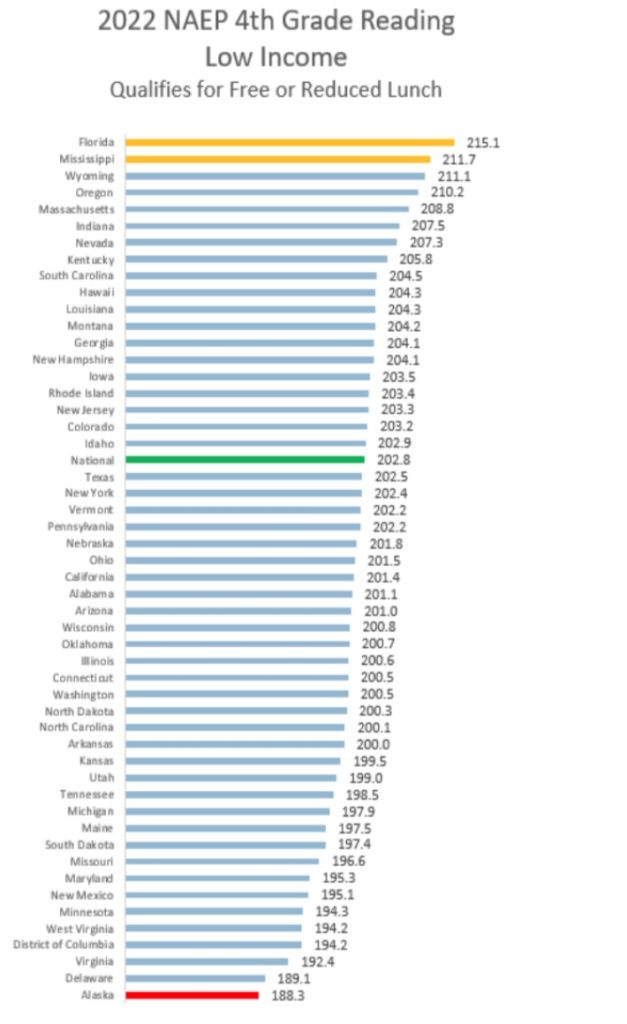
Was this accomplished by lower classroom sizes? By social promotion? After all, Mississippi had a lot to overcome. Mississippi ranks dead last in child poverty. It was near the bottom of the NAEP tests too.

No, it placed its energy into getting all children to read.
Now among low-income students, Mississippi fourth-graders are tied for best in reading and rank second in math!
Poverty isn’t the reason kids can’t learn. Mississippi proves that. Poor kids can learn just as well as other kids!
Here is how Mississippi improved its NAEP ranking for low-income 4th grade students since it implemented its reading program:
| 2013 | 2015 | 2017 | 2019 | 2022 | |
| Mississippi | 45 | 38 | 28 | 3 | 2 |
| Alaska | 51 | 51 | 51 | 51 | 51 |
Note that Alaska ranked dead last for low-income fourth-grade students for five consecutive years.
One of the most important elements of the program is the third-grade reading test. If a child does not pass this test, he/she is held back—no social promotion.
Would this stigmatize children? No!
It put accountability into the program–everyone, parents, teachers, and kids were energized.
And about 9% of third-graders fail the test in their third and final attempt.
Here’s the very interesting part: Those held back did not have any negative outcomes. In fact, they did much better several years later on sixth-grade English tests compared with those who had just missed being held back.
It seems as if they were incentivized to succeed.
The state did not reduce class sizes as many in the Alaska education community support. Instead, it spent the money on teacher coaching and tutoring.
And it had nothing to do with the color of a student’s skin or a family’s income level.
In the 2018-19 school year, 48% of students in public schools were black and 44% were white. And 75% were low income.
So, regardless of race, ethnic group, and income level, Mississippi has shown the nation that all kids can learn.
Let’s not focus on diversity, equity, sexual orientation, and restorative justice. Instead let’s focus on teaching kids how to read—at least by the fourth grade.
It may take many years to note the success of Alaska’s new reading program. The Alaska Reads Act, modeled after the Mississippi program, has given us the tools. Now let’s get it done.
This is the core business of our K-12 education system.
And Thank God for Mississippi! It has shown us the way.
David Boyle is the Must Read Alaska education writer.



