
By DANIEL SMITH
Several members of Anchorage Assembly and the Municipal Clerk practice what can best be called the “illusion of transparency and accountability.” Now they want even more control of our elections.
Currently the chair of the Anchorage Assembly and several assembly members are pursuing the events centered around the policy of thumb drive usage during the tabulation of votes in municipal elections.
There is no debate about whether or not the policy is a good one or not. It is good. The pursuit of information through the use of subpoena powers, which the Assembly may or may not actually have, is focused on the creation of the policy and how it was published.
In the case of one subpoena, only 25 hours existed between the time the subpoena was served and the time the subpoenaed election observer was ordered to appear, produce documents, and testify — or else suffer punishment of a financial and judicial nature.
The highest priority of the Assembly chair and several assembly members at this time is to establish a connection between the publishing of a very good policy and members of the Bronson administration through some sort of alleged and coordinated effort to overthrow the April 2023 municipal election.
Once the Assembly has either failed to prove or finds evidence to prove their theory, we are assured that the business of making our elections transparent and accountable will take center stage.
There are several areas where transparency and accountability can be improved immediately without the inquisition-flavored investigation going on in the Anchorage Assembly work session.
In the case of thumb drive (data transfer device), security disasters at the Election Center, you must first look at the April 2022 election.
In that election, the Municipal Clerk called in an employee from the software vendor to delete information from the server — during the election. We are told by the clerk that this was in order to remove some John Doe, Limited Road Service Area candidates mistakenly created during a logic and accuracy test conducted earlier.
The software employee was allowed into the locked cage that contains the server and was allowed to insert a thumb drive in order to make the requested deletions. The problem, of course, is that no person fully knows what was on that thumb drive or what else may have been deleted from or added to the server, either knowingly or unknowingly.
In other words there was no transparency. Election observers were not notified in advance that this actual security breech would take place. As far as anyone knows, there were no repercussions or reprimands from the Assembly to the clerk who is the Assembly’s employee. Election observers filed complaints, but for this event there was no accountability.
The Anchorage Assembly adopted the mail-in method of voting five years ago. With the practice of mail in voting came centralized tabulation of the votes. Ballots are run through three scanners at the Election Center. Votes are recorded in a central single server that is reported to be unconnected to the internet or “air gapped” for obvious security reasons.
Unfortunately, the air gap is violated routinely by the Clerk who runs the Election Center. She permits the use of a thumb drive to transfer vote tabulations to the municipal website for publication on election day and every day thereafter for about ten days total. Every time the thumb drive is inserted into the Municipal computer system there exists the opportunity for malware and viruses to be picked up and either knowingly or unknowingly, transferred to the server where vote tabulations are stored.
There is reportedly only one sweep or check for malware and viruses made each year to the one thumb drive that has been used to transfer vote tabulations. The one and only thumb drive has been in use since 2018 when mail in voting was brought to Anchorage without a vote of the people.
This should concern every Anchorage voter and was brought to the attention of the clerk and election officials through the complaint process by election observers. The complaint was not addressed to the satisfaction of observers and was elevated to the level of the Election Commission.
Regardless of how the thumb drive policy was created and published, it is almost universally accepted as good policy to check for viruses and malware before and each time the data transfer device (thumb drive) is inserted into the server. The peoples’ voice exists in electronic form within that server and can be modified by harmful electronic instructions.
At the public Session of Canvass conducted by the Election Commission, this risk was acknowledged by Commissioner Mead Treadwell. He offered the following analogy, “This is why we don’t use the same needle twice!”
The air gap provides an illusion of security, when it is routinely violated and breeched. No one is held accountable for this breech of security. The Anchorage Assembly has not addressed an obvious problem and could be seen to be at fault for the use of the thumb drive as practiced by their employee, the clerk.
Another concern expressed by observers is the management of voter roll information and selective ballot package mailing practices by the clerk and the election administrator.
Currently there is an outstanding Public Records Request No. 2023-24.
Unknown to the public is the identity of 1,730 voters who had their ballots returned to Election Center as undeliverable due to being temporarily away, having a damaged envelope or being from a previous election.
These 1,730 returned ballots were not reported to the State as undeliverable. Their undeliverable status was determined after certification of observers had expired on April 25 when the election was certified by the Assembly. A list of these undeliverable ballots was never created. It is understood the ballot packages have been diverted from the shredder and are available as a photo copy only, to the public at a price.
The physical presence of an observer or a member of the public at the time all 12,486 undeliverable ballots were run through the sorter would not have resulted in discovery of the phantom 1,730 voter identities.
Why should we care about 1,730 phantom ballot packages? Because observers cannot determine the total number of registered voters who were mailed a ballot in the 2023 MOA election, and to whom ballots were mailed.
A limited chronology of the 2023 Municipal Election regarding mailed ballots is outlined as follows:
- December 30, 2022 – K&H Integrated Print Solutions, Invoice #064171
201, 029 – Printed and mailed ballot packages
- January 31, 2023 – K&H Integrated Print Solutions, Invoice #064018
199,421 – Postcards advertising the election printed/mailed.
- March 5, 2023 – State of Alaska voter roll list provided to Observer, verified by MOA Clerk
235, 564 – active registered voters in Anchorage
- March 17, 2023 – Voters Receiving Ballots (VRB) list from Clerk
201,462 – Ballot packages sent – Difference of 34,102 between State Active Registered voter list and Clerk’s VRB list. Not mailing to all registered voters is allowed by AMC 28.40.020C. That practice appears to be repugnant to the State Constitution Article 1, Section 1, Inherent Rights – “…all persons are equal and entitled to equal rights and opportunities…”
More importantly, the clerk would later state at the public session of canvass on April 20, 2023, “This list (VRB) has somewhere around 1,800 duplicate names and/or bad addresses!”
The Clerk was asked by observers for the list of 34,102 not mailed a ballot.
- April 13, 2023 – All Anchorage Eligible Voters list – by Ralph Duerre, Liaison
199,514 –RG – Registered Voters
26,642 – UN – Undeliverable
9,257 – LM – List Maintenance
93 – LU – List Maintenance Undeliverable
57 – ID – ID Required
235,563 – Total
This report was offered as a response to the request for a list of voters who were not sent a ballot. It is impossible to discern which voters did not get mailed a ballot from this report. This report was provided almost one month after the request was made. This report serves to only obfuscate and deny the information requested.
- April 14, 2023 – A process question was posed to the clerk and election administrator. Noting a
difference between VRB and RG voters, how were additional 1,948 voters selected and
who were they?
- April 17, 2023 – Clerks answer: Can’t tell you due to critical infrastructure risk.
AMC 3.90.040R
Also: “That procedure has a private outside contractors watermark on it and is
proprietary.” Gayle Gerk, liaison.
In other words, a private outside contractor has access to the process by which voters are selected to receive a ballot that observers and the public does not have. For all observers can tell, the private outside contractor may be the ones creating the list of voters who get sent a ballot in our selective system of sending out ballot packages.
There is problem with having private outside contractors involved with your election process at this level. Contractors do not swear an oath of office because they hold no elected office.
- April 20, 2023 – Election Commission Meeting
- April 25, 2023 – Assembly Certification
199,683 Ballot Packages were mailed on 3/14/2023, from Assembly memorandum, AM 324-2023, from the Clerk’s office to the Anchorage Assembly
- May 1, 2023 – Observers were granted an extra Election Commission Meeting – Observers requested information from March 17, 2023 was received on a thumb drive from clerk. There were two lists of voters on that thumb drive. One list contained 35,974 voters who were excluded (not mailed a ballot). That makes 199,590 who were mailed a ballot. (235,564 – 35,974 = 199,590) or 76 less than had good addresses (RG) and 93 less than reported to the assembly for their certification on April 25th, 2023. UNLESS… you count the second list provided on the same thumb drive from the clerk, which contains 8,091 additional voters who did not receive a ballot bringing the total to 44,065 voters not mailed a ballot and results in 191,499 who were mailed a ballot or 8,015 less than had good addresses (RG) and 8,184 less than reported to the assembly for their certification on April 25th, 2023.
Similarly there is no clarity on voter turnout. From AM 324-2023 “voter turnout in 2023 was OVER 65,853voters or 27.96% casting ballots.” How many over? The same memo indicates 131,531 ballots were cast. Since there were potentially 2 ballots cast or 2 pages in this election, cast by each voter that would equate to a 65,765.5 voter turnout. That is actually 87.5 less voters than AM 324-2023 asserts. In any case 27-28% voter turnout is contrary to the promise that mail in voting would increase voter turnout.
So to be perfectly honest, there is not clarity whatsoever as to how many registered voters were sent a ballot, how they were selected or how many voted. And of equal importance to note, all of this confusion around who gets mailed a ballot is only a problem with mail in voting. This should concern every resident of Anchorage.
The people need clarity when it comes to their election process. The people should not have to pay extra to their trustees (elected officials) and appointed officials for transparency and accountability.
The State of Alaska provides voter roll information to the Municipality for use in its elections. The State is federally required to assign a unique identifier number, known as an ascension number, to each voter. This is different than the voter ID number which is private. It has been documented that the Municipality receives the voter roll information from the State which includes the ascension number. Anyone with $20 can receive the same list from the State.
It was discovered at the last Elections and Ethics Committee meeting that an effort is underway by the Clerk and the Assembly chairman to create a new and separate unique identifier number for Anchorage voters. Why would this be necessary if a unique identifier number is already provided by the State?
The purpose of the ascension number is to keep information organized and trackable. Ascension numbers allow data to be compared and aggregated by referencing a unique number instead of a name. Researching voter information by name is not accurate or reliable. As one example, John_ Doe is a different voter than John_ _ Doe even though they have the same address in Excel spreadsheets. John Doe gets confused with John Doe II as another example. A second unique identifier number only serves to confuse and obfuscate observers and prevent public oversight of Election Officials decisions regarding the selective distribution of ballot packages.
The Municipality’s Elections Center provides many different reports to observers. Curiously, the ascension number for each voter is missing from most of those reports.
A contest of the 2023 Anchorage general election was filed by 11 Anchorage voters on May 4, 2023. The contest raised issues regarding ballot package mail out practices by the Clerk’s office, failure to maintain an accurate “voters receiving ballots list” and removal of ascension numbers assigned to each voters name in the State of Alaska Division of Election database.
Each Assembly member received the Supplement to Petitioners’ Election Contest by email. Dean Gates, Assembly Counsel, was the point of contact for the MOA. The Supplement was received in a timely fashion as established by Mr. Gates.
Whether intentionally or unintentionally, the supplement authored by Joseph Miller, counsel for the petitioners, was not included in the printed Assembly agenda intended for public consumption. At the elections ontest hearing Assembly woman Meg Zaletel held up the initial one page Notice of Election Contest proclaiming this is all there is and it’s doesn’t warrant further consideration or a hearing of the merits of the contest, because this is all there is.
Attached is the Joseph Miller supplement:
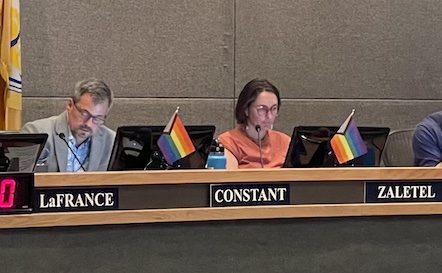
And now the Assembly is angling for more control of our elections. In his monologue as the chair of the Assembly and producer of subpoenas, Christopher Constant has alluded to one possible outcome of the investigations the Assembly has initiated. Constant stated that creation of a separate Information Technology Department under the Assembly might be what is needed.
In the opinion of many Anchorage voters, more control of the election process and facilities by the Anchorage Assembly is not warranted. The Assembly has not proven it has the capability or the will to manage the election process as administered by the Clerk for maximum transparency and accountability.
There are outstanding exceptional individuals on the Anchorage Assembly. In reference to the thumb drive policy, Assemblyman Kevin Cross asked the logical question. “If we have a policy that is reasonable, beneficial, and has merit why wouldn’t you want to implement it?” Assemblyman Randy Sulte stated, “Anytime you face question (in the election process) let’s make it more transparent. We are going to bore you with transparency to restore faith on all sides in our election process.”
Faith in our election process has most definitely been lost. Look at our weak voter turnout. Multiple generations are choosing not to vote. “It’s all rigged anyway,” they claim.
If implementing good policy was the goal, it could have started many months ago. Instead, a different agenda, one which appears as an attempt to punish political foes, has risen to the top of the Assembly’s “to do” list.
The Anchorage Assembly should not have its own Information Technology Department. It has not earned the trust and faith of Anchorage voters as evidenced by its actions, its lack of transparency, its quest for less transparency, its lack of accountability, and its pursuit of political opponents in the name of transparency.
Words will not be sufficient to restore faith in Anchorage elections. It will take actions. The only actions that will restore faith in Anchorage elections are the abolishment of machine counted ballots and mail-in elections. We must return to one day of voting, in person with picture identification where currency grade paper ballots are counted by poll workers, in the presence of observers, at the precinct where votes are cast. There is no other way.


