
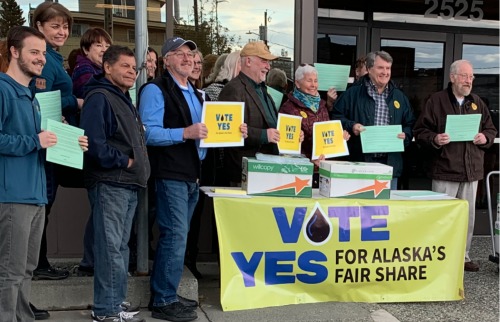
WHAT WILL THE ‘OUR FAIR SHARE’ OIL TAXERS DO NOW?
At one point during futures trading today, U.S. crude prices dropped more than 100 percent — into negative numbers.
The drop for West Texas Intermediate crude for contracts with May delivery ended at a minus $37.63. This means the traders had to pay someone to take the oil from them.
Tuesday is the last day for traders to buy May contracts. Prices are predicted to bounce back modestly by Wednesday. The June futures’ contracts are a bit above above $20, so the dire drop today isn’t expected to stick around.
But prices won’t rebound to profitability for many companies, oil analysts say. Not for some time, at least.
Alaska North Slope crude prices are announced on a four-day delay, so they look artificially higher than they actually are. Analysts expect them to drop in a day or two, and then bounce back into the $20s.
Still, for the major oil companies, profits aren’t taken until expenses are covered, and the cost of producing and shipping a barrel of oil in Alaska is about $40. They are not making money in Alaska and haven’t for some time.
The immediate risk for Alaska is whether enough tankers can be found to even take delivery of oil at the Valdez terminal. ConocoPhillips and BP have their own tanker fleet, but Hilcorp does not, and in any case, there’s no place to take the oil on the West Coast.
If tankers can’t be booked and storage tanks are full — and this is worst case scenario — it could mean the Trans Alaska Pipeline System could shut down. That could mean the shuttering of wells in Prudhoe Bay, Kuparuk, Endicott, and older legacy fields.
Those legacy fields are the same ones the “Our Fair Share” oil tax initiative is aiming to extract $1 billion in taxes from. And Robin Brena, a law partner of former Gov. Bill Walker, has paid to have that ballot initiative go to a statewide ballot some time this year.
Brena can’t just put the toothpaste back in the tube on his oil tax ballot initiative. He’s got his 39,174 petition signatures, and he’s submitted them for certification. The certification is done. Now, it’s in the hands of the State Division of Elections to schedule for a ballot.
Brena will likely say its even more important for Alaska to have a minimum tax, because the State needs money. His initiative would double the minimum tax paid by the legacy field producers, the very ones that are losing money on every barrel they pump from the North Slope.

What will Brena and his fellow oil taxers do in this Year of the Oil Glut?
The Our Fair Share organization has been strangely quiet, and so have the Democrats like Sen. Bill Wielechowski, who have supported the extreme tax proposal.
The current best option for Brena is to hope that the courts rule his initiative illegal, since the signatures on the petition were gathered illegally and since the Resource Development Council has filed a lawsuit.
If it goes to the ballot this year, it’s going to lose, because most Alaskans understand how bad it would be to tax companies that are losing money in Alaska.


