

DEMOCRATS’ NOMINEES PAY BIG MONEY TO GET EVERY ‘THUMBS UP’
If you’re an Alaskan voter, Democrat nominees Alyse Galvin and Alan Gross have spent a boatload of money to be your friend on Facebook. With millions of dollars from Outside donors, the two have shoveled it right back to Menlo Park, California to boost ads to your Facebook newsfeed.
And what they want most is a “thumbs up” to indicate you saw it and you like them.
Galvin and Gross are running against Congressman Don Young and Sen. Dan Sullivan.
While all candidates use the social media platform to boost their views and persuade voters, Galvin and Gross have deluged their messaging to Alaskans’ Facebook feeds at a spend approaching $850,000. By the end of this week, it will likely top $900,000 for Facebook ads alone.
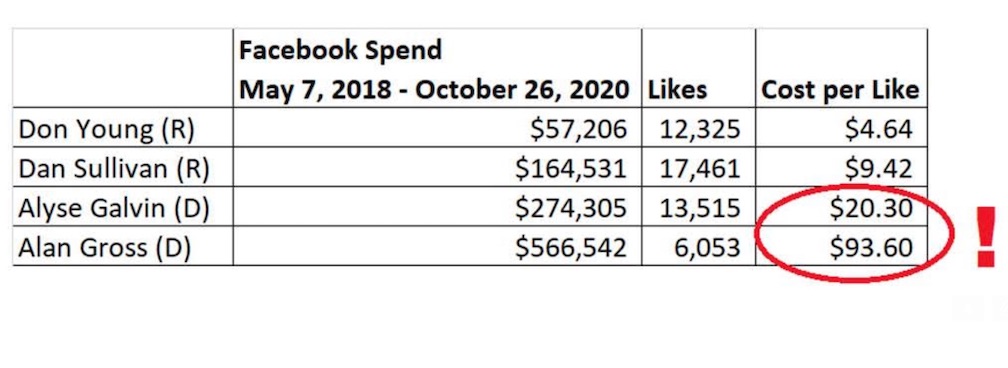
So far, it’s a cost of $20.30 per “like” for Galvin, and a whopping $93.60 per “like” for Gross.
Congressman Don Young’s campaign has not had to spend as much to get those thumbs up reactions — his cost is only $4.64 per “like.” He has slightly fewer “likes” than Galvin, but is spending far less than her. He’s been in office for decades, but in past years his campaigns haven’t focused as much on Facebook as it has this year.
Gross, who is taking on Sen. Sullivan, has a lot of Outside money burning a hole in his campaign pocket. But although he has spent $93.60 for every “thumbs up” he’s received on Facebook, he has the fewest likes of any of the four candidates — just 6,053 have given him a nod of approval. Maybe it’s because he killed a bear.
Sen. Sullivan has the most “likes” of the four candidates, and has spent one tenth of what Gross has spent on those boosted ads and posts.
Facebook has become a valuable property for candidates during this pandemic-ridden campaign cycle. There’s a lot less door knocking and a lot less baby-kissing going on, as candidates and voters keep their distance from each other.
Facebook is still a relatively new frontier for politics. This week the company put a halt to all new paid ads in the days leading up to and following the election in order to prevent false claims from being promulgated at the last minute. But savvy campaigns had already placed their ads before the Tuesday deadline, and are still running them at a feverish pace.
By the end of Tuesday, Nov. 3, the news feeds of Alaskans will return to something that resembles normal — recipes, vacations, and puppies — as all the political ads vanish into thin air.


