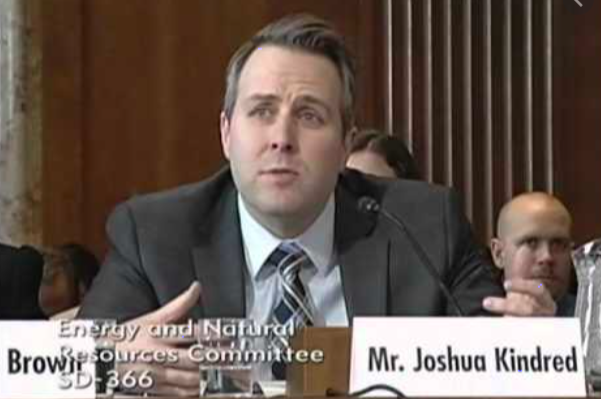
It all came down to sex and texts. Lots of texts. The Judicial Council of the Ninth Circuit has revealed the cause of U.S. District Judge Joshua Kindred’s sudden resignation in great and salacious detail. In the end, it was a forced resignation, the record shows. And it was so much more.
The complaint against Kindred was made two years ago. On May 23, the very detailed order and certification was made regarding the complaint of judicial misconduct against Kindred, who was appointed by former President Donald Trump to serve as one of three judges for the District of Alaska. The order and certification was made public on Monday, pursuant to 28 U.S.C. § 360(b) and in consultation with the Judicial Conference of the United States.
“The Order and Certification is the result of a thorough investigation conducted by a Special Committee appointed by Chief Circuit Judge Mary H. Murguia. In its Order and Certification, the Judicial Council concluded, among other things, that Judge Kindred engaged in misconduct by creating a hostile work environment for his law clerks and by having an inappropriately sexualized relationship with one of his law clerks both during her clerkship and after she became an Assistant United States Attorney. The former law clerk did not appear on any case before Judge Kindred while she was employed as an Assistant United States Attorney,” the court wrote.
In other words, Kindred had sexual relations with a law clerk who then became an Assistant U.S. Attorney. Such a person would appear before Kindred in court proceedings, creating a conflict of interest.
The order says:
“This judicial misconduct order arises from a complaint against Judge Joshua M. Kindred, District Judge of the United States District Court of Alaska. The Judicial Council adopts the findings of the Special Committee, which include a 105-page report along with 1,039 pages of exhibits. The Council concludes that:
- “(1) Judge Kindred created a hostile work environment for his law clerks by engaging in unwanted, offensive, and abusive conduct, and treating the law clerks in a demonstrably egregious and hostile manner.
- “(2) Judge Kindred engaged in misconduct by having an inappropriately sexualized relationship with one of his law clerks during her clerkship and shortly after her clerkship while she practiced as an Assistant United States Attorney in the District of Alaska.
- “(3) Judge Kindred did not retaliate against individuals for reporting his behavior or participating in the misconduct process.
- “(4) Throughout these proceedings, Judge Kindred lied to the Chief Judge, the Special Committee, and the Council. Although the evidence indicated that he had a sexual encounter with his former law clerk, Judge Kindred maintained that he “never had any sexual contact with [the law clerk].” Only when asked under oath during the Judicial Council meeting of April 5, 2024, did he admit that he had deliberately lied to the Special Committee.
- “In view of these findings and pursuant to 28 U.S.C. § 354(b)(2)(A), the Council certifies to the Judicial Conference of the United States that United States District Judge Joshua M. Kindred has engaged in conduct that might constitute one or more grounds for impeachment under Article II of the Constitution. It further orders that Judge Kindred be publicly reprimanded for the conduct described in this order that violates the Rules of the Judicial Conduct and Disability Act and the Code of Conduct for the United States Judges and is prejudicial to the effective and expeditious administration of the business of the courts and the administration of justice. It further requests that Judge Kindred resign voluntarily from the position of United States District Court Judge for the District of Alaska.
“In November 2022, Chief Judge Mary H. Murguia received information about possible misconduct by the Honorable Joshua M. Kindred, District Judge of the United States District Court of Alaska. Responding to this information, Chief Judge Murguia directed a limited inquiry under Rule 5 of the Rules for Judicial- Conduct and Judicial-Disability (“JC&D”) Proceedings.
“Upon determining that there was probable cause to believe that misconduct had occurred, on December 27, 2022, Chief Judge Murguia identified a misconduct complaint against Judge Kindred pursuant to 28 U.S.C. § 351(b) and JC&D Rule 5(a).1 The complaint stated that probable cause existed that Judge Kindred: (1) created a hostile work environment for one or more judicial employees by subjecting them to regular discussions about his personal life, including conversations of a sexual nature, and ostracized a judicial employee who raised concerns about this behavior; (2) engaged in unwanted physical sexual conduct with a former judicial employee and engaged in unwanted verbal sexual conduct with that employee both during and after her clerkship; and (3) told individuals with knowledge of his potential misconduct to remain silent. Judge Kindred was provided with an opportunity to respond to the complaint pursuant to JC&D Rule 11(f).2”
In his response, Judge Kindred offered his “unequivocal denials to these allegations,” the order explained, stating that he was “in possession of communications that [he] believe[s] clearly establish that these allegations are entirely without merit.”
Based on Judge Kindred’s response and the information gathered during the limited inquiry, Chief Judge Murguia determined that there were reasonably disputed issues that needed to be investigated by a Special Committee.
“The Committee’s investigation included a review of documents obtained from various witnesses and Judge Kindred, including text messages exchanged between Judge Kindred and his law clerks. These communications included more than 700 pages of text messages,” the order said.
“The Committee also interviewed witnesses, including Judge Kindred, current and former court staff, as well as several attorneys and individuals with knowledge relevant to the Committee’s investigation. In all, 21 individuals were interviewed in person or by video. All interviews included at least two interviewers. Of the 21 individuals interviewed, 13 were current or former judiciary employees, including nearly all of Judge Kindred’s current (at the time) and former law clerks.
“The Committee’s investigation revealed that Judge Kindred created a hostile chambers environment for his law clerks. Judge Kindred appeared to have no filter as to the topics he would discuss with the clerks. He discussed his past dating life, his romantic preferences, his sex life, the law clerks’ boyfriends and dating lives, his divorce, his interest in and communications with potential romantic or sexual partners, and his disparaging opinions of his colleagues. He also made disparaging comments about public and political figures.’
Some examples of the comments Kindred made include: “I was a huge hit at dinner Partly due to how much shit I talked about Sarah palin”; “I told a republican [state] senator to eat a dick”; and “[a senator] is worried that I can kick [] his ass.”
Kindred also routinely used language that was inappropriate in a professional setting, such as encouraging rating people based on “fuckability,” stating that he was not “hoe-ignorant,” or telling stories about “giving blow jobs in a hot tub.”
In the few instances where clerks came to Judge Kindred to discuss his inappropriate behavior, they were belittled or ostracized, and, in one instance, a clerk left the clerkship, the order continued.
“Though many of these comments occurred in chambers, Judge Kindred also sent his law clerks numerous text messages over an extended period. These text messages document the nature of Judge Kindred’s inappropriate interactions with his law clerks as these comments lacked any connection to the clerks’ legitimate job duties and were often sexual in nature. For instance, Judge Kindred made inappropriate and often vulgar comments to his law clerks such as “I’m just gonna pay for [a law clerk’s boyfriend’s] next ass tattoo”; “You’re going to the big leagues. You might be better in the butt leagues”; “I’ve never been invited to an orgy by a stranger before”; “I got asked out by a waitress which actually made me feel way less insecure about being single again, which was nice”; and “So it looks like I might need a judicial tinder profile.””
Sen. Dan Sullivan posted a comment expressing his disappointment, saying he was extremely disappointed.
“I will continue to work with the Alaska Federal Judicial Council for appointment of federal judges who understand Alaska’s unique role in our federal system. This is crucially important for our state. Federal judges have lifetime tenure – their decisions will positively or negatively impact Alaskans for decades. I remain focused on working with relevant stakeholders to appoint Alaska federal judges who interpret the law as Congress intended, not as special interest groups and unelected federal bureaucrats want it to be,” Sullivan said.
Read the entire investigation report here:
“In the Order and Certification, the Judicial Council publicly reprimanded and admonished Judge Kindred for his conduct, which violated the Judicial Conduct and Disability Act and the Code of Conduct for United States Judges. The Judicial Council also requested that Judge Kindred voluntarily resign and certified the matter to the Judicial Conference of the United States to consider impeachment,” the court wrote.
Judge Kindred resigned, effective Monday, July 8. The Judicial Conference of the United States will continue to consider the matter, including the certification with respect to impeachment, Murguia wrote, along with this statement:
“The Judiciary is entrusted to self-govern and, in doing so, must hold its federal judges to the highest standards of integrity and impartiality. We take judicial misconduct complaints seriously. When allegations arise, the Judiciary conducts a fair and thorough investigation that focuses on promoting a civil and respectful workplace, free of discrimination and harassment, and maintaining the integrity of the Judiciary. The process seeks to preserve the effective and expeditious administration of the business of the courts. In all respects, this was a serious and sensitive matter. I thank the witnesses who provided information, understanding fully how difficult that may have been. In my role as Chief, I will continue to ensure that our judges are held to the highest standards.”