
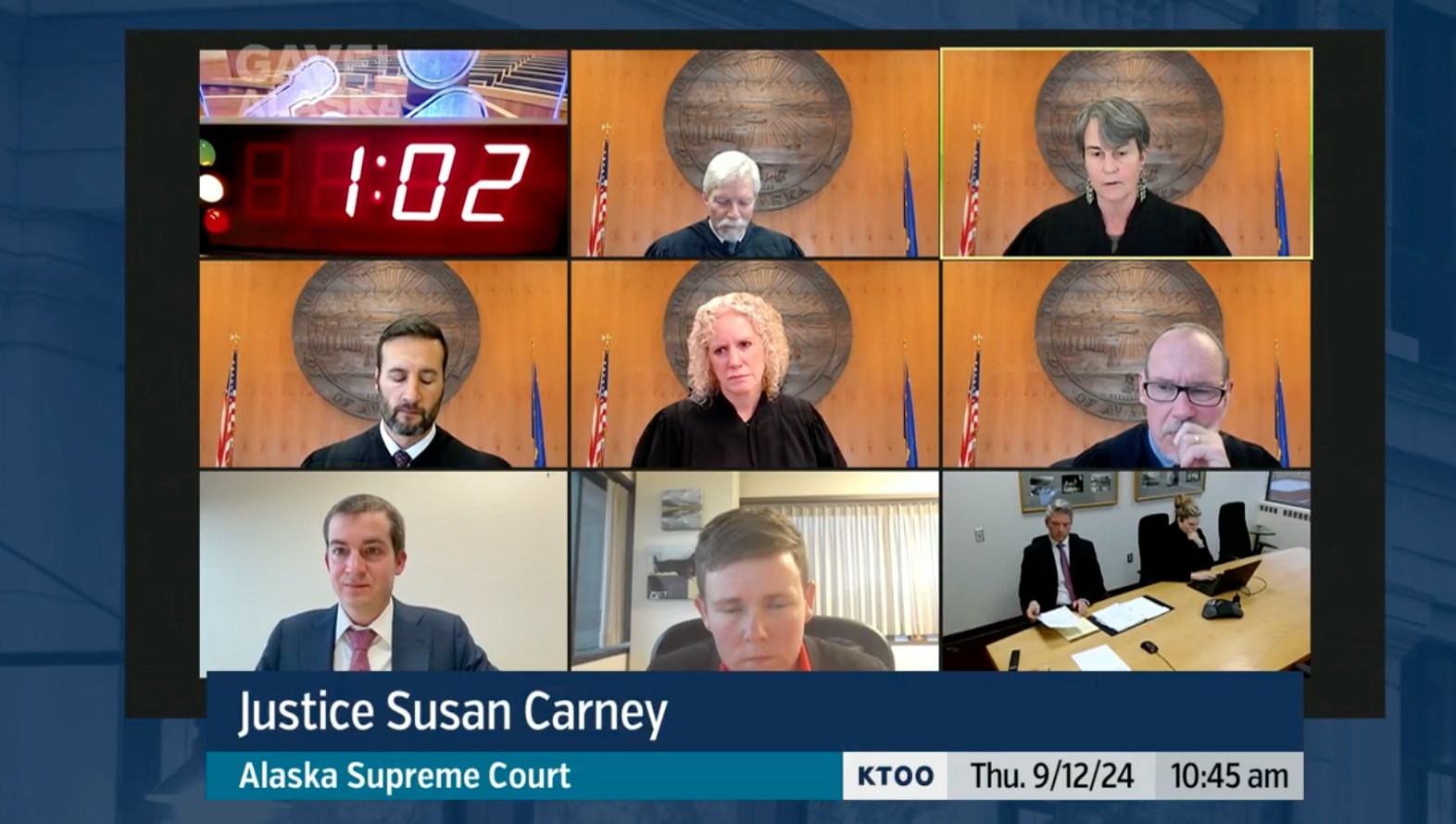
The Alaska Supreme Court on Thursday heard the appeal of the Alaska Democratic Party, which was trying to kick a Democrat off of the ballot in the Alaska congressional race so Rep. Mary Peltola, the party’s favored Democrat, could have a better chance at winning reelection.
In the end, the Democrats were denied their attempt to game the ranked-choice voting system. All the justices but one voted to uphold the judgment of Superior Court Judge Ian Wheeles, who had said the Democrats were essentially trying to change the rules and were too little, too late to challenge the candidacy of Eric Hafner.
Currently, Hafner, Peltola, and Republican Nick Begich and Alaskan Independence Party John Wayne Howe are on the November ballot, which is now being printed for the Nov. 5 election.
The Democrats raise several points about Democrat Eric Hafner, and why he should be kicked off the ballot so voters would not be confused by having two Democrats to choose from.

Democrats complained that Hafner is serving time in federal prison and therefore would not be able to serve in Congress. Yet the Constitution makes no law against felons running for federal office. That’s possibly because such a law would encourage opposing parties to arrest candidates — as the Democrats have done with Donald Trump — in order to make them unqualified to serve.
Superior Court Judge Wheeles’ decision said the Democrats had made up all kinds of imaginary possibilities for the future that they have no way of knowing or proving, and that Eric Hafner is within his rights to file as a candidate. The Division of Elections made no error of judgment in allowing him to take the fourth slot on the ballot, since two previous candidates had dropped out after the primary.
Wheeles said that “one’s failure to plan does not constitute another’s emergency,” of the Democrats and their challenge of Eric Hafner’s name on the ballot. It’s their own fault they didn’t challenge Hafner’s qualifications in the legal time allowed, which is 10 days after the closure of the candidate filing period.
Only Supreme Court Justice Susan Carney dissented from the decision of the Supreme Court, saying she would have reversed Judge Wheeles’ decision which can be read here:
The printing and testing for accuracy of the November ballot is already underway at the Division of Elections. The ballots for overseas military voters must be put in the mail this month.
The Supreme Court has only announced its decision and is expected to explain its reasoning at a later time.
The Alaska Republican Party statement came out at about 9 p.m. on Thursday. Carmela Warfield, chairwoman of the Alaska Republican Party, called it a great day for Alaska and the rule of law.
“The courts agreed with the Alaska Republican Party and did not allow the Alaska Democratic Party to game the election to their benefit,” Warfield said.
“But what the current law allows is that we have an incarcerated, out-of-state Democrat on the General Election ballot in Alaska because of the confusing, ill-conceived ranked choice voting scheme that is currently the law in our state, whether we like it or not. And the Alaska Democratic Party sure seemed to like ranked choice voting util they decided they didn’t like it. Our traditional, straight-forward voting process would have addressed this second Democrat on the ballot and he would have been removed through his party’s primary,” Warfield said.
“We Alaskans have the opportunity in November to make sure this does not happen again in our great state, to turn away from outside influences and do what’s best for Alaska, by returning to a system of fair elections that all Alaskans — regardless of party affiliation — can be proud of,” she said.
This story will be updated.



