

By BOB GRIFFIN
The Anchorage School District could solve much of its chronic budget problems by right-sizing its facilities – especially in excess elementary school floorspace.
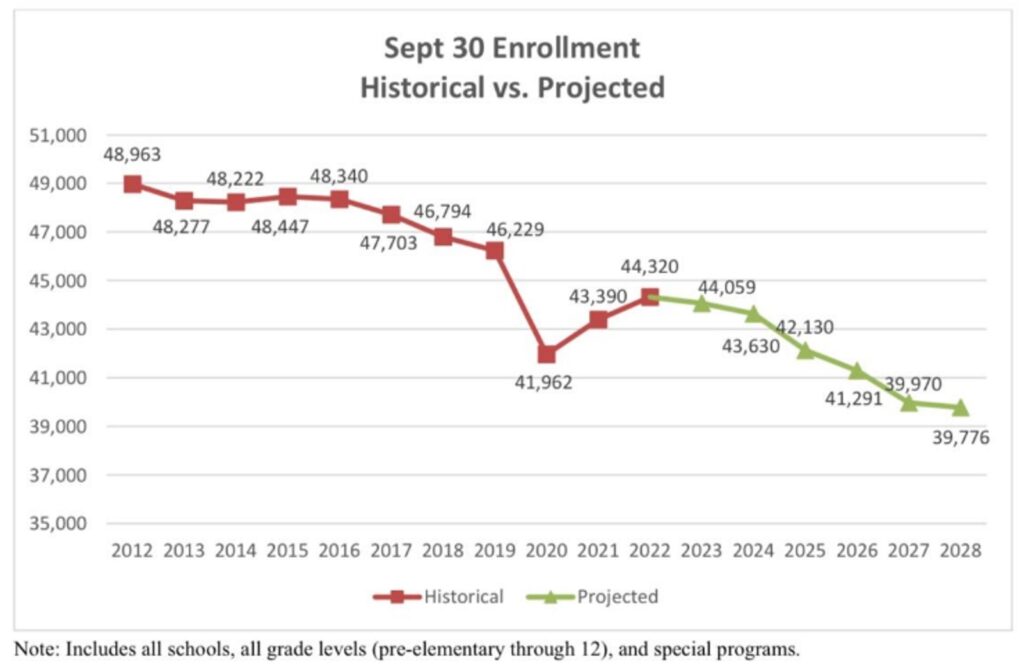
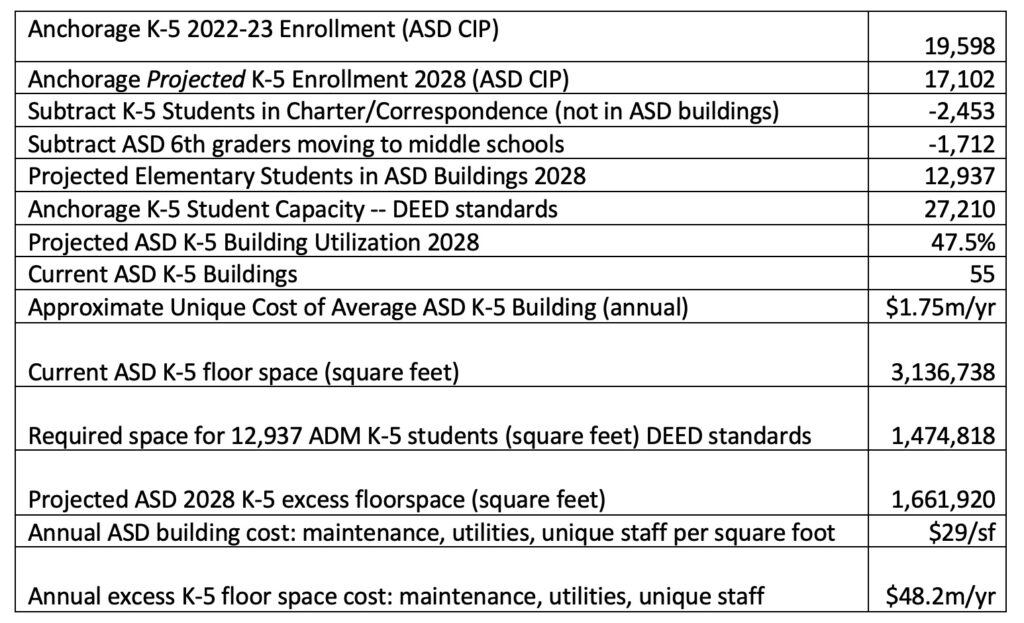
Over the next few years, ASD will have fewer than 13,000 elementary students in ASD buildings, with capacity to accommodate more than 27,000.
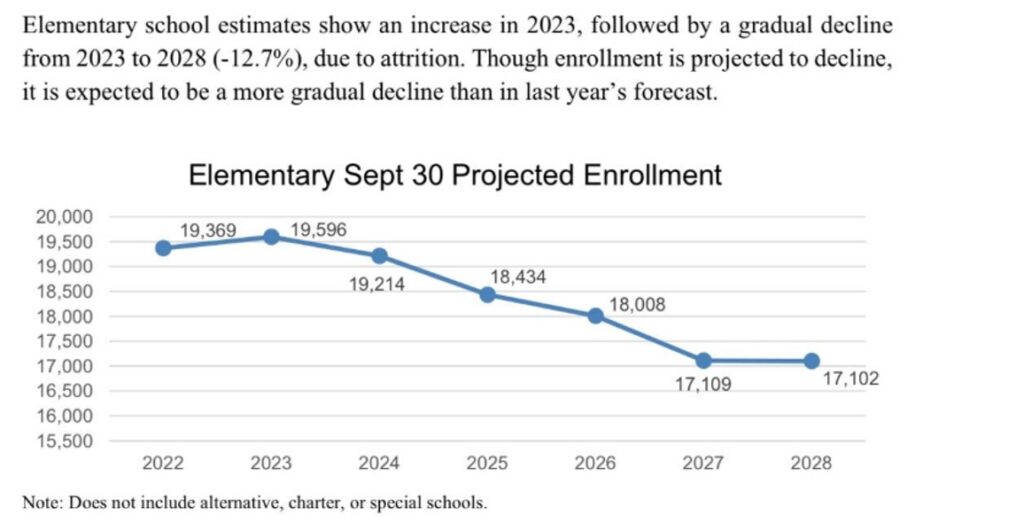
The Anchorage School District currently has capacity for 27,210 elementary school students according to Department of Education elementary school space requirements. The 2023-24 projected ASD elementary school enrollment was 19,958 students. That number is projected to decline to 17,102 by 2028.
The 2028 projection does not account for over 1,700 sixth graders who will no longer be in elementary schools with the new 6-8 middle school model in Anchorage. It also doesn’t account for the more than 2,400 ASD K-5 students in charter and correspondence programs who don’t use ASD facilities.
That puts student projections in ASD brick and mortar K-5 schools at 12,937 students –or lower, if more parents choose charter or correspondence programs over the next few years.
Many may consider that excess space a nice luxury. Great! Kids have more elbow room. But that luxury comes at a steep financial burden that robs resources from our kid’s classrooms.
The average ASD elementary school costs about $250,000/year to heat and light. The salaries for non-classroom teachers (principals, office staff, janitors, etc.) that are unique to each elementary school, averages about $550,000/year. Though the biggest cost of keeping excess floor space open is the long-term maintenance expense.
The current guidance recommends we invest 2% per year of the current replacement value of our schools to account for long-term maintenance like roof and boiler replacements and other needed future upgrades. Based on our most recent ASD construction projects, our current cost to replace a school is roughly $800/square foot.
Using the average of 60,000 square feet for an Anchorage elementary school, that results in around $960,000/year for long-term maintenance planning. With all those costs considered, Anchorage needs a little over $1.7 million eachyear to operate the average elementary school (teachers not included) or $29 per square foot per year to keep excess elementary schools open.
Keeping-up on long-term maintenance is not something we do very well in Anchorage. The current ASD deferred maintenance list is around $1 billion dollars (yes, with a “B”). Despite a fairly good record of passing maintenance bonds, that list has increased by around $80 million/year over the last several years.
Repurposing some excess floorspace to accommodate the acute needs of our very successful public charter schools is a pretty common-sense solution to some of this real estate glut. Eagle Academy Charter School in Eagle River is just one example. They are arguably one of the highest performing schools in the state of Alaska – operating out of a 50-year-old roller rink, with nearby underutilized campuses.
ASD currently operates a little over 3.1 million square feet of elementary floorspace while state standards require a little less than 1.5 million for the 2028 projected brick-and-mortar student population. That means we are likely squandering up $48 million per year on elementary school buildings we don’t need (we haven’t addressed middle and high school underutilization). Those squandered resources are not available for other needs — like paying up to 400 teacher salaries.
Bob Griffin is on the board of Alaska Policy Forum and serves on the Alaska Board of Education and Early Development, but writes this in his own capacity.
Bob Griffin is on the board of Alaska Policy Forum and serves on the Alaska Board of Education and Early Development, but writes this in his own capacity.


