
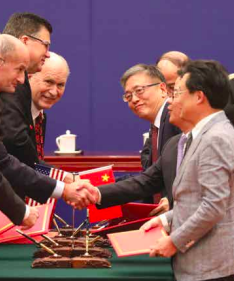
In 2017, former Gov. Bill Walker signed agreements with three large enterprises owned by the communist Chinese government; Sinopec was one of them.
The joint development agreement signed by Walker and Sinopec, the Bank of China, and China Investment Corporation, would lead to a China-built Alaska gasline, long a dream of Bill Walker, with contracts for Sinopec.
Last Friday, five of China’s largest state-owned companies, including Sinopec, said they will voluntarily remove themselves from U.S. stock exchanges rather than have transparent accounting, as required. Delisting can be voluntary or involuntary, but usually results when a company ceases operations, declares bankruptcy, merges, does not meet legal requirements, or decides to go private. Sinopec trades on the Hong Kong and Shanghai stock exchanges, as well as New York.
The move by Sinopec, PetroChina, China Life Insurance, Aluminum Corporation of China, and Sinopec Shanghai Petrochemical comes at a time of deteriorating relations between China and the United States. Sinopec is one of the largest oil and gas developers in the world, generating $456 billion in annual revenue and employing 385,691 workers.
But for Walker, the joint development agreement for Alaska’s gasline was nothing but opportunity for Alaska.
“This agreement has all five necessary signatories—the buyer, the lender, the investor, the developer and the state,” Walker said in 2017, as he announced the deal with the communist Chinese. “This is a big project with big players and big benefits.”
Walker, who won his election in 2014, took the gasline in a different direction than former Gov. Sean Parnell had. Parnell wanted private company investment, but Walker dismissed that direction, quickly nationalized the gasline and then started making deals with China and the Chinese-owned companies.
Before taking office, Walker said, “The fatal flaw of what [Parnell] is doing is, again, again, he has put control of Alaska’s future in the hands of companies that have competing projects around the world.”
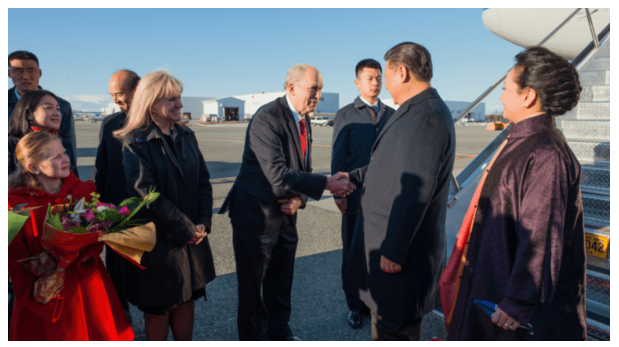
Communist China President Xi JinPing had visited Walker in Alaska in 2017 in a refueling stopover from a trip to Washington, D.C., after which Walker stated that Alaska’s relationship to China “is almost a personal thing. The time we spent here with President Xi and Madame Peng was a very close experience. It is a really important relationship at this time between the state of Alaska and China and a great opportunity for both.” Walker visited China three times during his governorship, cutting various deals and signing various agreements.
In 2017, Walker had in hand a memorandum of understanding with China that included financing, building, and sales in a trade deal that would sell $1 trillion of natural gas to China over the next 100 years.
“I ran for office because I’m a hunter of opportunities for Alaska. The opportunity with China really fits into my passion and my goals for Alaska,” Walker said in 2018. “I’m looking forward to developing this incredible relationship.”
Gov. Dunleavy canceled all the deals when he came into office at the end of 2018.
Since leaving office, Walker has formed a new company to build a large-volume pipeline to export North Slope natural gas, trying to wrest control of the project from the Alaska Gas Development Corporation, the state-owned entity in charge of the gasline development.
As for Sinopec, according to Barron’s publication, there has been a long-running dispute with the U.S. stock exchanges over the auditing of Chinese companies, “with China pushing back on external regulators examining audits of local firms.”
The communist Chinese cited national security and confidentiality concerns over the independent audits. In 2021, the Securities and Exchange Commission finalized rules stating that foreign companies trading on U.S. exchanges would be required to submit financial statements with their filings, and those reports had to be compliant with U.S. accounting standards. Some Chinese companies refused to do this and are now voluntarily de-listing rather than see their companies forced off the exchanges.
The Holding Foreign Companies Accountable Act was passed by Congress in 2020, after Chinese regulators repeatedly denied requests from the Public Company Accounting Oversight Board to inspect the audits of Chinese firms that list and trade in the United States, according to a story at CNBC. The board was created in 2002 to oversee the audits of public companies, including foreign companies trading on the U.S. exchanges.


