
By BRENDAN CLAREY | CHALKBOARD NEWS
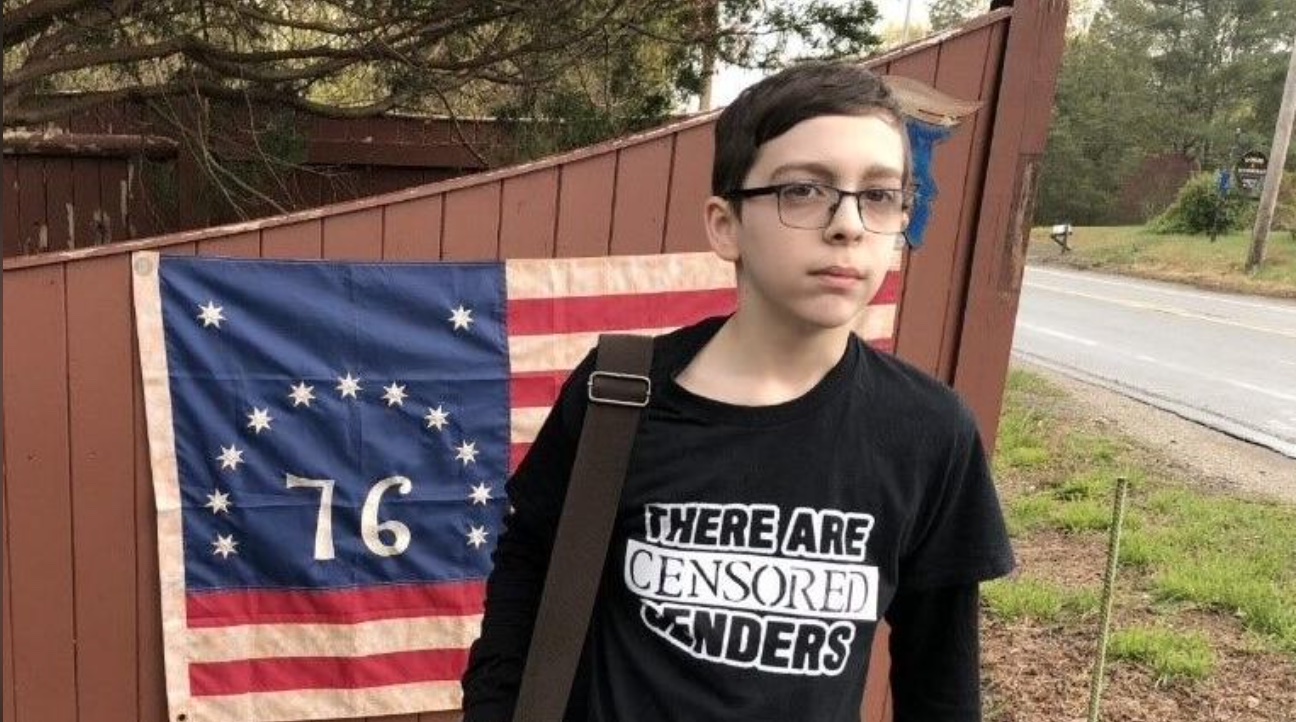
A federal appeals court has affirmed the decision of a lower court ruling on a Massachusetts school which told a student he could not wear a shirt saying “There are only two genders” and a similar one that censored the phrase to protest the school’s decision.
The First Circuit Court of Appeals affirmed the decision of a lower court this week that administrators at John T. Nichols Middle School in Middleborough, Massachusetts were able to tell student Liam Morrison to take his shirt off because it was offensive to gender-expansive youth.
At issue in the case, which was previously covered by Chalkboard, was the tension between Morrison’s free speech rights and those of other students at Middleborough Public School to be exposed to messages they would find hateful or harmful because of their gender identity.
The opinion explained that some LGBTQ+ Nichols Middle School (NMS) students said they had attempted to commit suicide and that about 10-20 students attended the school’s Gay Straight Alliance Club.

Despite this, seventh-grade student Liam Morrison wore a shirt to school in March of 2023 that said, “There Are Only Two Genders.”
“[Morrison] wore the Shirt both to express his own views, which he understood to be contrary to those NMS espouses on the subject, and to convey his belief that his views are not ‘inherently hateful,’” the opinion reads.
School administrators told him to take off the shirt and said in subsequent emails that it targeted “students of a protected class; namely in the area of gender identity.”
After Morrison’s family filed a lawsuit on his behalf, a district court ruled that school staff were “well within their discretion to conclude” that the shirt’s message would invalidate or erase students who identified as neither male nor female and that students “have a right to attend school without being confronted by messages attacking their identities.”
The appellate court agreed. The opinion filed Sunday said the shirt was demeaning to transgender and gender nonconforming students at NMS and that part of the issue was the age of the students to whom the shirt’s message was directed. The court ruled administrators reasonably predicted the effect the shirt would have on students.
“We agree with the District Court and so cannot say the message, on its face, shows Middleborough acted unreasonably in concluding that the Shirt would be understood — in this middle school setting in which the children range from ten-to-fourteen years old — to demean the identity of transgender and gender nonconforming NMS students,” the court ruled.
The 70-page opinion examined the legal precedence of free speech in school settings, often relying on the 1969 case Tinker v. Des Moines Independent Community School District, which found that students could wear armbands to protest the Vietnam War.
Part of the appellate court’s consideration were the “special characteristics of the school environment” raised in Tinker. Case law after Tinker also considers how to weigh the free speech rights of students against the rights of other students who are targeted by that speech.
The court said that, ultimately, educators are charged with deciding whether a message on a T-shirt would disrupt class and hurt the learning environment.
“We conclude the record supports as reasonable an assessment that the message in this school context would so negatively affect the psychology of young students with the demeaned gender identities that it would ‘poison the educational atmosphere’ and so result in declines in those students’ academic performance and increases in their absences from school,” the opinion reads.
The question of who determines when something crosses the line is one Chief Judge David J. Barron asked during oral arguments in February.
“The question here is not whether the T-shirts should have been barred. The question is who should decide whether to bar them — educators or federal judges,” the court’s opinion reads. “Based on Tinker, the cases applying it, and the specific record here, we cannot say that in this instance the Constitution assigns the sensitive (and potentially consequential) judgment about what would make ‘an environment conducive to learning’ at NMS to us rather than to the educators closest to the scene.”



