
The Alaska Oil and Gas Association hosted a Lunch-and-Learn session for legislators that delivered a data-driven snapshot of the industry’s outsized role in sustaining jobs, wages, and government revenue across the state. Presented by Katie Berry, president and economist at McKinley Research Group, the analysis underscored Alaska’s unique production stability amid price volatility, a record-high jobs multiplier, and continued capital commitment that positions the sector as the state’s strongest economic engine.
Rep. Chuck Kopp (R-Anchorage) opened the session by welcoming attendees and emphasizing the industry’s broad community investments. Berry, a lifelong Alaskan with deep expertise in statewide economic research, framed the study around 14 primary companies—11 focused on production and exploration, two refineries, and one pipeline operator. She stressed that this focused definition ensures precision, noting that employment figures may differ from broader Department of Labor statistics due to scope variations.
The presentation began with macroeconomic context. Over fiscal years 2015–2024, North Slope production remained relatively steady despite sharp price swings, a contrast to more reactive Lower 48 plays like the Bakken or Eagle Ford. Berry explained that harsh operating conditions and capital intensity make shutdowns impractical on the North Slope, where continuous operations are essential to prevent freezing and maintain infrastructure. State revenue, however, tracks price volatility closely, with oil and gas contributions fluctuating significantly between restricted and unrestricted general funds.
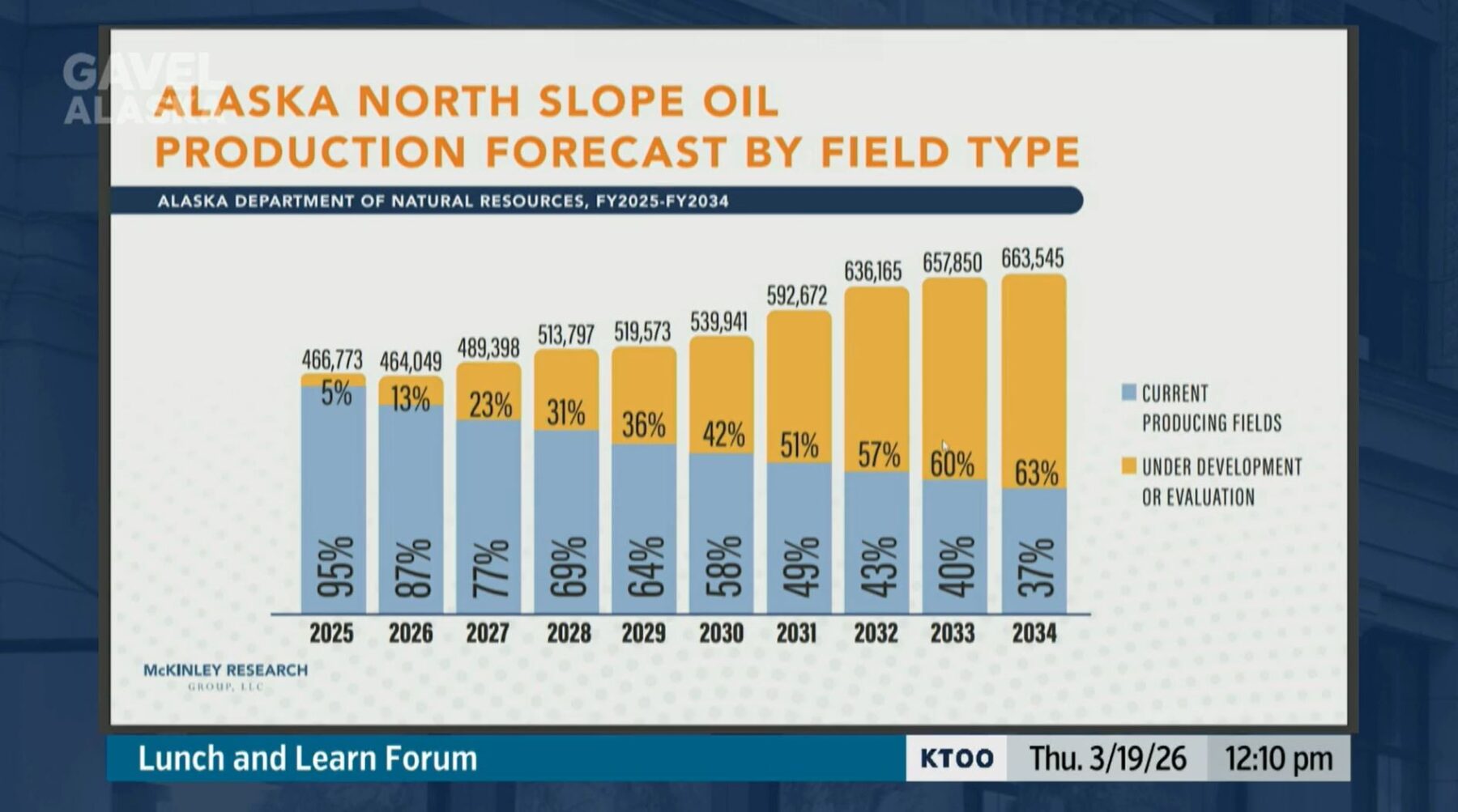
Turning to near-term production, Berry projected a modest increase driven by major projects. Santos’ Pikka field is expected to begin output in the first quarter of 2026, while ConocoPhillips’ Willow project is slated for 2029, with fuller effects visible in fiscal year 2030. By 2034, approximately 63% of North Slope production is anticipated from fields currently in exploration or development—underscoring that ongoing investment is required to offset natural depletion. Berry noted these projections exclude the Alaska LNG project pending a final investment decision, as its scale would warrant a separate update.
Current-year impacts painted a robust picture. In 2024, the 14 companies directly employed about 4,500 workers in Alaska, with roughly 75% Alaska residents—aligning with the statewide average. Early 2025 data suggest modest employment growth tied to development ramp-ups. These workers reside in 35 communities from Ketchikan to Utqiagvik, demonstrating the industry’s statewide footprint.
Vendor spending reached $5.8 billion with more than 1,000 Alaska businesses. Construction accounted for roughly $1.9 billion, oil and gas services $1.3 billion, with additional flows into retail, wholesale, transportation, and professional services. Government revenue totaled $3.5 billion in taxes, royalties, and fees, including $3 billion to the State of Alaska and $510 million to local governments. The North Slope Borough relies heavily on property taxes from the sector. That $3 billion state share represented approximately 19% of total Alaska government revenue.
Applying a detailed impact model—direct (payroll and vendor payments), indirect (vendor jobs and wages), induced (household spending scaled by residency), and government-supported (jobs funded by oil-derived revenue)—Berry reported that the industry sustained about 70,400 jobs and $6.6 billion in wages in 2024. This equates to roughly 16% of all Alaska jobs. The multiplier stands at 1:14—for every direct job at the 14 primary companies, 14 additional jobs are supported elsewhere. Berry described this as the highest multiplier of any industry in the state, driven by high resident employment, broad vendor distribution, and significant state revenue contributions.
Looking ahead, companies anticipate roughly $22 billion in investments over the next several years on the North Slope and in Cook Inlet. These outlays cover construction, capitalized drilling, and support services. Annual state revenue from oil and gas is projected at about $2.4 billion, with rising royalties from new fields, accounting for roughly 27% of unrestricted general fund revenue on average. Berry cautioned that these figures remain subject to oil price movements and will be refined by Department of Revenue updates.
One legislator inquired about company-level revenue breakdowns and per-barrel production data. Berry responded that such granularity exists in state sources but was not included in the public report to maintain accessibility, given typical attention spans. Another asked about the multiplier’s long-term stability. Berry explained that goods-and-services spending has remained consistent due to operational necessities in Alaska’s environment, while the government-supported portion has evolved as the legislature shifted toward percent-of-market-value (POMV) funding from the Permanent Fund, deliberately reducing reliance on oil and gas revenue.
Rep. Kopp closed by thanking Berry and McKinley Research Group, noting the potential for Alaska LNG—if funded—to amplify impacts substantially and warrant an updated analysis. The session ended on a note of cautious optimism and that resource development requires ongoing capital commitment and prudent fiscal policy to sustain benefits for communities and state services.


