

By DAVID BOYLE
In the just-released preliminary budget for the next school year, the Anchorage School District wants to increase its current budget by a whopping 6.4%.
And the general fund budget will increase by $49 million — an increase of nearly 9%.
This means the district’s budget will be more than $905 million, an increase of more than $54 million over last year, which does not include an additional $55 million for the PERS/TRS retirement programs.
This large budget (not including the PERS/TRS) equals $20,534 per student based on next year’s projected enrollment.
Here is the chart on next year’s ASD budget:

It appears as if the district will depend upon the Legislature to fund this increase as many districts and students (their travel to Juneau funded with K-12 dollars) lobby legislators.
Seeing that the makeup of the Legislature is ripe for giving the educational bureaucracy increased funding, the education industry leaders have descended upon lawmakers, demanding a huge increase in the Base Student Allocation (BSA).
The mantra is that “BSA funding has been flat since 2017.” The Senate has responded with Senate Bill 52, which increases the BSA by $1,000. This would cost the State more than $250 million with no more accountability than we now have.
ASD Superintendent Jharrett Bryantt doesn’t believe the district and other state school districts have been asking for more and more money.
In the February ASD Connect newsletter to the public he writes, ““…I hear over and over again from some that this session is about school districts asking for more money. I want to be clear — the districts around the state are not asking for more money. We are asking that systematic flat funding, which are cuts, are finally addressed after seven years, in the wake of chronically declining academic performance across the state.”
This seems to be doublespeak at its finest. Bryantt has neglected to explain that funding outside the BSA was added over that time. And he seems to imply this “lack of funding” is the reason for declining academic performance.
Despite what Bryantt says, many of the education industry proponents have done just that — asked for more money with no accountability for results.
In the 2023 school year, the Anchorage School District had 5,455 fewer brick-and mortar-students than in 2017. It received $9 million fewer state dollars due to that decrease in students.
Contrary to what Bryantt says, the declining academic performance has dropped consistently over the years — with or without additional funding. It’s been near the bottom for decades — since 2003, according to the latest NAEP results.
As one can see from this graph on 4th grade reading, Alaska student academic performance has lagged other states since 2003. Note that 10 points in the NAEP equates to one year of education. In 2022 Alaska’s 4th graders are more than one academic year behind lower 48 students in reading proficiency.
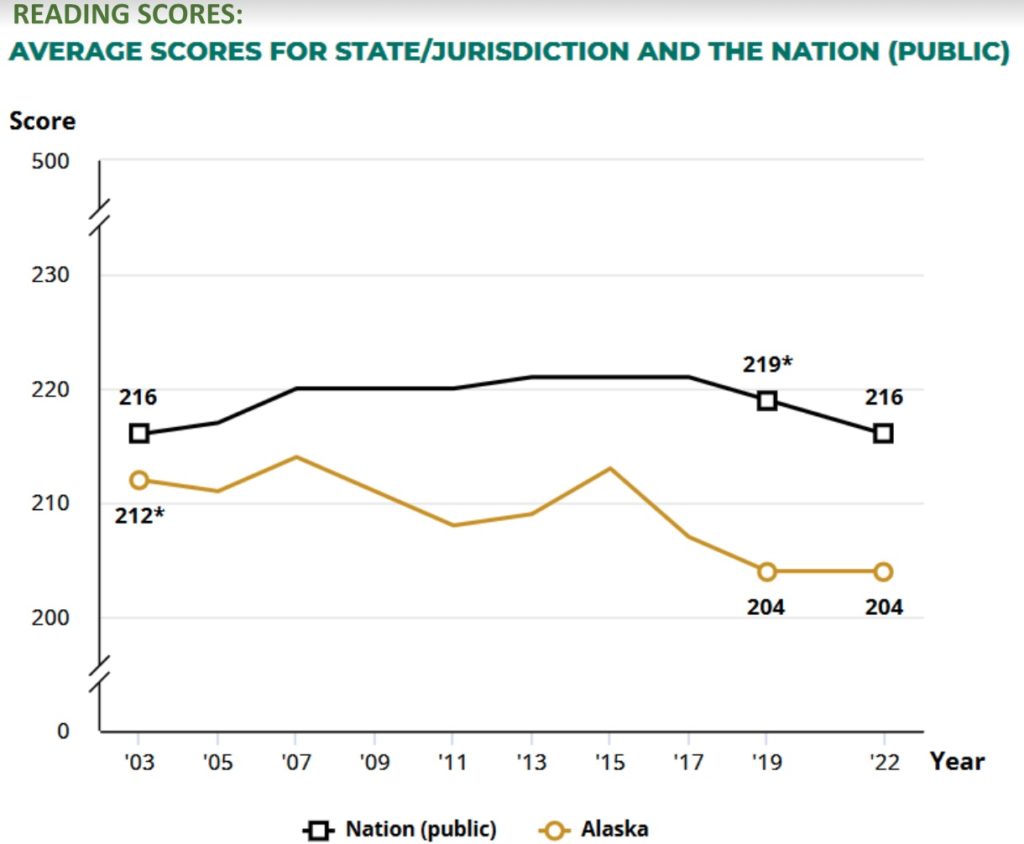
In 4th grade reading for 2022, only New Mexico performed worse than Alaska.
The 4th grade reading metric is said to be an indicator of student success — a child learns to read by 4th grade, then reads to learn thereafter.
Can Anchorage voters expect better student outcomes with this $54 million increase? Or will we be here again next year at the bottom of the NAEP scores while the Education Industry begs the legislature for more and more dollars?
And if they get the money, will they spend it on the classroom or on extraneous requirements such as diversity, equity, or indoctrinating children on transgender issues?
After all, there is no accountability written into the request. The school district will do what it always does, increase what it wants, and then come with its hand out to you, the taxpayer (or Permanent Fund shareholder), to fund it.
What do you think? The Anchorage School Board needs to hear from you. You can testify or send comments here: https://www.asdk12.org/Page/4329
David Boyle is the Must Read Alaska education writer and former executive director of the Alaska Policy Forum.



