
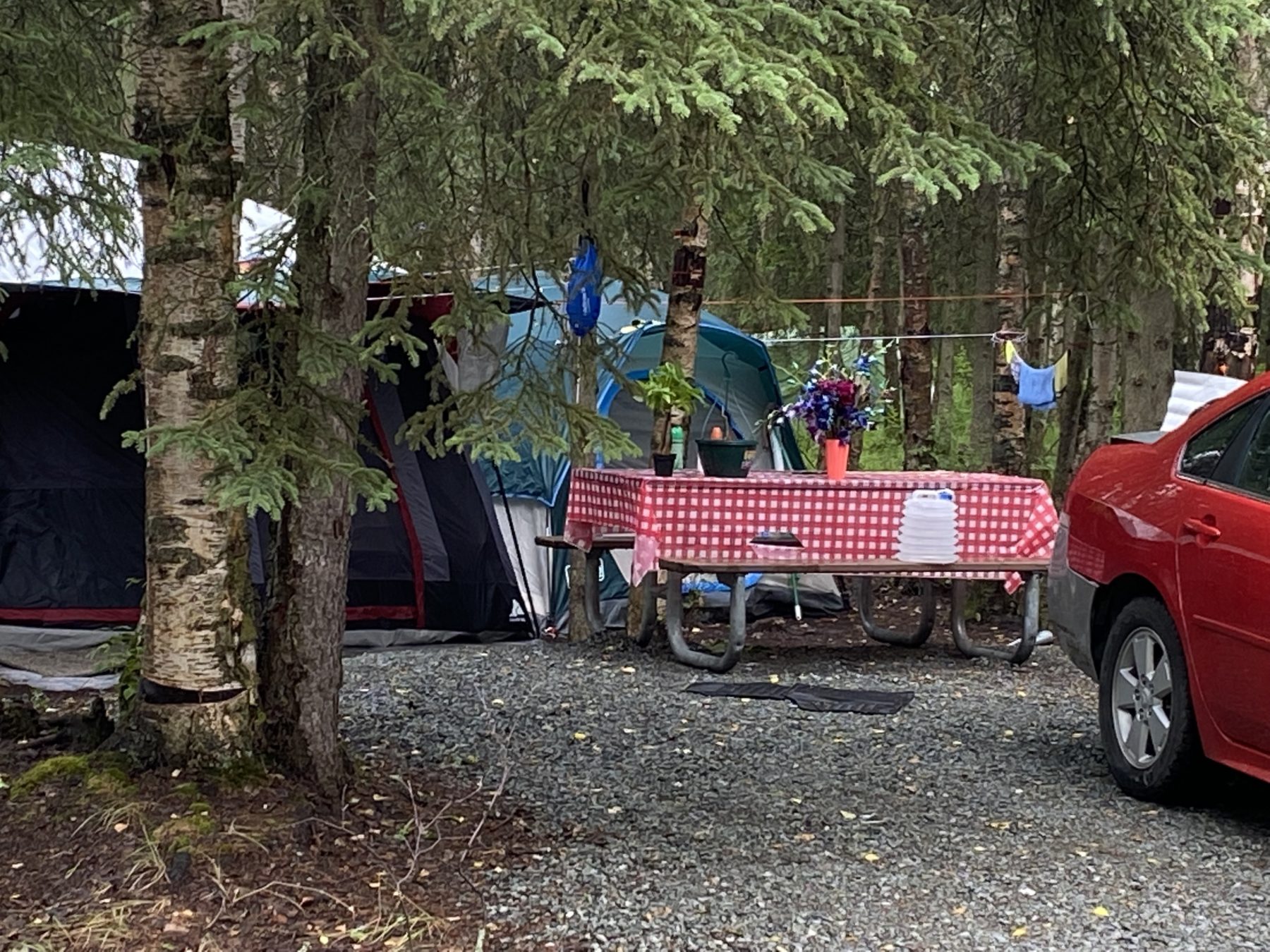
The Anchorage Coalition to End Homelessness told its partners on Monday that it would do outreach services to help rehouse homeless people at the Centennial Campground.
Within a few hours, the group said it was withdrawing all of its outreach services to the campground, which had been turned into a space for homeless people earlier this month, when wildfires in the unsupervised camps around Anchorage green spaces posed a major threat to life and property.
“Due to the continued lack of site control and dangerous conditions at Centennial Park, ACEH will no longer direct or coordinate outreach teams to Centennial,” the coalition said in its email to its partners and the municipality.
ACEH is run by Meg Zaletel, who in addition to running Anchorage’s homeless industrial complex also wears another hat — being a sitting Anchorage Assembly member. The Assembly pays her salary both on the Assembly and in large part at ACEH through appropriations of taxpayer dollars. She makes a six-figure salary at ACEH, which had a budget last year of more than $1.2 million.
In a letter to the mayor recently, Zaletel demanded that sanctioned camping be offered as one of the options for the homeless, particularly for the people who were illegally camping around the city and who were not willing to go to shelters. But once the campground was established, ACEH got busy to try to develop a revenue stream for some of its coalition partners who sit on the ACEH board.
Salvation Army is not one of those official partners, in that they don’t have a seat on the board. But Salvation Army is willing to work with the municipality to coordinate services, “client care coordination, feeding, intensive case management, and managing the plethora of donations coming in,” as one person close to the situation put it.
Critics say ACEH had not done that much at the homeless camp, but hang a couple of tarps and that Zaletel showed up for a photo opportunity.
By Wednesday, Zaletel had done an about face. Now, ACEH says it will see what happens in the next 24 to 48 hours, and may get reinvolved.
“As someone who has visited Centennial almost every day since the Sullivan closed, the tremendous improvements over other unsanctioned sites in Anchorage are obvious,” Mayor Bronson said in a statement late Monday. “I truly believe we are at our best when we set aside politics and work together, and I’m grateful for the many stakeholders who share that vision.”
Meanwhile, another camp-raiding black bear has been dispatched at the campground, the fifth that has had to be destroyed since about 200 people relocated to the camping sites, where the campers have toilets, running water, wi-fi and cleared areas where they can set up tents and tarps.
Bears have been destroyed in this tract of land east of Muldoon several times per year for at least a decade. The surrounding mountains and foothills provide a seemingly endless supply of black bears.
Anchorage has plenty of problems with black bears; five people in Anchorage have been killed by bears in since 2014, and there have been numerous attacks by black bears in the municipality area over the past many years.
One person has died at the camp, but not by a bear attack. It was a drug overdose death, not uncommon among the homeless. But there was also a “Narcan save” that same night in that camp as the on-scene team at Centennial was able to save the other person at that campsite who had overdosed.


