
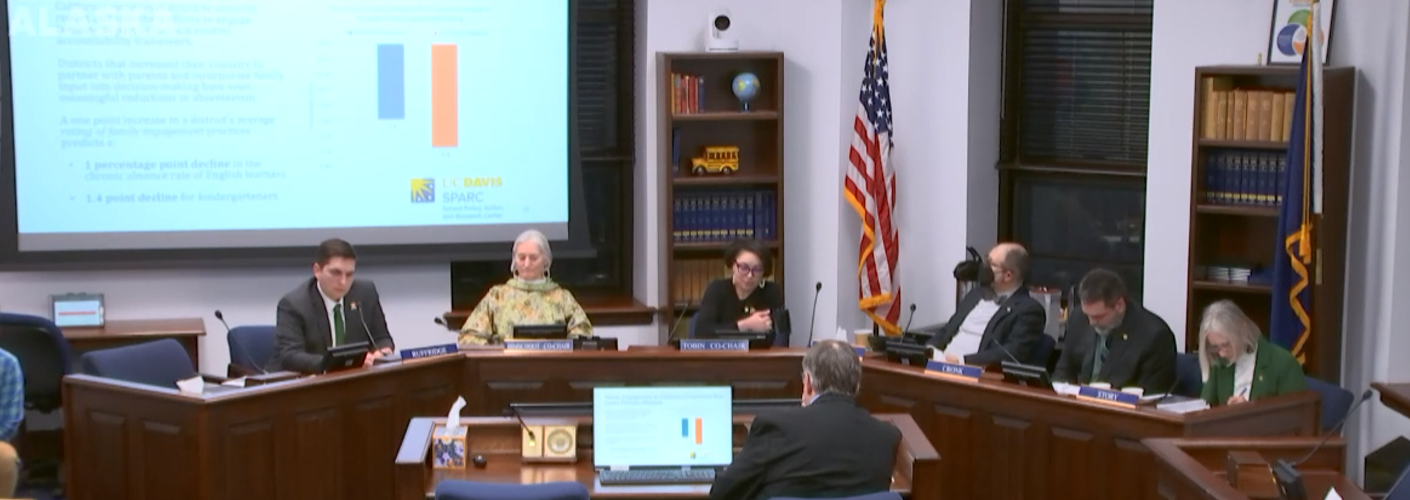
Today, Jan 23, the Task Force on Education Funding met at 3:30pm to hear invited testimony. Among those invited to give testimony was Michael Hanley, former Commissioner of Education and current Superintendent of the Aleutian Region School District.
Hanley has spent 35 years in the Alaska public education system with his experience including being a teacher at the Anchorage School District, Principal at an ASD school, Commissioner of Education, and now Superintendent of one of the most remote school districts in the nation.
Opening remarks from Hanley emphasized his appreciation for the task force’s willingness to look beyond numbers and understand the underlying issues causing low test scores and chronic absenteeism in Alaska’s schools.
“It is really easy to make a decision from a distance. But it is really challenging to make a good one,” he stated. “If there’s a silver bullet in education, it is not in the Commissioner’s seat, it is not – respectfully – in your [the legislature’s] seat. It is a high-quality teacher in the classroom. That’s the silver bullet.”
Hanley emphasized the need to not only look at test scores and data, but to get out to schools in person and get to know the administrators, teachers, and students. Because Alaska has a wide range of districts and educational situations, Hanley points to the need to look at underlying causes rather than numbers.
Some of the underlying factors affecting Alaska’s public education, according to Hanley, are domestic violence, poverty, and tribal priorities.
Alaska ranks in the top 3 states with the highest rates of domestic violence and abuse in the nation. Children who face instability and/or trauma in their home lives consistently test lower and have higher absenteeism than children in stable, healthy homes. Poverty and the stress poverty places on a child’s home life also contribute to lower performance scores in schools with a high population of impoverished families.
Another factor that many people do not realize, according to Hanley, is a factor more specific to rural districts: tribal priorities. He stated that 25% of his students in Atka are chronically absent. However, that reported 25% is three high school students who are highly engaged in their tribal culture. Hanley indicated these kids will skip school to participate in tribal events. Hanley does not offer a solution to this observation but presents it “as an example for why you have to look beyond the numbers.”
Hanley wrapped up his remarks with this warning: “My caution to you is that there may not be a simple solution, a simple statute that adequately addresses the challenges we face… But the fact that you are looking into it is taking us a step forward.”
Then Senator Loki Tobin (D-Anchorage) asked Hanley to share his insight on consolidating districts for the purpose of saving State money.
Hanley responded that the State would not substantially benefit from consolidation and districts would be substantially harmed by reducing community representation. “General consolidation won’t lead to savings for the State,” he said. “Do the math… you will find it to be a negligible benefit [for the State] and at great cost to the districts, the loss of voice.”


