
DR. ZINK ISSUES ADVISORY: WEAR FACE MASKS IN PUBLIC PLACES
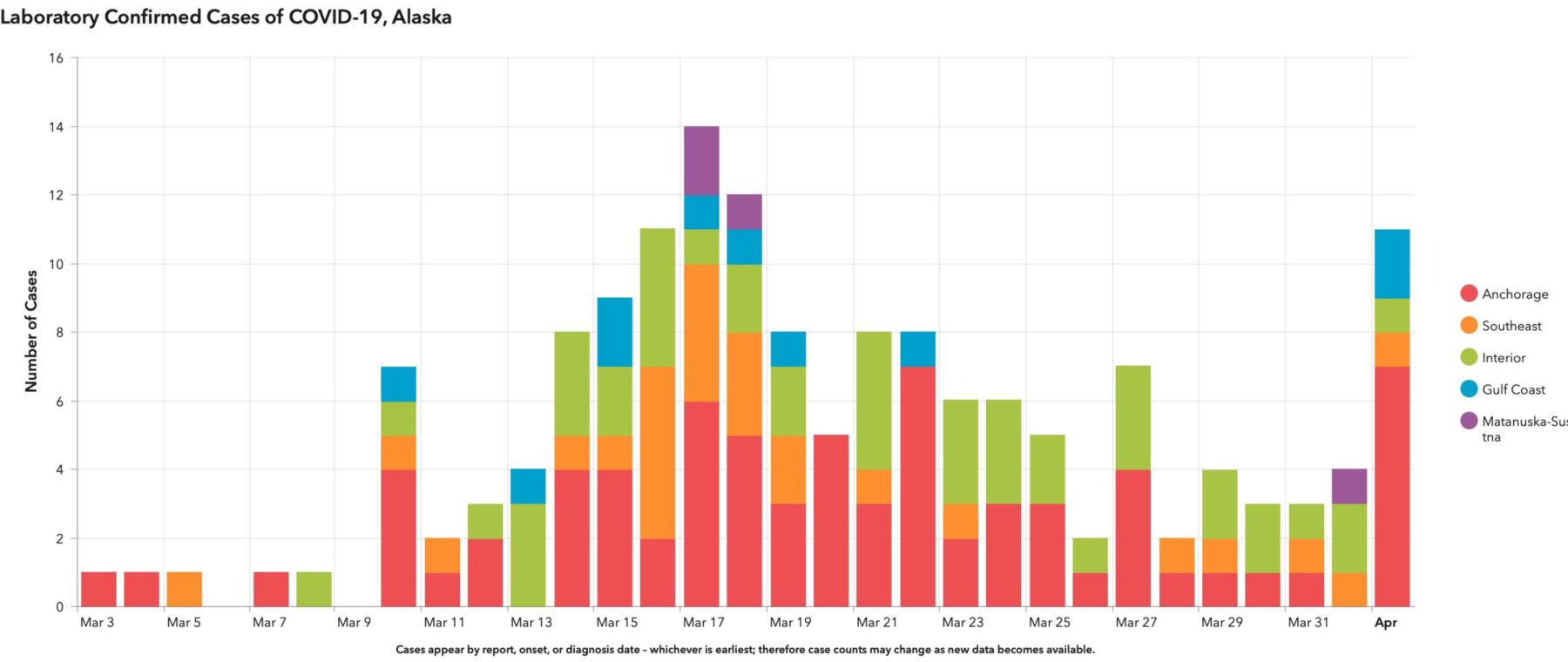
Alaska now has had 157 cases of COVID-19 coronavirus, an increase of 11 since Thursday. There are no new deaths. The increases have been modest day after day this week, reflecting Alaskans’ compliance with health mandates.
It’s far too soon to declare victory, but what Alaskans are doing appears to be working.
Two new hospitalizations brings the total hospitalized to 15, although some are no longer in the hospital. Of those 11 announced today, one is a traveler who is not from Alaska — only 10 were Alaskans. 6,016 individual Alaskans have been tested.
“We seem to be holding our own and we seem to be doing better than the vast majority of states,” Dunleavy said, speaking about the number of people tested and the number those who are known to be infected. He was also encouraged that no deaths have been reported since last Saturday, when a 73-year-old man died at an Anchorage hospital from the coronavirus. He had been admitted to the hospital five days earlier.
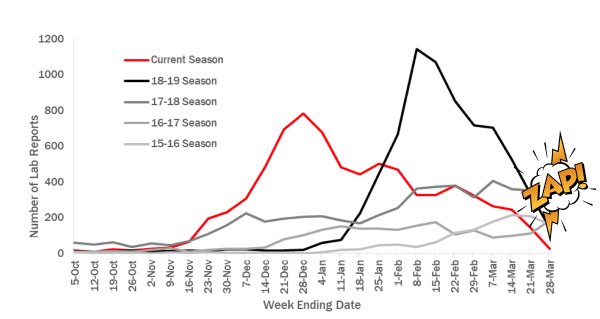
If the state’s influenza chart can be used to track how well Alaskans are adhering to the social distancing and hand washing mandates, then there’s good news on that front.
The Wuhan coronavirus known as COVID-19 is much more contagious than influenza A or B, but the cases of flu in Alaska have fallen almost to zero. That’s important, because flu is transmitted the same way as the coronavirus — through droplets. Last year, 18 Alaskans died of complications from regular influenza.
At the end of March, 2020, after what started out as a heavy flu season, the flu was all but over, as shown by the red line below:
Dunleavy was cautious about the progress Alaskans have made is staving off the spread of the coronavirus. And his caution is understandable, since the numbers could spike at any time for this virus, which spreads in clusters.
But looking at some of the models, it appears Alaskans have a strong desire to not get infected and are minding the advisories and mandates for social distancing and sanitizing.
The University of Washington model for Alaska says Alaska is still 11 days away from “peak deaths” expected from COVID-19. That model predicts there will be five associated deaths per day by April 14, a rate that will continue for several days before tapering off to four deaths per day by April 21. By August, 148 Alaskans will have died from the illness, the model predicts.
From the trends, however, it looks like Alaskans intend to cheat death by beating the models, and they are right now leading the nation in both low case count, numbers tested, and numbers of deaths. The first case in Alaska was detected on March 12, and it’s been growing as more people are tested, but not expanding as exponentially as it has in New York City and other urban areas where people cannot avoid each other.
State Medical Officer Dr. Anne Zink today issued the 10th health advisory for the State of Alaska: Wear a mask when in public to cover both your nose and mouth. This prevents you from spreading the virus if you are an asymptomatic carrier of it.
At this point, Zink said, everyone should assume they’ve been exposed to COVID-19 and could be spreading it. Zink’s advisory has specific instructions for how to use masks, when to use them, and when and how to remove them:
Health Alert #10: Recommendations Regarding the Use of Cloth Face Coverings
Scientific evidence available to date indicates that asymptomatic and presymptomatic shedding of the virus that causes COVID-19 is occurring. This means that people who have no symptoms whatsoever may be infected with the virus and capable of transmitting the virus to others when interacting in close proximity—for example, speaking, coughing, or sneezing. This heightens the need for community-wide implementation of control measures to prevent the spread of COVID-19 among people who are not experiencing symptoms of illness.
The primary ways to do this are through social distancing, frequent hand-washing, and disinfecting high-touch surfaces. Another tool that may help to minimize transmission while people are around others outside of their household is the use of face coverings. Because we are experiencing a nationwide shortage of medical supplies, including facemasks, we recommend that Alaskans make their own face coverings and wear them in public settings where other social distancing measures are difficult to maintain (e.g., grocery stores and pharmacies) — especially in areas of significant community-based transmission. This recommendation aligns with current national guidance from the CDC.
The following measures are highly recommended for all Alaskans:
- Wear a cloth face covering in public settings where other social distancing measures are difficult to maintain (e.g., grocery stores and pharmacies).
- Make sure the face covering covers both the nose and mouth.
- Do not remove the face covering until you return home.
- When removing the face covering, avoid touching the front of the face covering (because it may becontaminated). Remove it by grasping the ear loops, ties, or bands and immediately discard or place ina designated container for laundering.
- Wash your hands immediately after removing the face covering and before touching anything else.
- Wash face coverings in hot, soapy water between uses.
- Do not wear N-95 or surgical masks; these are needed by health care workers and first responders.
- Do not rely on face coverings as the primary way to prevent COVID-19 transmission, and be careful to
avoid developing a false sense of security through the use of face coverings. Continue to follow social
distancing measures, including maintaining at least six feet between yourself and others, staying at home, avoiding touching your face, and washing your hands frequently.
What is a cloth face covering?
A cloth face covering is a material that covers the nose and mouth. It can be secured to the head with ties or straps or simply wrapped around the lower face. It can be made of a variety of materials, such as cotton, silk, or linen. A cloth face covering may be factory-made or sewn by hand, or can be improvised from household items such as scarfs, T-shirts, sweatshirts, or towels.
How do I make a homemade face coverings?
Cloth face coverings can be fashioned from household items or made at home from common materials at low cost. There are a number of instructional websites and videos that people can refer to for making face coverings; two such videos are available at https://youtu.be/VgHrnS6n4iA and https://youtu.be/1r2C1zGUHbU
How well do cloth face coverings work to prevent spread of COVID-19?
There is limited evidence available on how well cloth face coverings help reduce COVID-19 transmission. Their primary role is to reduce the release of respiratory droplets into the air when someone speaks, coughs, or sneezes, including people who have COVID-19 but have no symptoms. Cloth face coverings are not a substitute for physical distancing and washing hands and staying home when ill, but they may be helpful when combined with these primary interventions.
How should I care for a cloth face covering?
Wash your cloth face covering frequently, ideally after each use, or at least daily. Have a bag or bin to keep cloth face coverings in until they can be laundered with detergent and hot water and dried on a hot cycle. If you must re-wear your cloth face covering before washing, wash your hands immediately after putting it back on and avoid touching your face. Discard cloth face coverings that:
• No longer cover the nose and mouth
• Have stretched out or damaged ties or straps • Cannot stay on the face
• Have holes or tears in the fabric


