
By SUZANNE DOWNING, EDITOR
The Alaska Supreme Court has left no doubt that it is an activist court. It has weighed in on the events that unfolded subsequent to the killing of George Floyd, a Minneapolis man who died at the hands of police, and whose death has become a rallying cry against the United States in general.
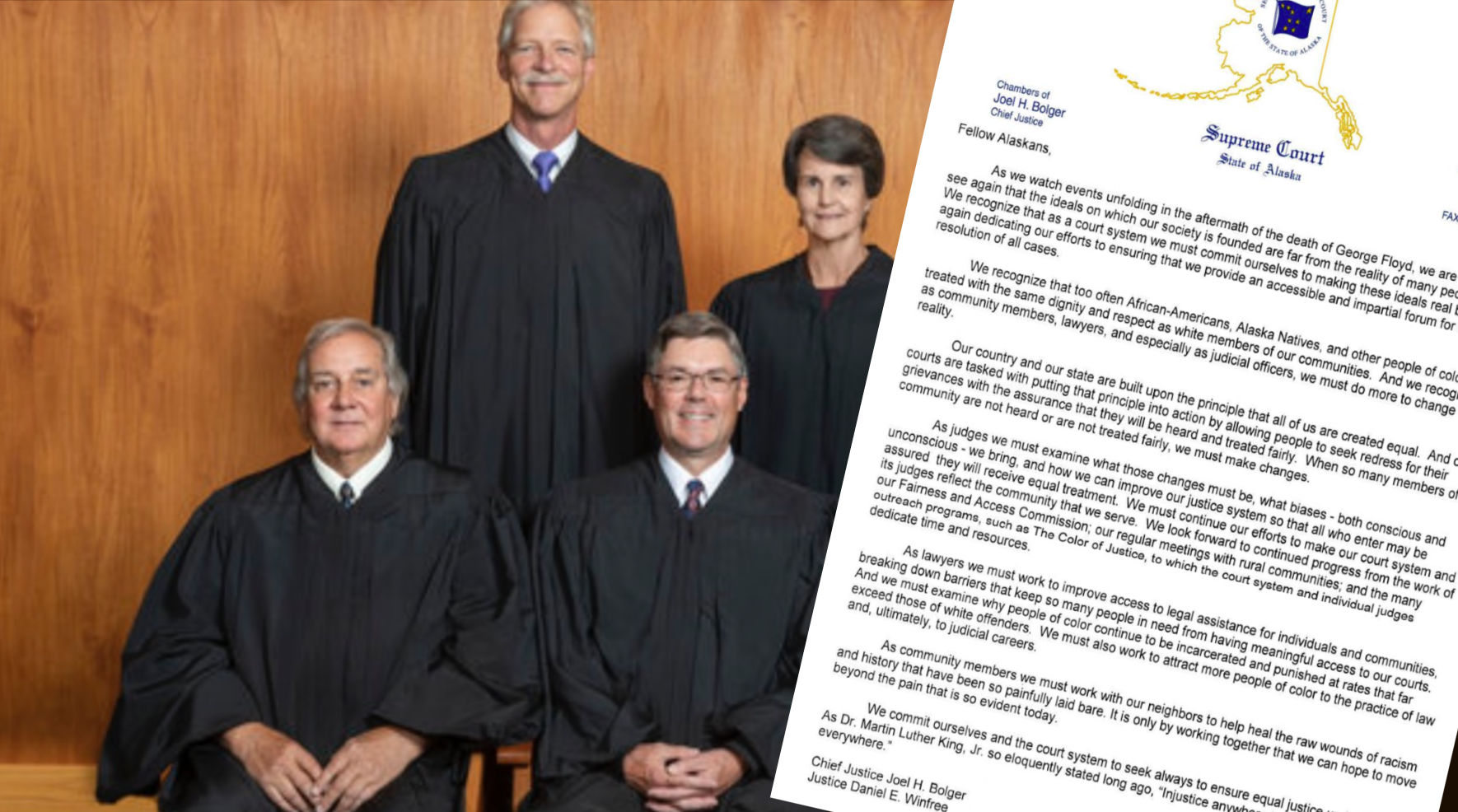
After days of violent riots around the world (as well as peaceful protests in Alaska), after many innocent people were curb-stomped by rioters across the country, after law enforcement officers were beaten and killed in cold blood, the Alaska Supreme Court posted a letter of sympathy for the insurrection that could have been written by the Alaska ACLU.
“As we watch events unfolding in the aftermath of the death of George Floyd, we are saddened to see again that the ideals on which our society is founded are far from the reality of many people’s lives. We recognize that as a court system we must commit ourselves to making these ideals real by once again dedicating our efforts to ensuring that we provide an accessible and impartial forum for the just resolution of all cases,” the judges wrote.
Read that again. It was not the death of George Floyd, but the events that unfolded after his death that have prompted the judges to clutch at their pearls in a virtue-signaling letter that sends a message all the way through the Alaska court system, to lower court judges, workers in the judiciary, prosecutors, and defense attorneys.
Here’s what that Supreme Court is signaling: Since African-Americans, Alaska Natives, and other people of color “are not treated with the same dignity and respect as white members of our communities,” the courts “must do more to change this reality.”
What does that mean, in practical terms? Not arrest criminals? Not prosecute drug dealers or human traffickers? Allow looters to destroy businesses? How do the black-robed judges propose to change the hearts of the society they live in, or is it even their job?
Critics say that the job of the Third Branch of government is to uphold the law, to rule impartially, and to deliver justice.
But the Supreme Court chose last week to undergo a a very public Maoist Struggle Session in writing for all to see, to examine their own hearts and personal histories for bad things, such as their role in societal inequities, and to say that society needs to be better than it is. The letter was very nearly an apology for their white privilege.
The judges say that they “must work with our neighbors to help heal the raw wounds of racism and history that have been so painfully laid bare. It is only by working together that we can hope to move beyond the pain that is so evident today.”
Healing the raw wounds in society has now become their job?
Most people recognize that no matter the criminality of George Floyd, his death was an outrage. But the national riots that followed also have markers that the passions of a pent-up, unemployed public was being manipulated by Antifa, a tentacle organization that has probably been infiltrated by bad actors and possibly even foreign agents to create chaos and provoke police response across the country. There is plenty of video evidence that provocateurs were at work across the country to turn a valid protest into breaking and entering, looting, pillaging, murder, and hate crimes against whites.
The justices didn’t need to wade in on this. Chief Justice Bolger should have used better judgment.
Nowhere in the letter did the justices say that victims of crime deserve justice.
Nowhere in the letter did the justices say that the burning of St. John’s Church in Washington, D.C. violated the rights of Americans to exercise their First Amendment freedom of religion.
Nowhere did the justices acknowledge that the storming of the White House last week was an illegal attempt to overthrow the government of the United States.
Nowhere did they express thanks for our law enforcement officers who leave their homes each morning, hoping they will live through the day to return home.
In fact, the judges simply wrung their hands and waffled on what should be done about the imperfect world we all live in.
The June 8 letter was about virtue signaling, letting protesters know that, if they are arrested for breaking a window during a protest, the court system will take it easy on them for the sake of social justice.
The justices cannot presume that their societal pronouncement lands in the public arena without context. Days of rage and lawlessness had preceded their decision to release this letter of white judicial culpability.
Chief Justice Joel Bolger has stepped into the political arena before. His last publicly posted letter was posted in 2019, warning Gov. Mike Dunleavy to not cut the court’s budget and advising that the courts need to remain independent. In so many words, Bolger said the court was under political pressure. He went before the Alaska Federation of Natives and asked for their help to protect the court from administrative budget cuts.
This is the same court that decided the governor could face a recall election this year. And the same Supreme Court Chief Justice who only recused himself from that decision-making panel after Must Read Alaska pressured him to do so.
[Read: Under pressure, Supreme Court Chief Justice recuses]
The duty of the court is not to jump in and pronounce society as unfair. The duty of the court is to make it fair each and every day as it adjudicates questions of crime and matters of civil disagreement.
But Alaska’s Supreme Court has jumped feet first into the Days of Rage drama, as Antifa and Black Lives Matter conspired in an actual attempt to overthrow the government.
The Alaska Supreme Court justices have shown their judicial activism card and we have seen it. Perhaps the very best thing they can do now is to simply resign, since their white privilege cannot be redeemed, even if they took a knee.


