

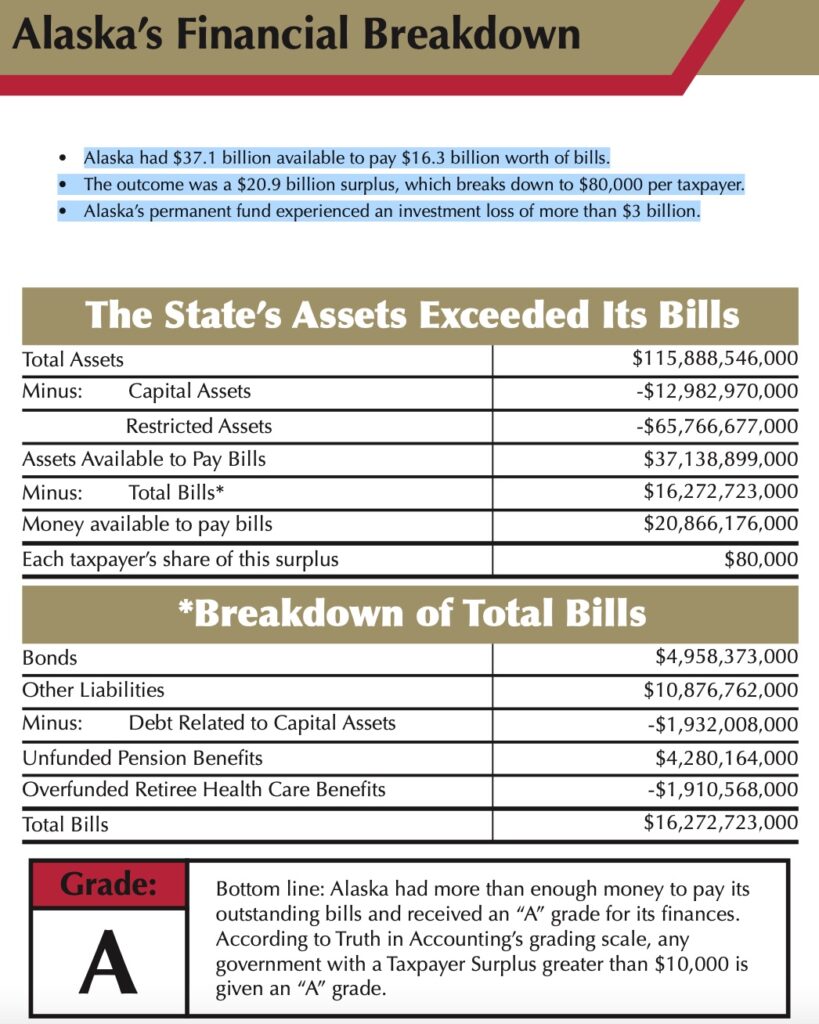
Alaska’s state budget condition was the strongest in the nation in 2022, with a surplus of $20.9 billion, according to the state’s latest audited financial report for fiscal year 2022.
The findings come from Truth in Accounting, a non-profit organization dedicated to providing citizens with clear, reliable, and transparent government financial information. The organization assigned Alaska an “A” grade for its financial performance.
The solid financial footing can be attributed to a combination of factors. Federal funding aimed at Covid-19 relief played a role, alongside an increase in economic activity linked to a growth in tourism.
- Alaska had $37.1 billion available to pay $16.3 billion worth of bills, giving it a nearly $21billion surplus, coming out to $80,000 per taxpayer.
In comparison, California’s budget health received a D from Truth in Accounting. The Democrat-dominated state requires more than $18,000 from every taxpayer to pay its bills. Connecticut received an F, needing $50,700 from each of its taxpayers to pay all of its outstanding bills. Connecticut ranked #49, just behind the worst state — New Jersey, coming in at #50; New Jersey would need $53,600 from each of its taxpayers to pay all of its outstanding bills.
According to the organization, at the end of fiscal year 2022, 28 states did not have enough money to pay all of their bills. In total, debt among the states was $938.6 billion, down from $1.2 trillion at the end of fiscal year 2021.
State debt decreased mostly due to tax revenue increases due to the Covid lockdowns ending, and millions, if not billions, of dollars in federal Covid funds received by the states. That money added to the national debt, however, which is now over $33 trillion.
Every state except Vermont has a balanced budget requirement. This means that to balance the budget—as the law requires in 49 states—states should not carry any debt.
“However, we found that most states could not pay all of their bills. When states do not have enough money to pay their bills, TIA takes the money needed to pay bills and divides it by the estimated number of state taxpayers. The resulting number is a Taxpayer Burden™. Conversely, a Taxpayer Surplus™ is the amount of money left over after all of a state’s bills are paid, divided by the estimated number of taxpayers in the state,” said Truth in Accounting’s summary of the report.


