
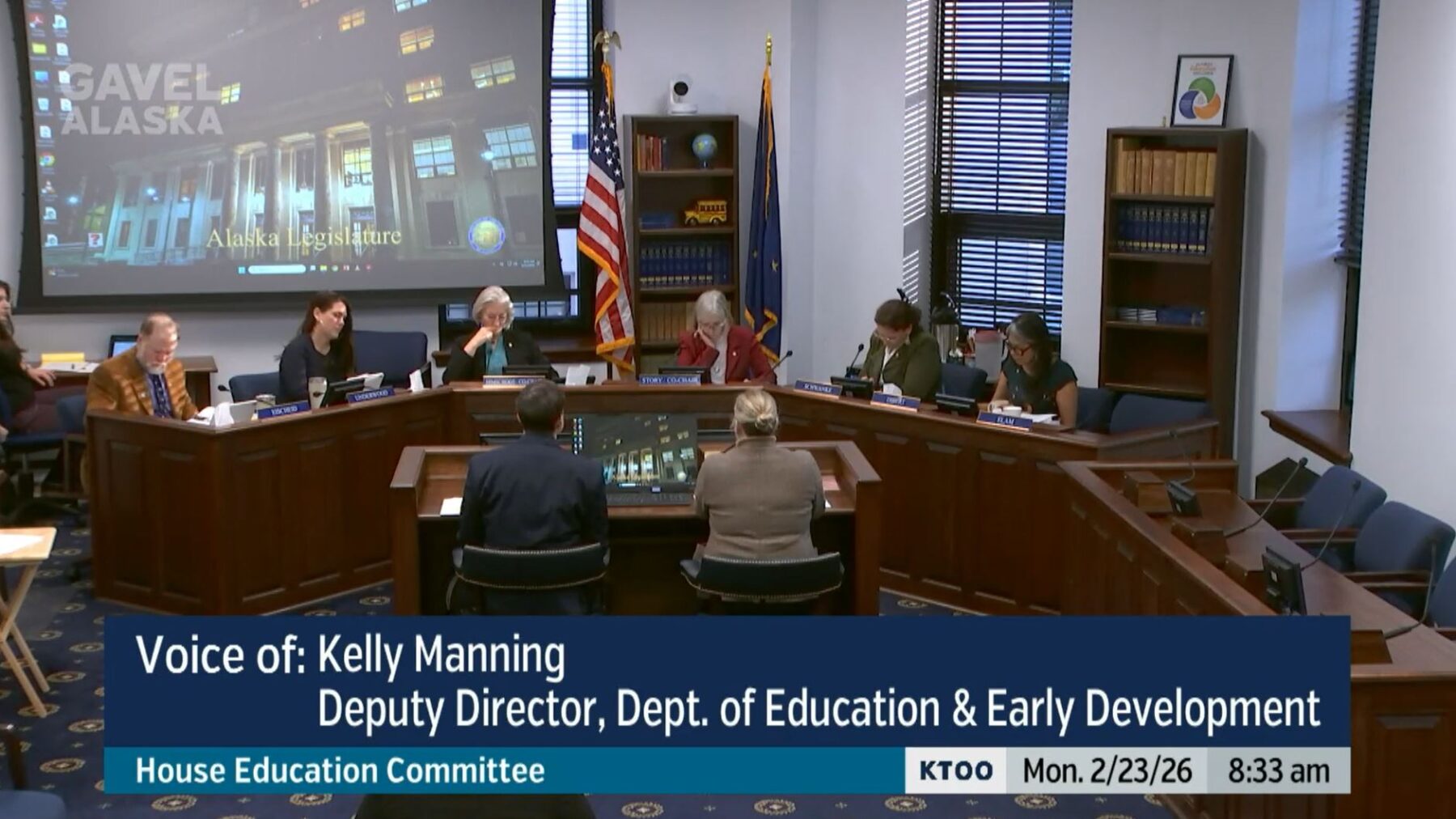
The Alaska House Education Committee delved into pressing issues facing the state’s schools, from innovative student engagement programs to legislative proposals aimed at combating modern bullying and stabilizing funding. The meeting, chaired by Co-Chair Rep. Andi Story (D – Juneau) and Rep. Rebecca Himschoot (NA – Sitka), blended celebration with policy deliberation, highlighting both successes in local education and the challenges posed by technology, declining enrollment, and special needs services.
Addressing the Digital Battlefield – HB 240 Targets Cyberbullying and AI Impersonation
The committee’s legislative agenda kicked off with House Bill 240, sponsored by Rep. David Nelson (R – Anchorage), which seeks to mandate school districts to adopt policies against digital harassment and non-consensual digital impersonation. This bill arrives at a critical juncture, as advancements in artificial intelligence (AI) and social media have amplified bullying tactics, particularly among youth. Nelson opened by painting a stark picture of the evolving threats: “As technological advances in artificial intelligence and the proliferation of social media have made clear, school children are now susceptible to new methods of bullying and harassment.” He emphasized how deepfakes and impersonations disproportionately affect women and children, urging the need for updated frameworks to empower schools.
Staffer Donna Fox Page provided a detailed sectional breakdown, explaining how the bill amends existing statutes under AS 14.33 to require policy adoption, integrate training, enhance reporting, protect against false accusations, and define key terms. The effective date is set for January 1, 2027, allowing districts time to prepare. A poignant moment came from student testimony by Alexandra (last name withheld due to her minor status), an Anchorage high schooler who shared her experiences with online torment. “Bullying doesn’t happen in the hallways or in the cafeteria anymore. It happens on many social media platforms like Instagram, Snapchat, or TikTok,” she testified, describing how fabricated images and accounts erode mental health and classroom focus. “It impacts how you walk into school the next day, how you focus in class, and how you see yourself.” Alexandra’s plea was straightforward: “We’re not asking for anything extreme. We’re asking for rules that reflect the world we actually live in.”
Committee members engaged deeply, raising concerns about scope, constitutionality, and implementation. Rep. Schwanke (R – Glennallen) highlighted the rapid evolution of synthetic media, sharing a personal anecdote about AI-generated faces and voices, and questioned whether the policy should extend statewide. Nelson agreed on the need for broader AI legislation in the coming years. Representative Underwood brought emotional weight, referencing recent tragedies: “Just in the last seventy-two hours, I have read and heard two different mothers’ testimonies about their children no longer being with us because of AI bullying.” She advocated for action at state and federal levels to save lives.
Co-Chair Story inquired about outreach to districts like Anchorage and the Alaska Association of School Boards (AASB), noting potential overlaps with existing model policies. Deputy Director Kelly Manning from the Department of Education and Early Development (DEED) clarified that while statewide bullying guidelines exist and are being updated for online elements, AI-specific harassment like deepfakes isn’t explicitly covered yet. “We do have statewide policy around bullying and harassment and our e-learning materials… are being updated to include information regarding online bullying and harassment,” Manning said, but admitted the “fast-changing landscape” demands more.
Rep. Dibert (D – Fairbanks) flagged First Amendment issues: “Have you looked into freedom of speech when it’s online—if that’s going to affect this?” Nelson acknowledged this hadn’t been fully explored, signaling a need for legal review. Rep. Eischeid (D – Anchorage) sought clarity on definitions, asking if something as innocuous as an emoji could qualify as harassment. Page distinguished intentional impersonation from symbolic expression, noting emojis likely wouldn’t meet the threshold.
The discussion underscored a balance between urgency and caution. With no public testimony, the bill was set aside for refinements, including definitional tweaks and constitutional safeguards. Unresolved issues include statutory cross-references for digital harassment, district adoption rates, and off-campus jurisdiction. This part of the meeting revealed a committee committed to protecting students in an increasingly digital world, where virtual harms spill into real-life trauma.
Stabilizing the Fiscal Foundation – HB 261: Reforms Average Daily Membership and Funding Formulas
Shifting gears after a brief recess, the committee examined House Bill 261, sponsored by Co-Chair Story, which proposes reforms to Average Daily Membership (ADM) calculations, school size adjustments, and intensive needs funding to provide stability amid declining enrollment. Story framed the bill as essential for predictable budgeting, especially in rural areas: “In a school district with around eighty kids, losing four students is about $300,000… Small schools are delicate… losing that in the first year is significant.” She highlighted nationwide trends of fewer children, urging Alaska to prioritize stability to boost retention and planning.
DEED School Finance Manager Lori Weed dissected the updated fiscal note, projecting a $147 million impact. She explained the methodology: “We did have to generate new ADM numbers… taking the previous three-year average as defined in the bill and comparing those to this year’s preliminary count for SY26.” The bill replaces hold-harmless provisions with a three-year ADM average, selecting the greater of the average or current count per school. Weed estimated the alternative high schools component at about $5.8 million, due to removing minimum ADM thresholds and interactions with host schools. For intensive needs, she isolated roughly $43 million to use the greater of prior averages or current counts.
Co-Chair Story sought confirmation: “With the exchange of hold harmless for the three-year average… you looked at each of the 53 districts… result is a net addition of funding—is that correct?” Weed nuanced it as school-level dependent, noting some districts might lose absent hold-harmless, while others gain. Current hold-harmless costs about $12 million in state aid, potentially offsetting part of the new note.
Rep. Schwanke requested walkthroughs for districts with large increases and decreases to demystify the “cascading” formula effects. Story floated ideas like grandfathering hold-harmless districts or a rural stabilization fund, criticizing “chaotic backwards funding.” Data sources were clarified: preliminary FY26 OASIS data for current counts, with SY23-25 for averages.
The bill addresses broader challenges, including alternative programs and intensives, amid enrollment drops. Story anticipated the fiscal note could rise if declines accelerate, as averaging cushions losses. With time short, the bill was set aside for further analysis, including DEED scenarios and policy explorations for rural schools.
Overall, it reflected a proactive stance on evolving educational demands, with follow-ups slated for Wednesday’s session. As Alaska grapples with these issues, the committee’s work underscores the delicate balance between innovation, protection, and fiscal responsibility in serving the state’s diverse student population.


