

By DAVID BOYLE
We knew this was coming—the coordinated assault by various special interest groups to increase education funding, and using your PFD to pay for it.
The special interest groups believe they know better than you about how to spend your money.
The education industry attended the Senate Education Committee on Jan. 25, hands outstretched for more and more money to solve Alaska’s K-12 education problems.
All the industry members, NEA (teachers union), Alaska Council of School Administrators, Alaska Association of School Boards, and the Coalition for Education Equity want to increase the Base Student Allocation.
Their common mantra was, “The BSA has been flat funded since 2017” and Alaska must adjust for inflation now and for the future.
The NEA’s presentation stated that the Anchorage School District was proposing to close six schools. That proposal went nowhere. The ASD is now recommending five of the six be repurposed for new programs and putting the Alaska Native Cultural Charter School in another. This statement by the NEA was, it appears, misinformed.

The NEA’s presentation also included this slide:
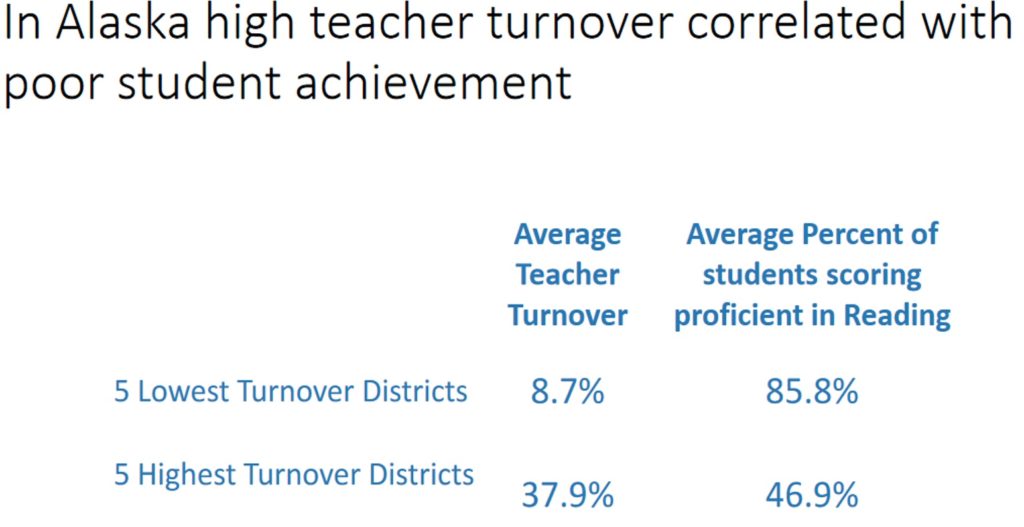
At first blush one would conclude that the districts with high teacher turnover directly correlate with low student reading scores. Once again, this is misinformation because the reading scores are outdated; these may be the 2014 reading scores. None of our reading scores are anywhere near the cited 85.8%.
The recent AKSTAR statewide tests showed that only 29.46% of students statewide were proficient at reading. The best reading proficiency score was the Sitka School District with a 40.62% for all grades.
Hopefully, members of the Senate Education Committee are aware of the significant differences and misleading NEA statements.
Calculating funding for school districts is not as simple as it seems.
The Base Student Allocation is used to determine funding for school districts. Once it is set, it is then multiplied by the adjusted average student membership. The BSA is not multiplied by the actual number of students, as some would like Alaskans to believe.
This adjusted average student membership is the result of a multiplication process. Through that process, the actual Anchorage School District student count of 41,196 goes to a whopping 73,746 students.
The Alaska Council of School Administrators wants a 14-18% increase in the Base Student Allocation and wants it inflation-proofed in future years.
That would mean at today’s (FY23) adjusted student population of 259,015, an increase of the BSA by 18% would be $7,033. The total cost of K12 would be $1.8 billion. This would be an increase of $604.4 million. Even at the low end of a 14% increase in the Base Student Allocation, the increase would be $542.6 million, and change.
The Anchorage School District repeats the “flat funding of the BSA since 2017” mantra and wants an increase in the BSA of $860, or a jump from $5,960 to $6,820 per student.
In terms of last year’s Permanent Fund dividend ($3,284), that would be 168,193 dividends. Do that many Alaskans want to use their PFD to funnel more money into K-12 public education?
The Education industry cherry picks the base year of 2017 because it was the last year the BSA was substantially increased. But for a more accurate look, one should go back further—to the year 2000. This would ensure a smoother funding curve with more accurate inflation numbers.
The FY 2000 BSA was $3,940. If we inflation adjust that to 2022 dollars that would mean a BSA of $6,528. The result would be $1,692,096,768, an increase in K12 funding of $472,568,205. This would be the equivalent of 143,900 PFDs.
All the organizations listed above go to Juneau to lobby for more and more money. Alaskans, through their various taxes, pay the membership dues of those organizations that descend upon the Legislature to ask for more money.
The circle of funding is to pay for more for K-12 with little to no accountability by educators.
Lon Garrison, President of the Alaska Association of School Boards, said about accountability, “We measure success by a student receiving a diploma. We need to stop measuring success with spending.”
Fewer than 28% of Alaska’s 9th graders are proficient at reading. Will they be able to read their diplomas?
The BSA should be increased somewhat. Many will argue that the districts need to also be more accountable for that funding and that Alaska cannot continue to throw more money at K12 education and hope to get better results. The funding needs to be tied to results.
Without accountability, we can expect to see even more future demands for your PFD.
David Boyle is the education writer for Must Read Alaska.



