
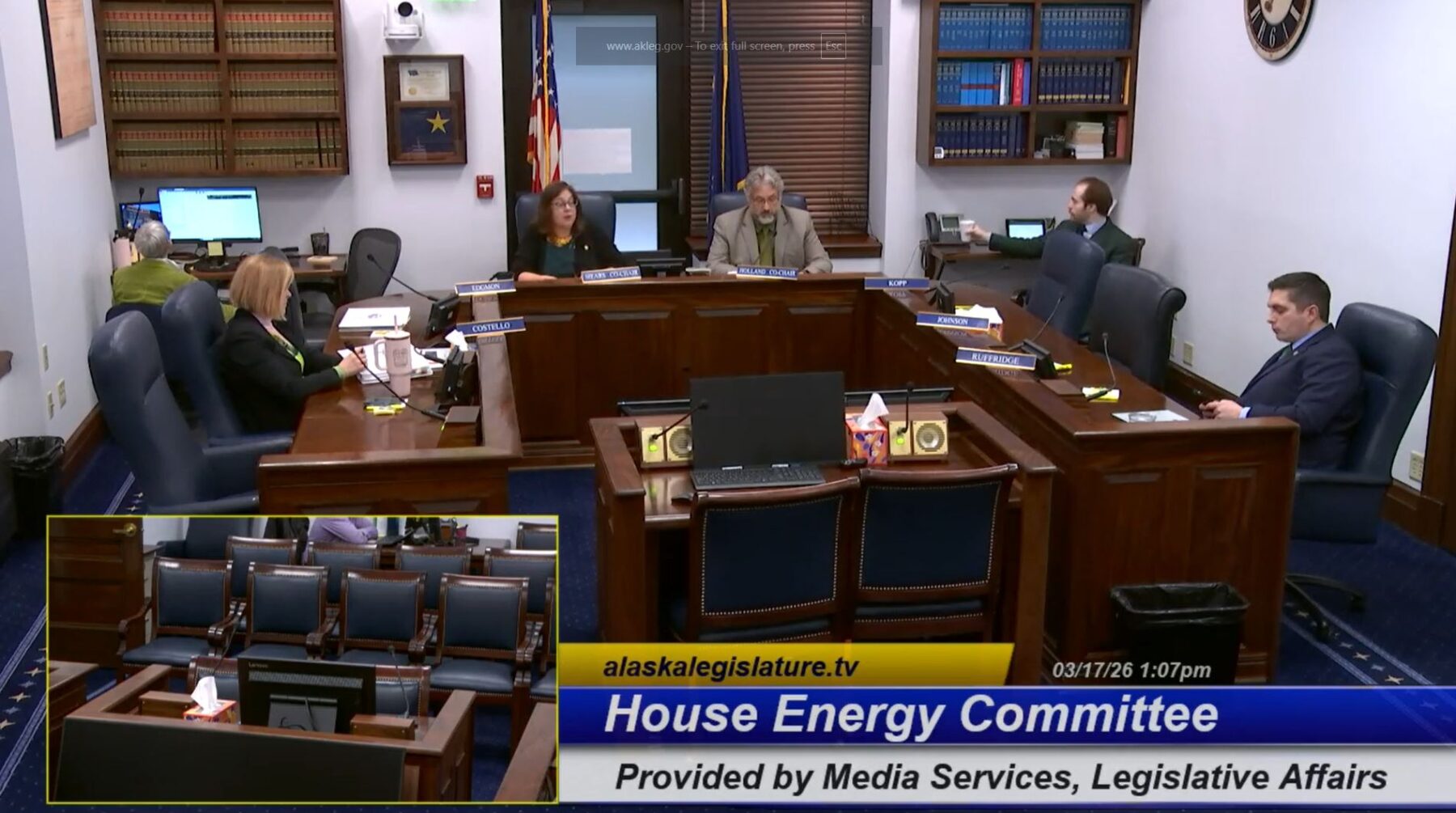
The House Energy Committee, sitting as the finance subcommittee for the Department of Commerce, Community, and Economic Development, held a focused session Tuesday afternoon to discuss funding recommendations for the Renewable Energy Fund (REF). With the governor’s proposed budget containing zero dollars for REF projects—a break from prior years’ placeholder amounts—the committee seized the opportunity to develop flexible tiered recommendations for the House Finance Committee.
HB 328 – Renewable Energy Fund Appropriations
Co-Chair Rep. Donna Mears (D-Anchorage) presented a draft memo outlining three funding tiers based on the Alaska Energy Authority’s (AEA) 28-project priority list. The full-funding option would appropriate just over $41 million to support all 28 projects, delivering substantial leveraged private and federal match dollars and projected annual household energy savings. A mid-tier level of nearly $25 million would fund 13 projects, while a minimum tier of approximately $7 million—consistent with the previous year’s appropriation—would cover the top five. Mears emphasized the tiers’ geographic and project-type diversity and noted that annual savings figures understate long-term value, as many projects span 10–20 years of operation.
Co-Chair Rep. Ky Holland NA-Anchorage) reinforced the multi-year perspective, stating, “You have to start looking at this over the life of a project that might be 10 or 20 years to recognize what looks like a fairly small annual savings is much larger.” He cautioned against overemphasizing single-year metrics, particularly for early-stage planning or battery-storage initiatives that strengthen grid reliability without immediate generation increases.
Rep. Justin Ruffridge (R-Soldotna) raised a practical concern about generation output. He acknowledged the value of planning, battery systems, and grid enhancements but questioned the electron production from many listed projects. “We’re not really generating a lot in the way of electrons with these projects,” he observed, requesting AEA data on expected kilowatt-hour generation before committing to broad funding. Rep. Mia Costello (R-Anchorage) stressed fidelity to the REF Advisory Committee (REFAC) and AEA ranking process, cautioning against any precedent that would allow future committees to reorder priorities. Co-Chair Holland suggested clarifying that the committee endorses following REFAC’s due diligence rather than independently re-ranking.
The committee agreed to refine the memo language to reinforce support for the existing REFAC/AEA process and to seek AEA’s generation estimates. No formal vote was taken; the recommendations will be forwarded to House Finance once finalized.
HB 369 – Energy Omnibus Bill
The committee briefly scheduled its next meeting for Thursday, March 19, at which it will hear the committee substitute for HB 369, the comprehensive energy omnibus legislation. The omnibus measure is expected to address a range of energy policy issues, including potential refinements to permitting, grid interconnection standards, and renewable project incentives, though details remain pending committee review.
The committee’s work positions the REF as a targeted tool for energy security and affordability rather than broad subsidy. With generation data forthcoming and the omnibus bill set for Thursday, lawmakers appear intent on advancing only those projects that demonstrably strengthen Alaska’s energy systems without straining the general fund.


