
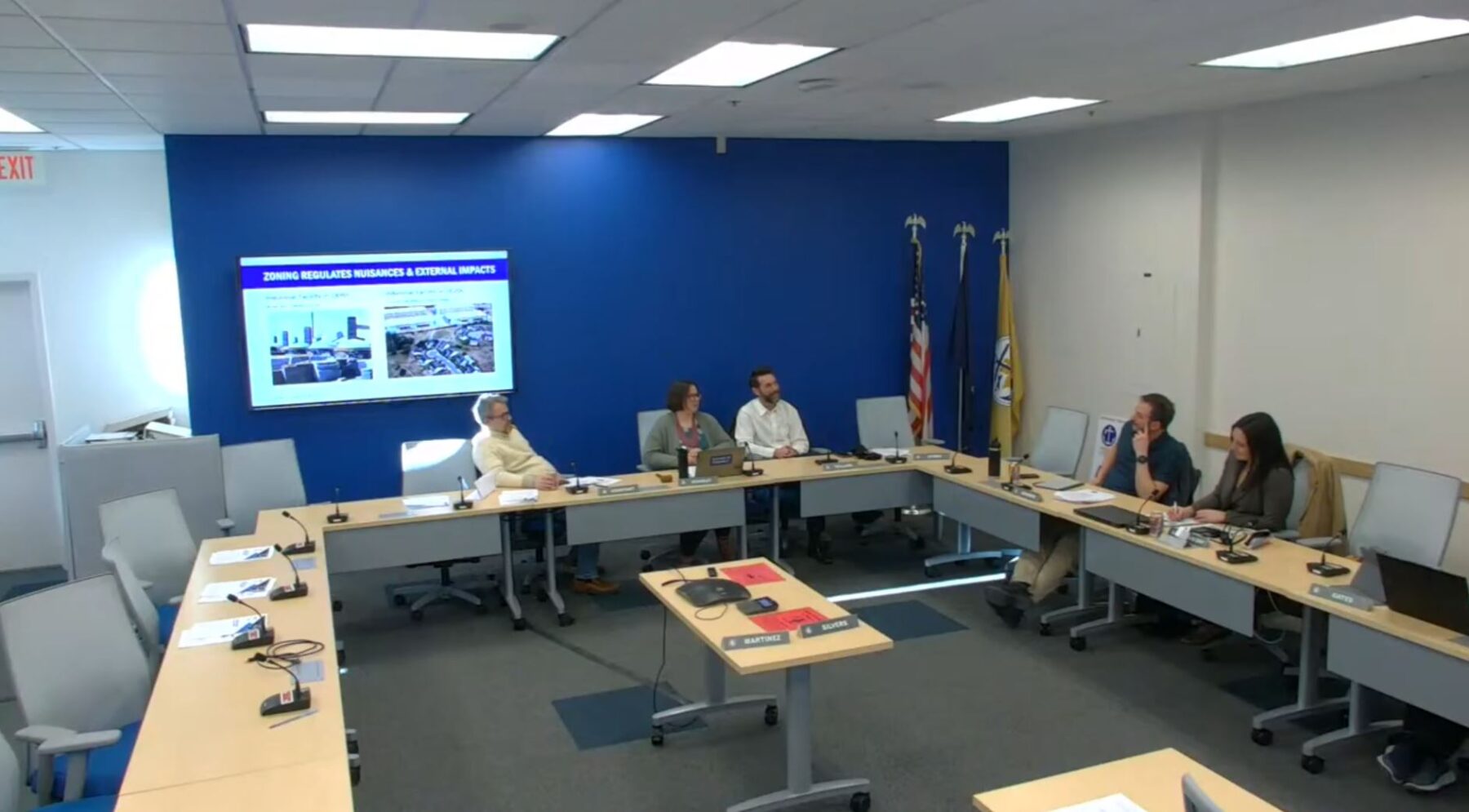
With artificial intelligence and cloud computing driving explosive demand for data processing nationwide, the Anchorage Assembly spent nearly two hours on February 27 examining how to manage potential large-scale data centers before any formal proposals arrive in the city. During a worksession on Ordinance AO 2026-27, members explored amendments to Title 21 of the Anchorage Municipal Code that would define data centers as a distinct land use, restrict them to conditional approval in industrial, port, airport, and public lands zones, and require detailed impact reviews.
The ordinance, introduced by Assembly Vice Chair Anna Brawley and co-sponsored by Assembly Member Daniel Volland, responds to a clear gap in existing code. Current definitions for “data processing facilities” or “warehouses” date to the 1990s and fail to capture modern server farms that can consume electricity equivalent to entire cities while operating with minimal on-site staff.
Brawley, who serves on the National League of Cities’ Energy, Environment and Natural Resources committee, opened the session with a detailed presentation highlighting both opportunities and risks. She noted that data centers range from compact “closet-sized” installations, such as the GreenSpark project collocated at a hydroelectric facility in Cordova, to hyperscale campuses that resemble massive warehouses. These facilities power everything from cloud storage to generative AI models but bring intensive electricity and water demands, continuous cooling noise, potential wastewater contaminants, and on-site backup generators.
A single large data center can use as much power as 100,000 households—roughly Anchorage’s entire residential base—raising urgent questions in a Railbelt region already facing rising utility costs. “Across the country, communities are responding to the development of large-scale data centers to drive economic activity and support growing computing needs,” Brawley stated in the official press release supporting the measure. “Those projects often bring significant community impacts, from operational noise to very high demand on public water, wastewater and electrical utilities. This ordinance invites a proactive dialogue to decide the conditions in which a proposed data center is compatible with our existing public processes [to] mitigate anticipated impacts.”
Assembly discussion delved deeply into balancing benefits against burdens. Proponents highlighted potential tax revenue from both real property (the buildings) and personal property (millions of dollars in servers that cannot easily be relocated for tax purposes). Construction would create temporary jobs, and new large ratepayers could theoretically help stabilize utility finances. Yet speakers repeatedly noted the low number of permanent operating positions—often limited to maintenance crews—compared with traditional industrial or retail developments.
Concerns focused on noise, visual impacts, and strain on municipal infrastructure. The proposal includes 200-foot setbacks from residential zones, required noise mitigation studies, visual screening, landscaping standards, enclosed power generation, and confirmation from utilities such as Chugach Electric that the grid can support the load. Members referenced the municipality’s existing marijuana facility code as precedent, where applicants must demonstrate and, if necessary, fund upgrades to utility capacity at their own expense.
A key procedural element drew attention: the ordinance waives initial Planning and Zoning Commission review. Sponsors cited four reasons— the use is brand new, the changes do not affect existing developments, timeliness is critical to avoid reactive “catch-up” regulation seen in Virginia and Ohio, and the commission’s heavy workload would delay action by months while staff research continues. The measure instead directs the Planning Department to develop use-specific standards for energy-intensive facilities and report back with recommendations.
Volland emphasized the forward-looking approach. “Amid concerns about Railbelt energy shortages and rising utility costs, it’s exciting to imagine the potential economic benefits innovative projects could create for Alaska,” he said. “Those benefits don’t come without a cost to our community. Now is the time to establish a proactive regulatory framework that balances public interests with evolving industry needs.”
Several members raised broader policy questions that extend beyond land use. Discussions touched on whether data centers should be required to invest in renewable energy, contribute to infrastructure upgrades, or enter community benefit agreements—ideas mirrored in pending state legislation HB 259 and SB 250. One assembly member addressed online criticism directly, stating the effort is not about blocking economic development but preventing residents from waking up to an unvetted industrial neighbor. The ordinance explicitly excludes residential zones and mandates holistic review of multi-phase or multi-parcel projects.
No active data center applications currently exist in Anchorage, but members cited nearby examples in Cordova and Wrangell, plus national trends showing thousands of facilities under construction. Virginia’s Loudoun County, once a by-right approval jurisdiction, retroactively imposed special permits after rapid build-out. Columbus, Ohio, has documented rising utility costs driven partly by data center demand. Anchorage leaders stressed they want to avoid similar surprises.
The worksession underscores a measured tone: treat data centers like other impactful industrial uses, such as the historic brick factories that helped establish modern zoning authority, while recognizing their 21st-century characteristics. The 20-megawatt threshold for defining larger facilities—drawn from state legislation—was debated, with suggestions it could be lowered or supplemented with server-count criteria to avoid loopholes.
Public testimony will shape the final version. A public hearing on AO 2026-27 is scheduled for Tuesday, March 3, 2026, at 5 p.m. in the Loussac Library Assembly Chambers. Residents may testify in person, by phone (sign up by 5 p.m. March 2 at ancgov.info/testify), submit written comments online, or email [email protected].
If approved, the ordinance would mark Anchorage’s first step toward managing a technology sector poised to reshape energy landscapes worldwide. Assembly members repeatedly framed the discussion as responsible stewardship—protecting neighborhoods, ensuring utility reliability, and positioning the city to capture benefits without unintended consequences.


