
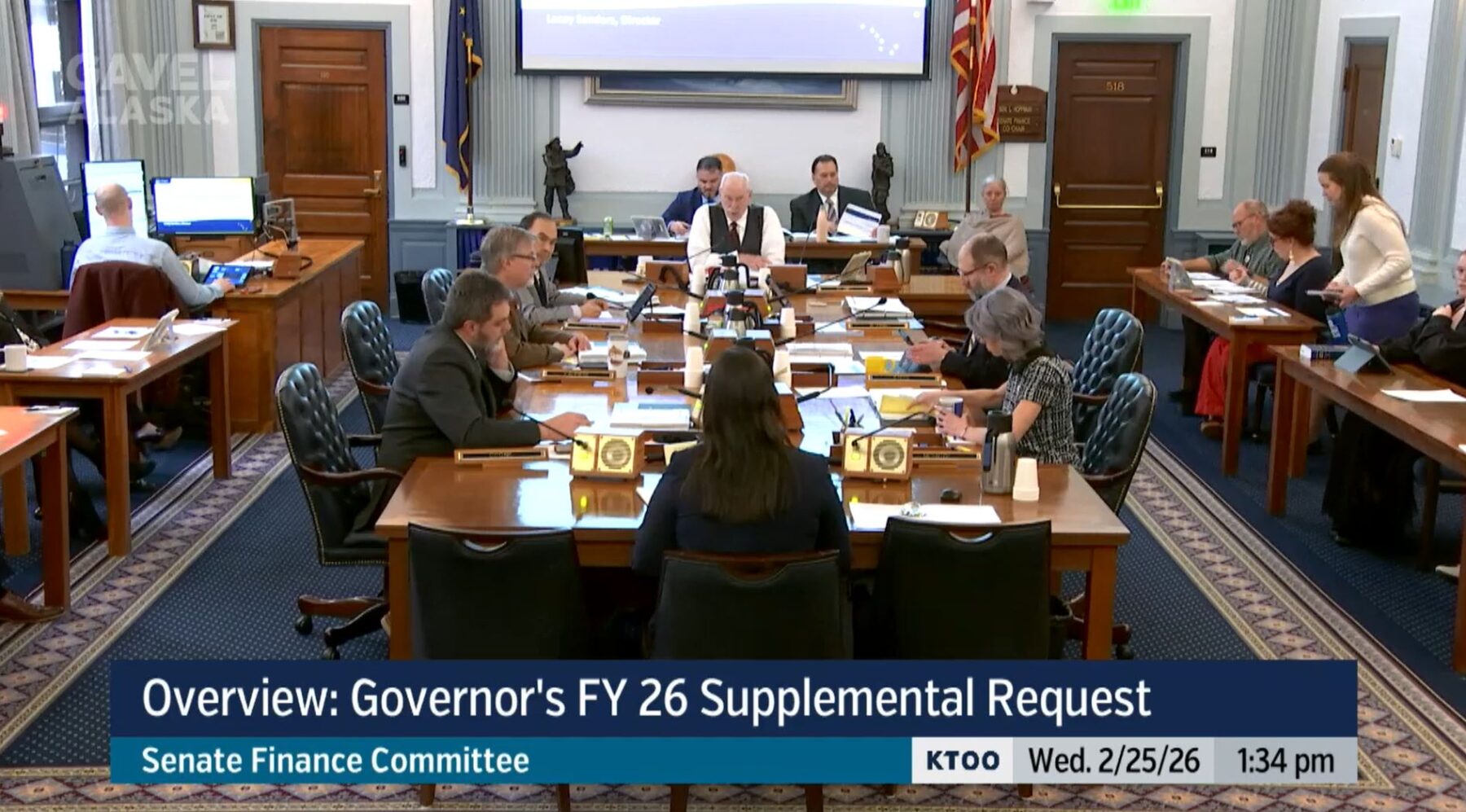
Alaska Senate Finance Committee, reviewed the Governor’s proposed FY2026 supplemental budget, addressing a projected $467.7 million shortfall driven by declining oil revenues, escalating disaster costs, and operational necessities. Office of Management and Budget (OMB) Director Lacey Sanders presented the package, emphasizing the need for swift action to avoid payment defaults, program interruptions, and construction delays. The hearing highlighted fiscal prudence amid oil price fluctuations, with a mid-March revenue forecast from the Department of Revenue poised to potentially alter the deficit outlook.
Sanders framed the discussion around unrestricted general funds, noting the supplemental’s scale: “$467.7 million is a substantial amount for a supplemental.” This figure stems from a $52 million revenue shortfall, down from a $68 per barrel oil price assumption last spring to $65.48 in the fall forecast. She stressed volatility: recent prices have climbed to around $70, but dips to near $60 remain possible, underscoring the need for “headroom” in appropriations to buffer against further declines.
Key components include $35.6 million for formula programs. The Department of Health requested $1.125 million for the Senior Benefits Program due to increased utilization, warning that without it, payments to eligible seniors would cease. More significantly, Medicaid needs $34.4 million in state funds plus $361 million in federal authority, based on mid-February projections. Sanders explained: without this, the state would halt $14 million bi-weekly check runs to providers, leading to defaults and compounding arrears into FY2027.
Fund capitalizations total $138.7 million, with $40 million for the Disaster Relief Fund to cover the October Ha Long storm (estimated at $150 million total, assuming a 90/10 FEMA match) and repay $10 million borrowed from a Department of Environmental Conservation project. An appeal for the 90/10 split is pending; denial would revert to 75/25, increasing state exposure. Sanders noted Alaska faces “about a disaster a month,” projecting $4-6 million remaining if no more occur by June. Fire Suppression requires $98.7 million, including $55 million from interim declarations and $43.7 million for prior obligations and spring preparedness, leaving $7-8 million cushion.
Statewide items amount to $127 million, featuring $2.5 million in debt service savings from bond refunding by the Department of Revenue. A $70.2 million capital supplemental recapitalizes the Alaska Higher Education Investment Fund from the Constitutional Budget Reserve (CBR), reversing last year’s drawdown. Operational needs total $44 million, including $3.3 million (multi-year) for Public Defender Agency contractors to clear backlogs, $4.7 million for Department of Corrections health care, and $1.25 million for Village Public Safety Officers (VPSOs) to fill vacancies.
A $70.2 million capital item for Department of Transportation (DOT) federal matching drew urgency. Senator James Kaufman (R – Anchorage) pressed: “I honestly don’t want to see projects delayed another year,” citing three years of instability. Sanders confirmed executive support, with Chair Stedman (R – Sitka) affirming timeliness to stabilize the industry. Without July 1 funding, projects risk deferral.
Comparing to House Bill 289 ($489.9 million), Sanders noted differences: a $2 million Medicaid reduction, $43 million more for fire suppression, and House inclusions like $30 million headroom and $35 million disaster contingency. Headroom, she explained, preauthorizes CBR draws via three-quarter vote, providing flexibility without repeated supermajorities. Stedman clarified legislative control: “We can still turn it down.”
Recent amendments (February 18) include Medicaid tweaks, VPSO funds, Economic Research Group retention adjustments to combat turnover, and bond savings. These post-date HB 289’s cutoff, so the Senate will incorporate them upon receipt.
Concerns arose over $1 million for “statehood defense” in the Department of Law, with Senator Jesse Kiehl (D – Juneau) questioning its use for cases potentially misaligned with Alaska sovereignty. Stedman noted planned scrutiny in the operating budget.
Sanders projected 98% confidence in stabilizing funds like fire suppression via reimbursements. The committee intends swift action on HB 289, prioritizing essentials while monitoring FEMA and revenue updates.
This supplemental addresses immediate gaps but underscores Alaska’s fiscal challenges: oil dependency, rising disasters, and program demands. Public testimony is slated for upcoming sessions, with regional access. As Sanders concluded, “Always happy to help answer questions,” signaling ongoing collaboration.


