
BOARD REINFORCES COMMITMENT TO RACIAL AND CULTURAL PURITY
The Juneau Arts and Humanities Council apologized to everyone for how it handled the “cultural appropriations” controversy that it created last weekend, when it chose not to defend, but publicly shame an artist and model because an Asian-inspired entry into the Wearable Arts 2018 exhibit had offended a viewer.
The Council issued the letter today to the “Juneau Community and beyond,” saying:
“We write understanding that harm has already been done that cannot be undone. As a board it is our responsibility to guide a multifaceted organization as it navigates sometimes tricky waters. Our belief is, and remains, that the Juneau Arts and Humanities Council and all those who engage with it ultimately seek good in our community. This belief is foundational.
“There has been a spectrum of responses in the community and in our own correspondence that represent a range of perspectives on both this incident and the broader concept of cultural appropriation. We want everyone to know that we hear you. We have read every word you have written and listened carefully to each word spoken. We value your voices. We value you. Our goal is absolutely not to censor art and we do not believe this piece was intended to do harm, however it did.”

The piece in question?
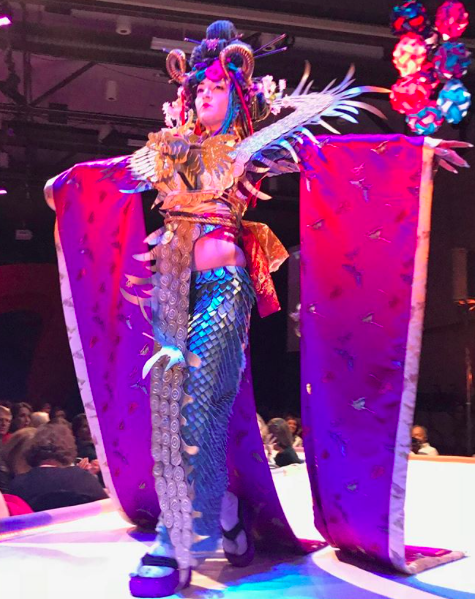
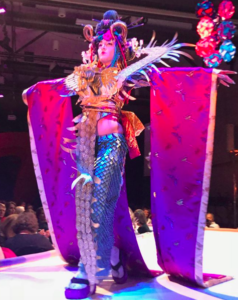
The art the council censored: An Asian-inspired, mermaid-inspired, dragon-inspired whatcha-ma-call-it that went down the runway like this, and won third place before it was banned:
The offense?
The artist is, apparently, white. She’s from Haines and she is probably not used to being asked if she is white.
The model?
That’s hard to say. Juneau far-left assumes she is white or, at the very least, not Asian. It doesn’t appear they asked in this shoot-first-ask-later environment.
In social media posts, the model has an indeterminate racial appearance. As many of us are these days, she could be a “Heinz 57” of just about any heritage — Laplander, Tibetan, Peruvian — we can’t hazard a guess in this era without running the risk of offending Juneau. But she looks like this:

In other words, the model presents like many Americans who have a mix of lineage from the great melting pot. More than seven percent of Americans are mixed heritage and they belong to families. That means nearly half of families have people of more than one race.
The costume entry had a mix of themes as well. And it contained workmanship that appeared to have taken months to complete.
But someone in Juneau who has a Asian background (but is clearly an all-American) was highly offended and wrote extensively about it on Facebook, and others in the community threw gasoline on the fire. The council pulled the work of art from the show.
Few defended the textile artist. The council certainly didn’t defend the artist, but rushed into an apology to the community.
Now, the council writes that it is going into resist mode. It is going to resist cultural appropriation, whatever that is:
“With that understanding we also reaffirm our commitment to racial equity, which includes the elimination of policies, practices, attitudes and cultural messages that reinforce differential outcomes by race. We must resist practices such as cultural appropriation that promote stereotypes that further oppress marginalized communities. As we build a strong and prosperous community we must condemn marginalization and misrepresentation. Not only do we believe the individuals who have communicated that the display of cultural appropriation was hurtful, we believe that stereotypes are harmful to the entire community.
“At an institutional level, many steps could have been taken much sooner to address this issue. There was a path available to the JAHC through patient, kind, thoughtful, and constructive communication for a more amiable resolution. That opportunity was missed, and for that we have the most regret.”
The council is appeasing the “cultural appropriations” crowd, doubling down on cowardice by saying the work of art harmed the “entire community.”
That’s a lot of power to give one artist from Haines, Alaska, who has found herself on the wrong side of political correctness.
SORRY, SORRY, SORRY
The council continued to apologize in its letter, and continued to align with the sentiments of the “racial and cultural purity” crowd that will, in the future, dictate what art is acceptable:
“The JAHC is receiving a high degree of criticism from both sides of this debate, and truthfully it is deserved. By allowing escalation to the degree it reached, our organization let the entire community down. We are sorry to the communities of people of color and individuals who were hurt by this display. We are sorry to the artist who put painstaking hours and obvious talent into their work. We are sorry to the model who was caught in the middle. We are sorry to the friends and family of the artist who were sideswiped by the controversy. We are sorry to the artists and attendees whose celebration of art was interrupted. We are sorry to the individuals who in bringing the issue to light, did not receive the response deserved. It should have been identified and addressed sooner. It was not. That the piece was still judged and awarded is yet one more error made.”
Finally, JAHC wrote about how it is now more dedicated than ever to censorship, will adopt a policy and educational material for all future artists, and will train itself how to identify politically incorrect art. It will censor art far in advance, literally behind the scenes, so the public doesn’t have to see it in a show:
“The JAHC staff and board will work with community leaders to determine a policy and educational materials for all future Wearable Art entrants on identifying and avoiding cultural appropriation.
“The JAHC will seek equity training for the staff and board, a step already identified in the Diversity and Inclusivity Task Force report.
“The JAHC will reaffirm its commitment to equity in the arts and full representation of our entire community.”
[Read: The end of art in Juneau]
PALMER ENJOYS WEARABLE ARTS CONTEST
Meanwhile, in Palmer, Alaska, a wearable arts contest went off without controversy, in spite of the fact that this Roman-inspired costume, made up of Valley Arts Alliance tickets from 12 years of shows, was designed and modeled by non-Romans. And, to the best of our knowledge, nobody of Italian descent was “hurt” by it.



