
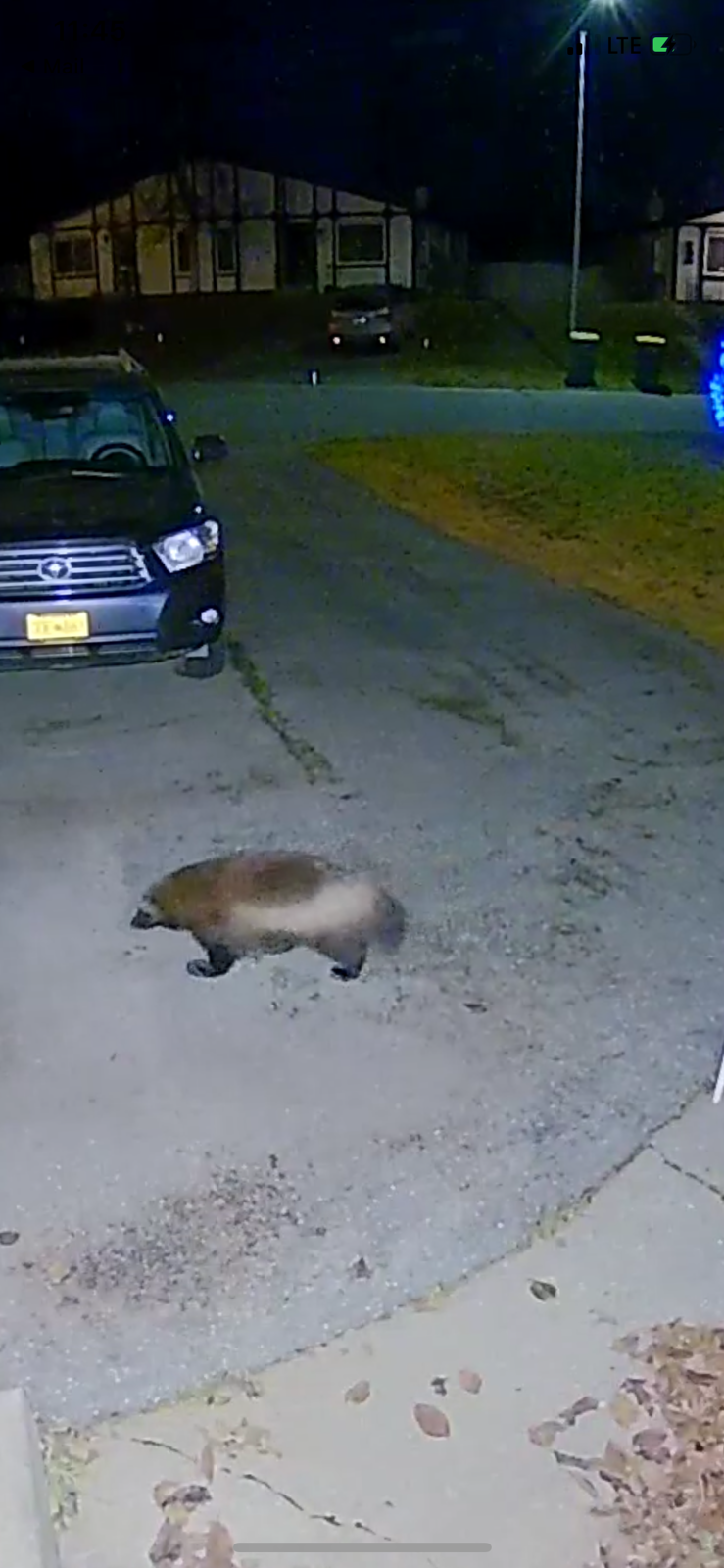
As if human prowlers and burglars are not enough in Anchorage, a wolverine captured on a home security camera near 68th and Elmore Road in Anchorage showed a prowler of a different nature in a dense neighborhood: A wolverine.
The video made the rounds on NextDoor.com, a neighborhood-specific communication website.
The animal also was reported to have appeared a couple of blocks over, on 66th, and a woman said her cat was fighting it off when she intervened.
“A large wolverine tried to make my cat his dinner last night about 2 am. He was on my porch fighting w. My cat. I live Off of Elmore and 66th. I would highly recommend keeping all small pets indoors. He was not easily scared by my yelling and screaming,” wrote Torrie Ruhle, who has lived in the area for 10 years and never before encountered one.
Another neighbor said a wolverine was spotted two weeks ago near Cange Street and Huffman Road.
Dacia Davis said a wolverine had chased a friend’s cat in the area, and when her friend intervened, the animal hissed and snarled. “He said it was quite vicious.”
At the same time, several reports of missing cats have shown up on the communication thread, leading some to speculate that the wolverine is hunting them.
It’s a neighborhood where bear sightings are not infrequent, and where moose are common. Every so often, someone will report a wolf slinking through; there is a greenbelt nearby, and the neighborhood is not far from the Chugach National Forest.
Urban wolverines, however, are rare. They are more likely found in boreal forests and tundras, where they spend their lives hunting and scavenging. With their thick fur that resists frost, they were prized by trappers and thinned considerably, but their population has rebounded in North America. Alaskans trap and hunt about 550 wolverines annually, according to the Alaska Department of Fish and Game.
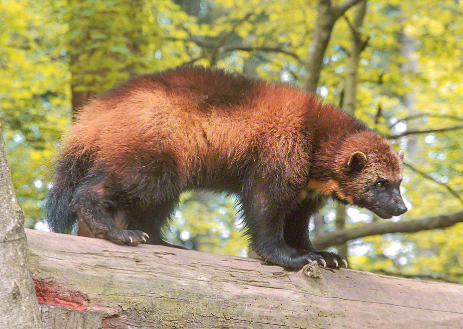
They have a reputation for being solitary and ferocious, and with speed and musculature, they can take on prey far bigger than themselves. Wolverines been said to fight bears, but typically they’ll be hunting hare, voles, scavenging kill from wolves and bear, or just maybe in Anchorage, they’re now opportunistically hunting family pets.
Wolverines’ scientific name is Gulo gulo (Latin for “glutton”). They are the largest of the weasel family and have a strong glandular smell, which has earned them the nickname of skunk bear. Fish and Game says that the Chugach State Park is home to about 4.5 to 5.0 wolverines per 1,000 square miles in the Turnagain Arm and Kenai Mountains.
In Southcentral Alaska, female wolverines use about 115-230 square miles and males use about 270 to 380 square miles; female territories rarely overlap with other females, and male territories don’t overlap much either.
On the Fish and Game page devoted to “Living with Wildlife,” there are tips for living among bears, moose, wolves, and muskox, beavers, bats, and bison — but no tips for living among wolverines.
On NextDoor’s communication group for the Taku-Campbell area, Abbott Loop North neighbors are warning people to keep their small dogs and their cats inside at night.
[Read this Fish and Game report on the life of wolverines by Riley Woodford]
Have you had a wolverine encounter? Share it below!


