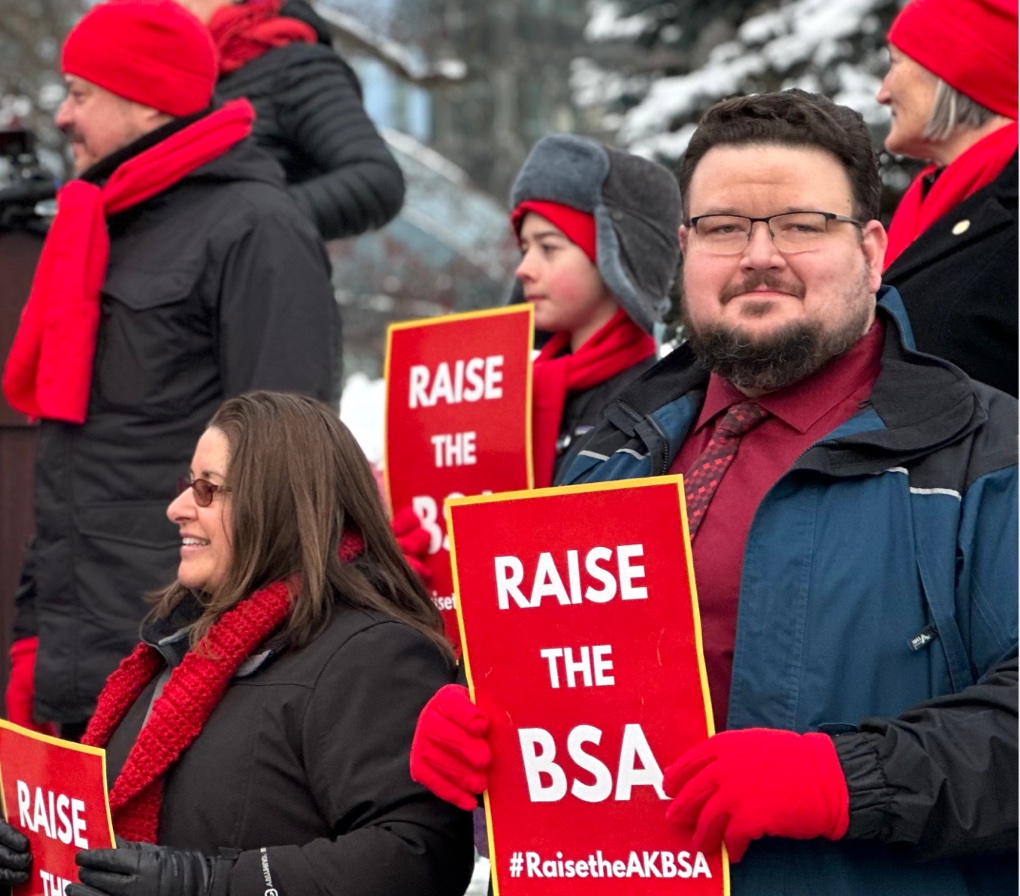
Dozens of Big Government educators and union representatives gathered Saturday in downtown Anchorage to rally for more funding for education. They wore red coats, scarves, and hats and were calling on the Legislature to override the governor’s veto of half of a massive education funding bill passed last year. They would love to have the Legislature poke Gov. Mike Dunleavy, who won reelection in 2022 with over 50% of Alaskans on the first round of voting.
The bill last year had $175 million that the legislative majority wanted for schools; Gov. Mike Dunleavy vetoed $87 million, since many schools had remaining fund balances from the year before.
It takes three-quarters of the Legislature to override a veto and, although legislators never called themselves into special session last year to vote on a veto override, they have five days after gaveling in on Tuesday to lock in the votes. Every district still got a large per-student increase. Dunleavy vetoed the $680 increase, keeping it down to a $340 increase.
An override would mean that many Republican legislators would have to go against the top Republican in the state — the governor, who has time and again called for education spending and performance accountability in a state where educational outcomes are some of the lowest in the nation and spending is the highest.
Although the Alaska Senate has gone more liberal, it would mean that senators from conservative districts — such as Sen. Kelly Merrick of Eagle River, Sen. David Wilson of Wasilla, and Jesse Bjorkman of Kenai — would have to stand with the Democrats against their own governor.
This, at a time when $2.6 billion was spent on education in Alaska for public school districts, not including local taxpayers’ contribution through their property taxes, in those organized boroughs that collect taxes. In addition, House Bill 106, the teacher retention bill from Dunleavy from 2023, passed, giving $15,000 bonuses to people who teach in rural Alaska, and the governor invested in a reading program.
Carl Jacobs, the vice president of the Anchorage School Board, says that inflation had increased 28% since the last adjustment to what’s known as the BSA — the Base Student Allocation — in 2016.
Yet Jacobs and the others at the rally did not acknowledge that even though the formula has not changed, schools get a one-time boost in funding every year from the Legislature. Last year they just didn’t get as much as they demanded, and yet they have continued to spend beyond their means.
Enrollment has dropped in most districts around the state except the Matanuska-Susitna Borough, where student count has grown.
For example, Anchorage schools since 2016 have lost over 10% of their students, yet no schools have closed and the student-teacher ratio is 17:1, considered exceptionally low.
Anchorage has 97 schools and about 43,000 students, the lowest enrollment in over a decade.
For comparison, Chandler, Arizona has 44,000 students and 45 schools. Sacramento, California has 40,000 students and 73 schools.
Juneau schools had 4,688 students in 2016, but have lost more than 600 students since then. The U.S. Census data predicts the capital city will continue losing students, as residents of Juneau have stopped having children.
The Juneau School District projects that in 2032, there will be 3,036 students, but it has made no effort to consolidate campuses. Juneau has 14 schools, including two high schools.
For comparison, Olympia, Washington has 9,500 students and 20 schools. Durango, Colorado has 5,800 students and 14 schools.
Carl Jacobs said on his campaign website, “This economic squeeze has led to the closure of schools, diminished educational opportunities for students, and placed our dedicated educators and paraprofessionals in a precarious financial position, struggling to meet basic needs.”
No schools have closed, contrary to Jacobs’ claims.
In addition, raising the BSA does not guarantee the money will go to teachers, because that is a local district decision. Jacobs has been sitting on the school board and is responsible for teacher salaries in Anchorage, and also responsible for deciding if schools should close.
On top of the BSA, the Anchorage schools get 58% of Anchorage property taxes, and the district also get federal disbursements and grants.
Those students who do attend Anchorage schools are missing a lot of classes. Last year, 43% of Anchorage students were chronically absent.
Students report that they are not learning enough in schools because the teachers are disengaged and not teaching, and so students would rather study at home. Teachers are also missing from classrooms, students report, and depend too much on substitute teachers, who show movies.
The results are profoundly disturbing to parents: In Anchorage, 43% of elementary students test at or above the proficient level for reading, and 39% tested at or above that level for math.
Even so, in April, Anchorage taxpayers will be asked to pay for a $30 million bond to build a brand new school to replace Inlet View School, which some critics say should be closed. The school is in Assembly Chair Chris Constant’s district.
The chanters and union representatives in Anchorage want the money guaranteed year after year. They’ll be heading to Juneau next week to lobby the legislature in the same “red for ed” manner.
Joelle Hall, head of the AFL-CIO, rallied the crowd: “If it’s outside the formula, we all know what happens there. You have a job one year. You don’t know if you have one the next. That’s no way to run a school. Hell, it’s no way to run a state.”
If the legislators really want the funding, rather than poke the governor in the eye, they would also have the option to offer a supplemental funding package. Every year, there is a supplemental budget; this year will be no different. The question is: Would Republican legislators rather get into a confrontation with Dunleavy, who enjoys broad support across the state?