
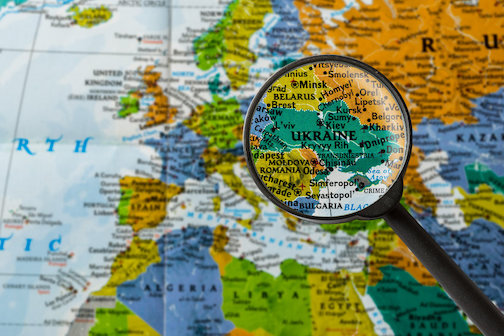
U.S. officials warn that a Russian attack on Ukraine is likely just days away, and has withdrawn all U.S. personnel from the country. Canada has withdrawn all of its military trainers from the area and urged Canadian families to depart immediately, leaving Ukraine now vulnerable. Most of these remaining allies are now in Poland.
The evacuation spells the end of “Operation Unifier,” a large allied training mission in Ukraine, involving both the United Kingdom and the United States. The Ukrainians are once again on their own, as 100,000 Russian troops surround Ukraine along the vast border, and Ukrainians say that portions of their country are already under Russian control.
But the battle ahead may be untraditional and may take place through noncombat means — especially cyberattacks, economic attacks, and terroristic bomb threats, especially since the United States has warned Russia of economic sanctions should President Vladimir Putin attack Ukraine.
With the United States now under the leadership of a frail president, whose mental capacities are demonstrably diminished, Putin may have plans for cyberattacks against the U.S., should our nation retaliate economically against Russia, as President Joe Biden has vowed.
It may be too late for America’s power plants, electric grids, internet, water treatment, and other infrastructure to harden the security of those economic cornerstones, if such an attack is launched.
“We assess that Russia would consider initiating a cyber attack against the Homeland if it perceived a US or NATO response to a possible Russian invasion of Ukraine threatened its long-term national security,” according to a DHS Intelligence and Analysis bulletin sent to law enforcement agencies on Jan. 23.
The DHS bulletin also said a “range of offensive cyber tools that it could employ against US networks” are available to the Russians. According to CNET.com, “In recent weeks, the Russian government is believed to have initiated a handful of cyberattacks against Ukraine. Last month, hacker groups linked to Russia’s intelligence services were blamed for a cyberattack that defaced dozens of Ukrainian government sites with a message warning the country to ‘be afraid and expect the worst.'”
Such a similar attack on U.S. infrastructure would be seen as an act of war, and would have to be sweeping and done with an element of surprise, otherwise the retaliation by Americans would be crippling to Russia’s own infrastructure.
The threat has been growing: In December, the Department of Homeland Security Cybersecurity and Infrastructure Security Agency (CISA) issued an urgent bulletin: An internet “vulnerability, which is being widely exploited by a growing set of threat actors, presents an urgent challenge to network defenders given its broad use,” according to CISA Director Jen Easterly. “To be clear, this vulnerability poses a severe risk.”
Easterly was referring to a component of software called “Log4j,” a utility that operates in the background of the vast majority of software applications in the United States. Even the Department of Defense uses Log4j.
What does this mean for Alaska? Alaskans may expect to see more activity around its military bases in coming days, more sorties and exercises, as well as more base security.
For a far-flung state like Alaska, the threat of being wholly dependent of shipping for fuel and food over long distances in difficult conditions, makes the threat of a cyberattack more serious concern, especially for rural Alaska, where there are no roads. A cut to the communications system, such as if the cellular network went down, or the jamming of computers that operate the Trans Alaska Pipeline System would necessitate a state disaster declaration or state of emergency. A governor might need to call up the National Guard in such an emergency.
Gov. Mike Dunleavy has already focused on increasing security, requesting $25 million from the Legislature to increase food security in the state, and another $23 million to migrate all state servers to “the cloud,” in the anticipation of major disruptions, such as the one that could occur with Russia and possibly North Korea.
But it would take years to effect the change toward greater food security in Alaska, as well as to harden the state’s servers from being taken down by foreign hackers, even if Dunleavy could get the Legislature to agree.
Whether the Legislature has the clarity to work on this issue is a question. For as much as a cyberattack on the United States is a threat of some magnitude to Alaska, the House Committee on Military and Veterans Affairs on Tuesday will continue its inquisition into the veterans’ group known as the Oath Keepers, with a presentation from Sam Jackson, author of “Oath Keepers: Patriotism and the Edge of Violence in a Right-Wing Antigovernment Group,” and Matthew Kriner, senior research scholar at the Center on Terrorism, Extremism, and Counterterrorism, at Middlebury Institute of International Studies.


