
By Captain David Bayes
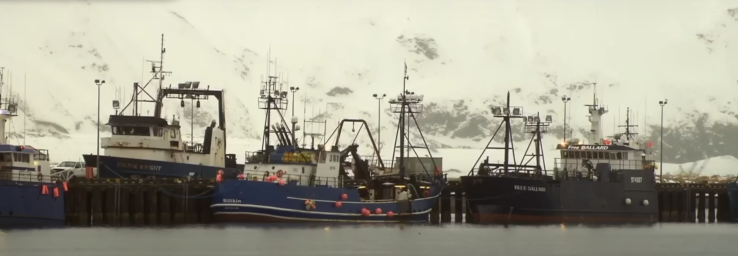
The trawl (also known as the dragger) fishery occurring offshore of Alaska is one of the largest in the world. Many trawl boats currently fishing in Alaska moved here after fisheries in their home waters collapsed. Many crews of factory trawlers fly from their homes in other states/nations to meet the boat, extract Alaskan fish, sell them mostly overseas, and then fly home. Therefore, they rely upon Alaska’s fish, but they do not rely on nor significantly contribute to Alaska’s economic and geographic stability.
Trawl’s Enormous Scale
The scale of trawl and trawl bycatch (discarded fish) is difficult to comprehend. Over the last decade, trawlers in Alaska average 141 million pounds of observed and reported bycatch each year. That amounts to approximately 3.53 billion pounds of bycatch waste since the year 2000. On an hourly basis, that equates to 16,000 pounds of waste per hour. Trawl is a fishery built for speed and volume. Although many issues exist, trawl is protected by a management regime which absorbs extreme damage as “routine.”
Trawl’s Impact on Habitat
Trawl’s habitat footprint is equally astounding. The largest trawlers drag 6 square miles of seafloor every day. There are dozens of these vessels fishing hundreds of days per year. The cumulative seafloor habitat destruction extends over tens of thousands of square miles annually. Although the harm happens invisibly beneath the water, the irony of this destruction is not lost upon Alaskans. For comparison, the Willow oil project receives scrutiny for a surface impact of 0.8 square miles per year. On land, fractions of a square mile are treated as emergencies. But underwater, entire landscapes are scraped without debate.
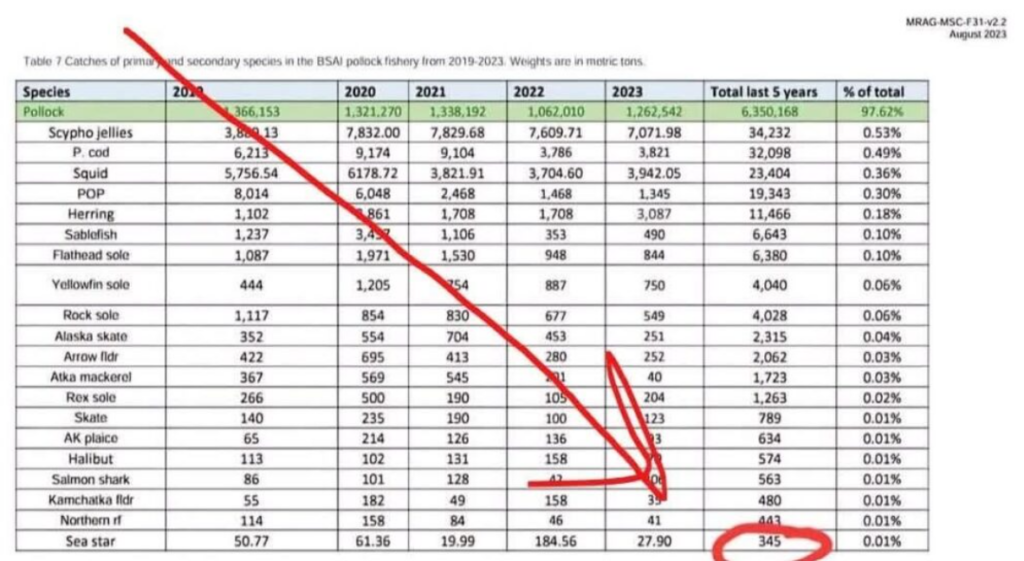
The contradictions run deeper when you look at trawl’s “mid-water” nets. The name suggests gear suspended above the bottom, but their bycatch of bottom dwelling species tells a different story. Over the last 5 years midwater nets caught 14 million pounds of flathead sole, 8.9 million pounds of yellowfin sole, 8.88 million pounds of rock sole, 6.8 million pounds of skates, 4.55 million pounds of arrowtooth flounder, and 1.2 million pounds of halibut. They also caught 760,000 pounds of sea stars (starfish). These are bottom species. Their presence in these volumes is not the whole bycatch picture; however, it is crystal clear evidence that the “mid-water” label is a misnomer.
Trawl’s Toll on Alaskan Communities
The toll on Alaskan communities is also immediate. Families on the Yukon and Kuskokwim cannot take a single Chum or King Salmon, even though trawlers are rubber stamped to waste 77,500 individual Kings each year statewide. Halibut quotas are shrinking, and many crab fisheries have experienced total closure. These are total economic and social erasures, which disproportionately fall on the people who harvest the least. Meanwhile, trawl continues to harvest the most.
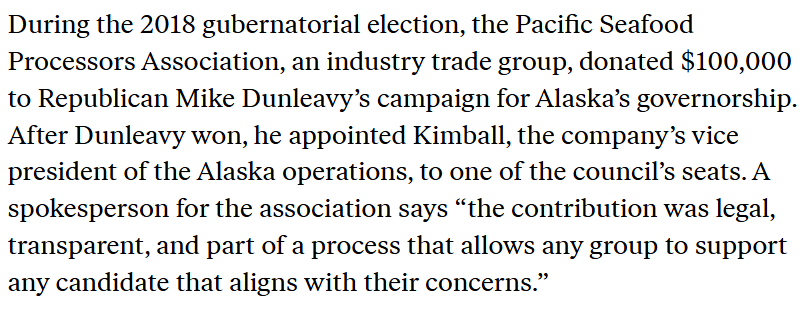
Paralysis by elected officials allows this to continue. Polling shows 70% of Alaskans want trawling banned or restricted. That level of agreement is extremely rare, yet it has not moved state or federal leadership. Senators, our Governor, and many others in Alaskan politics have and continue to accept money from corporate interests tied to trawl. Combined, trawl’s campaign contributions reach into the hundreds of thousands of dollars.
As the impact and awareness of these issues mount, Alaskans are increasingly frustrated that top Alaskan officials are sidestepping the issue by attempting to say that it’s either not “their” job, or that their “hands are tied”, since the federal government also plays a role in management. Senator Sullivan, Lisa Murkowski, and Governor Dunleavy all received large sums of campaign money from trawlers.


What Can Be Done
The North Pacific Fisheries Management Council (NPFMC) is the federal council which regulates the bulk of trawling. The NPFMC has 11 voting members. The Alaska Governor nominates 6 of those 11 members. Those nominations create a permanent “Alaskan” majority on the NPFMC, which then directly determines trawl policy. If the Governor wanted hard bycatch caps, mandatory cameras, real-time closures, habitat safeguards, lower catch limits, and robust enforcement of mid-water gear classifications, then he or she needs to appoint people who value those protections to the Alaskan NPFMC seats.
The Alaska Congressional Delegation has similar power. Congressmembers could pressure NOAA Fisheries. They could order oversight hearings. They could require transparency on observer coverage and bycatch mortality. They could push the White House to initiate a federal review of trawl impacts. And they could amend the Magnuson Stevens Act (MSA). After all, it is the MSA which determines how bycatch is counted, how habitat is defined, and how regional councils operate.
Conclusion
Alaska is now following a pattern which has repeated globally. Extreme extraction. Weak oversight. Political reluctance. Ecological decline. And (if the trend continues) collapse.
But the trawl fleet will simply move on after the system breaks. Trawl will find a new region and a new council willing to believe the same assurances Alaskans once heard. The people harmed most will be the ones who depended on these fish long before trawling arrived.
Which leaves the questions that matter: How long should a public resource be exploited for private profit? How much more loss should coastal communities bear? How many red flags must appear before leadership intervenes? What do we do when the science warns of structural decline, but the political system shrugs?
The people put in power by Alaskans must use the authority they are given to protect our resources and communities.
Captain David Bayes in a long-time fisherman based in Homer. He founded and owned DeepStrike Sportfishing from 2003-2024. He has served as president of both the Alaska Charter and Homer Charter Associations. He manages the “Stop Alaskan Trawler Bycatch” Facebook group, a group gaining traction in their efforts to change bycatch rules and protect Alaska’s seafood resources.


